
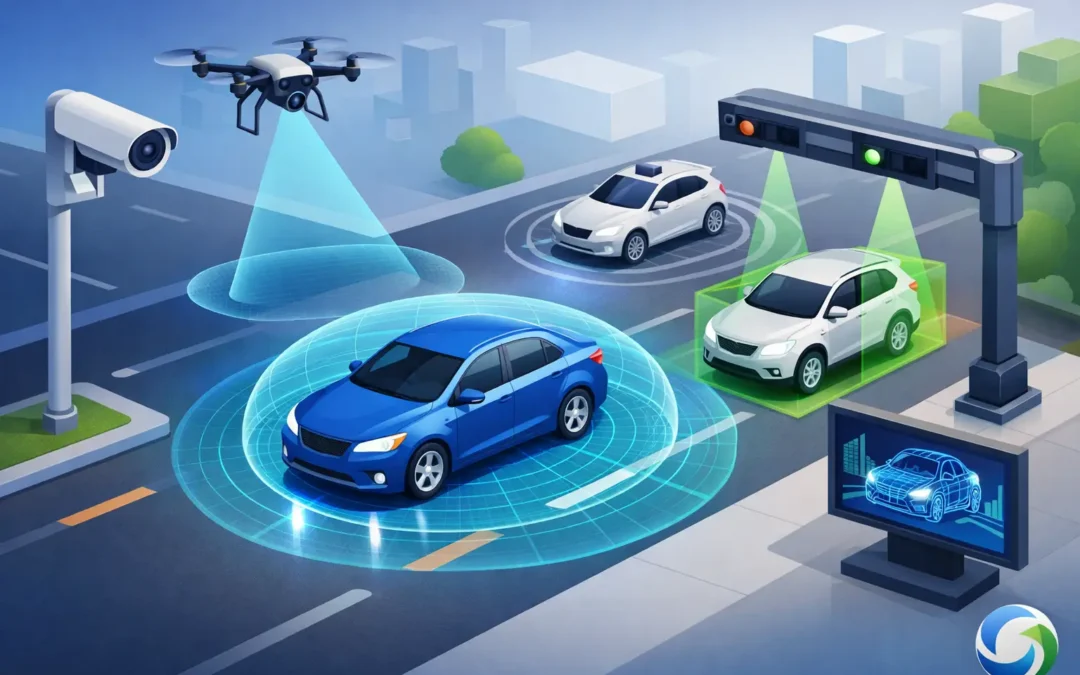
A failed detector at a busy junction rarely stays a small problem for long. Signal timings drift out of step with live demand, side roads wait too long, buses lose priority, and maintenance teams inherit a fault that often means intrusive roadworks to put right. That is exactly why vehicle detection technology has become a critical part of modern traffic management rather than a background component of signal control.
For highways authorities, consultants and contractors, the question is no longer whether detection matters. It is which technology delivers reliable data, accurate actuation and manageable whole-life performance without creating disruption on the carriageway. In many schemes, that shifts the conversation away from embedded loops and towards above-ground detection that is quicker to deploy, easier to maintain and better aligned with current network priorities.
What vehicle detection technology needs to do now
Historically, vehicle detection was often specified for a narrow purpose – call a phase, extend green time, or register presence at a stop line. That is still part of the job, but operational expectations are broader now. Detection is increasingly expected to support adaptive control, queue monitoring, speed awareness, active travel measures, classification, turning movement analysis and evidence-based safety interventions.
That wider brief changes what good performance looks like. Accuracy still matters, but so do detection zone flexibility, installation speed, maintainability and the ability to gather richer data from the same asset. A detector that performs well in isolation can still be the wrong choice if it requires lane closures for installation, frequent carriageway intervention, or limited configuration once conditions change.
This is where non-intrusive systems have gained ground. Radar, AI-powered video and wireless sensing can be deployed above ground, reducing the civil engineering burden and making it easier to upgrade detection without cutting into the road surface. For authorities under pressure to improve traffic flow and safety while reducing disruption, that is a practical advantage, not a theoretical one.
Why legacy loop-based detection is under pressure
Inductive loops remain familiar, and in some locations they continue to perform adequately. But familiarity is not the same as suitability. Loops are vulnerable to carriageway deterioration, utility works and reinstatement quality. When faults occur, repair is rarely simple. It often means traffic management, excavation and repeat disruption on live roads.
There is also a design limitation. A loop is fixed in the road where it was installed. If lane use changes, if a stop line is moved, if a temporary layout becomes permanent, or if a controller strategy is refined, the physical detection layout may no longer match operational need. Above-ground systems offer far more adaptability because detection zones can often be reconfigured in software rather than rebuilt in asphalt.
That does not make loops obsolete in every case. It does mean specifiers should test whether a legacy standard is still justified against current delivery requirements. If the network needs faster installation, lower maintenance exposure and better data output, embedded detection can become the constraint.
The main types of vehicle detection technology
Radar detection
Radar has become a strong option for signalised junctions, crossings, speed monitoring and approach detection because it performs well in varied light conditions and does not depend on visible image quality in the same way as camera-based systems. It can track approaching vehicles, identify movement and support dynamic control strategies with a high degree of consistency.
For many engineers, the attraction is straightforward. Radar is compact, above ground and relatively quick to install. It can also be effective where weather, shadows or low-light periods may challenge other technologies. The trade-off is that specification matters. Detection performance depends on mounting position, geometry, lane arrangement and the exact operational task. A poorly positioned radar detector will not deliver the same result as one integrated properly into the junction design.
AI video detection
AI video has moved well beyond basic image processing. Modern systems can identify and separate vehicles, cyclists and pedestrians, apply multiple virtual detection zones and generate detailed movement data from a single field of view. That creates real value where authorities want more than simple presence detection.
At a complex urban junction, for example, AI video can help support multimodal detection with far greater flexibility than embedded systems. It can also be useful for analysing conflict points, queue build-up and turning movements. The strength of video lies in richness and adaptability. The main consideration is scene quality. Camera positioning, occlusion, glare and maintenance of the viewing environment all affect outcomes. Good AI can mitigate some issues, but not all of them.
Wireless and above-ground traffic sensors
Wireless traffic sensors and related above-ground technologies are especially useful where rapid deployment is important or where invasive works would be difficult to justify. They can support temporary studies, permanent monitoring points and data-led decision making without the installation burden associated with cut-in infrastructure.
Their value is often operational rather than dramatic. Less time on site, less disruption to traffic, and easier redeployment can make a scheme far more manageable. That is particularly relevant where authorities need network insight quickly or want to build evidence before committing to wider intervention.
Choosing vehicle detection technology for the real site
No detector is best in all conditions. The right choice depends on what the site needs to achieve and what constraints apply.
At a straightforward approach to a signalised junction, radar may be the most efficient answer if the requirement is reliable vehicle actuation and extension without intrusive installation. At a congested urban site with cycle movements, pedestrian demand and frequent layout refinement, AI video may provide better long-term value because of its flexibility and broader analytics. For network surveys or low-disruption deployment, wireless sensing may be the better fit.
This is why procurement based on headline technology alone can be misleading. The better approach is to start with the operational requirement. Is the authority trying to improve MOVA or VA performance? Detect cyclists more reliably at a crossing? Replace failing loops without repeated road closures? Gather classified traffic data to support a scheme business case? Once that objective is clear, detector choice becomes more defensible.
Installation and maintenance are part of performance
Detection technology is often judged on accuracy figures, but installation and maintenance have a direct effect on network performance too. A detector that needs extensive traffic management to install or repair has an operational cost even before maintenance budgets are considered. Road occupation affects safety, congestion and public tolerance.
Above-ground vehicle detection technology changes that equation. Faster installation reduces time on site. Reduced need to cut the carriageway lowers disruption and can improve safety for installation teams as well as road users. Ongoing maintenance is also generally more manageable because assets are more accessible and faults can be investigated without immediate excavation.
That does not mean above-ground systems are maintenance-free. Cameras need clean views. Mounting structures need to be appropriate. Detection zones require correct commissioning. The difference is that these tasks are usually less disruptive than reopening the road to repair buried infrastructure.
Better detection leads to better traffic decisions
The strongest case for newer detection technology is not simply that it replaces loops. It is that it supports better decisions across the network.
Reliable live detection improves signal responsiveness. Better classification and movement data improve scheme design. More accurate detection of cyclists and other vulnerable road users supports safer crossings and junction operation. Faster deployment helps authorities respond to changing conditions without waiting for major civils windows.
There is also a sustainability argument, although it should be treated practically rather than rhetorically. Reducing excavation, site time and repeat maintenance interventions can lower the environmental burden associated with traffic management and construction activity. More efficient signals can also reduce unnecessary delay and stop-start conditions, though outcomes depend on broader network design as well as the detector itself.
For organisations responsible for road network performance, that combination matters. Detection is not just an input to a controller. It is a source of operational intelligence.
Where the market is heading
The direction of travel is clear. Detection is becoming more data-rich, more software-defined and less dependent on disruptive infrastructure in the carriageway. That suits modern traffic management because networks are expected to do more with existing road space, support more user types and justify interventions with stronger evidence.
Specialist suppliers such as C & T Technology are part of that shift because they combine above-ground detection hardware with technical understanding of how traffic control systems work in practice. That matters. A detector is only useful if it is specified properly, installed correctly and aligned with the operational objective.
For specifiers and asset owners, the opportunity is not to chase novelty. It is to adopt vehicle detection technology that reduces disruption, improves reliability and gives the network team more usable information than the previous generation ever could. The most effective schemes usually start there – with a clear operational problem, a realistic view of site conditions, and a willingness to move beyond methods that are only familiar because they have been used for years.