
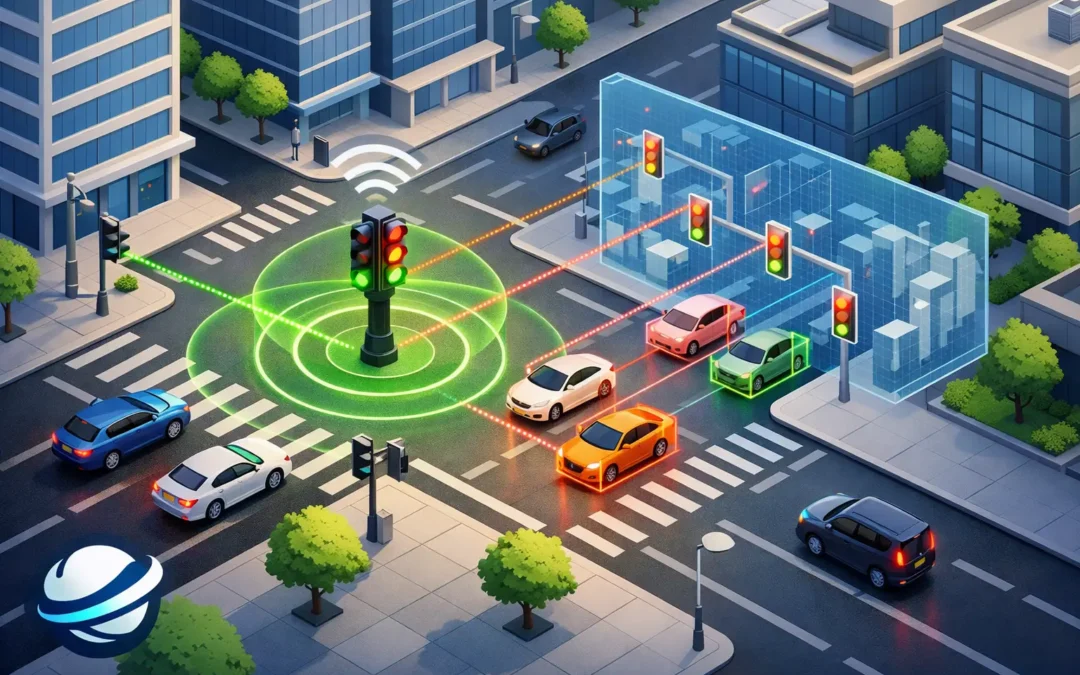
A signal stage that calls too late, fails to extend, or overlooks a cyclist can quickly become a network problem. Knowing how to improve traffic signal detection means looking beyond the detector itself: the approach geometry, user mix, controller logic, communications and ongoing validation all determine whether detection produces safer, more efficient operation.
For many authorities, the starting point is also an opportunity to move away from disruptive road-embedded loops. Above-ground radar, AI video and wireless sensing can be deployed with less carriageway intervention, while providing richer and more adaptable detection data for modern junction control.
Start with the operational problem, not the product
Detection specifications are often written around a technology type rather than the outcome required at the junction. That can result in a detector that technically works but does not solve the real issue. A vehicle-presence requirement at a side road is different from reliable queue measurement on a constrained urban approach. Cycle detection at an advanced stop line is different again from detecting an approaching cyclist early enough to call a stage.
Define the failure mode before selecting or repositioning equipment. Is the junction suffering from missed calls, unnecessary stage demands, poor gap-out behaviour, delayed bus priority, or queues extending beyond the detection zone? Does the issue occur at certain times of day, in rain, at night, or when a large vehicle obscures a smaller road user? These questions establish the detection objective and the level of accuracy needed.
A good brief identifies the users to be detected, the relevant detection zones, the required response time and the control action triggered by each output. It should also consider whether the requirement is presence, passage, speed, queue length, classification or occupancy. Treating all detection as a simple on-off call wastes the capability of current above-ground systems.
How to improve traffic signal detection through better coverage
Detector performance is heavily influenced by what the sensor can actually see. Poor positioning is one of the most common reasons for inconsistent operation, particularly where street furniture, turning vehicles, vegetation, bus stops or high-sided lorries affect the field of view.
For radar and video detection, survey the approach before installation. Confirm mounting height, offset, viewing angle, lane geometry, stop-line position and likely sources of occlusion. A camera positioned to obtain a broad overview may be valuable for analytics, but it may not provide the most dependable view of a small cycle waiting area. Equally, a radar placed for approaching-vehicle detection may need a separate zone or sensor arrangement for reliable stationary presence at the stop line.
Detection zones should follow the control strategy rather than default dimensions. A short zone near the stop line can support demand detection, while a longer upstream zone can provide early call, queue monitoring or speed-based extension. On higher-speed approaches, earlier detection may be necessary to give the controller time to respond safely. In dense urban environments, tighter zoning can reduce false calls from adjacent lanes, footways or circulating traffic.
The right arrangement is not always one detector per approach. Complex layouts may justify complementary sensing technologies, particularly where vulnerable road users, multiple lanes and restricted sight lines create competing requirements.
Match the technology to the road user and location
Inductive loops have long provided dependable presence detection, but their installation and repair require carriageway work. They are also fixed once cut into the road surface, making later changes to lane use or detection geometry more involved. Above-ground detection offers a practical alternative where authorities want faster deployment, reduced disruption and flexibility to refine detection zones remotely or during commissioning.
Radar is particularly effective for vehicle detection in difficult weather and low-light conditions. It can detect approaching and stationary vehicles, measure speed, and support multiple detection zones without cutting the carriageway. This makes it well suited to signal-controlled junctions, pedestrian crossings, ramp metering and priority applications. The exact capability depends on the sensor and configuration, so performance should be tested against the site-specific operational requirement.
AI-powered video detection adds a different strength: it can distinguish between road users and interpret movement within defined areas. This supports applications where the authority needs to identify cycles, pedestrians, cars, buses or lorries separately, rather than treating every movement as a generic vehicle demand. Video can also provide useful visual context during validation and post-installation review.
There are trade-offs. Video requires a well-managed view and suitable lighting conditions, while radar may be the more resilient choice where visibility is regularly compromised. Video deployments also need proportionate consideration of privacy, data handling and camera governance. A combined approach can be appropriate where a junction needs the all-weather confidence of radar alongside road-user classification and analytical insight from video.
Configure detection around signal control logic
Even accurate detection will not improve traffic flow if the controller is configured to use it poorly. The detector outputs, zone timing and controller strategy must be reviewed together.
For example, a side-road call should be filtered or held in a way that prevents repeated, unnecessary demands from transient movements. A main-road extension zone should reflect approach speed and saturation conditions, rather than keeping a stage running after the queue has cleared. Cycle and pedestrian demands should be configured so that they are recognised reliably without creating avoidable delay for other movements.
This is particularly relevant where adaptive or responsive control is in use. Systems such as MOVA and SCOOT depend on meaningful, stable detection inputs. If a detector is poorly zoned, incorrectly mapped, or reporting intermittent occupancy, the control system may make poor optimisation decisions at speed. Before altering controller parameters, verify that the incoming data represents real traffic conditions.
At multi-stage junctions, map every detection channel clearly. Engineers and maintenance teams should be able to see which zone calls which stage, whether it provides extension or presence, and how the controller responds if communications are lost. Clear documentation reduces fault-finding time and avoids configuration changes that create unintended consequences.
Commission in real traffic conditions
A detector should not be considered complete when it first reports a signal to the controller. Proper commissioning tests the full chain: sensing, communications, input mapping, controller response and operational outcome.
Observe the junction during representative conditions. That includes peak and off-peak periods, daylight and darkness where possible, and the movements that previously caused concern. Check that each target user is detected in the intended zone, that adjacent traffic does not create false activations, and that the controller call or extension occurs at the right moment.
Pay particular attention to cyclists, motorcyclists and pedestrians. These users are more likely to be affected by detection gaps, and their movement patterns can be less predictable than those of general traffic. At a crossing or cycle facility, the requirement may be to detect presence continuously, identify an approach movement, or prevent a user from being stranded. Each outcome needs separate testing.
Commissioning should also include fault scenarios. Confirm what happens if a detector loses communication, loses power or reports invalid data. A safe fallback strategy is essential, but it should be designed to maintain reasonable junction operation until the fault is addressed.
Use data to maintain detection performance
Detection degrades operationally before it necessarily fails electrically. A lens may become obscured, vegetation may grow into the field of view, a pole may be struck, or a change in road markings may alter how traffic occupies a lane. These changes can lead to missed detections or poor stage utilisation without triggering a conventional fault alarm.
Use available detector and controller data to identify anomalies. A sudden drop in calls from one approach, unusually long occupancies, repeated demand from an empty lane, or changes in queue patterns can all indicate a detection issue. Comparing data before and after a scheme change is often more revealing than relying on site complaints alone.
Planned inspections remain valuable, especially for video equipment and sites with known visibility challenges. However, data-led maintenance allows teams to prioritise the locations where performance is changing rather than treating every junction as identical. This reduces reactive visits and protects the quality of the traffic data used for wider network decisions.
Build flexibility into future schemes
Traffic signals are rarely static. New cycle infrastructure, housing development, bus priority measures, school travel patterns and revised lane layouts can all change what a junction needs to detect. Specifying adaptable above-ground sensing helps authorities respond without returning to extensive carriageway works.
C & T Technology supports this approach through non-intrusive radar and AI video detection solutions that can be aligned to the practical needs of signal control, road safety and network monitoring. The value is not simply in replacing a loop, but in gaining detection that can be adjusted as operational priorities change.
The most effective improvement is usually a disciplined combination of clear objectives, correctly selected technology, careful siting and evidence-based commissioning. When detection reflects the road users and decisions that matter at each junction, signal control has a far better foundation for reducing delay, protecting vulnerable users and keeping traffic moving.