
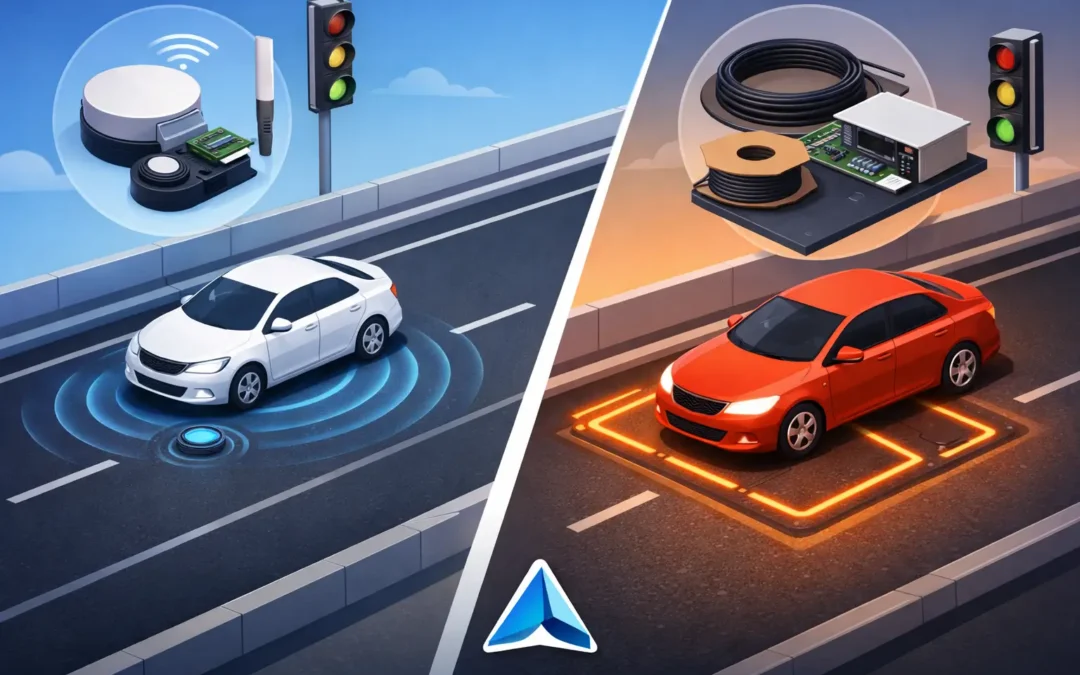
When a detector fault means cutting back into a live carriageway, the real issue is not just maintenance – it is network disruption, safety risk and lost operational time. That is why wireless sensors vs loops is no longer a niche technical debate. For authorities, signal engineers and contractors, it is a practical decision about how detection should perform under real traffic conditions without creating avoidable roadworks.
Wireless sensors vs loops – what is the real difference?
At a basic level, inductive loops are embedded in the road surface and detect vehicles through changes in inductance when metal passes over the loop. Wireless traffic sensors, by contrast, are typically installed above ground or at the roadside and communicate detection data without the need to saw-cut the carriageway.
That difference in physical installation drives almost every operational consequence. Loops depend on civil works, traffic management, reinstatement quality and the long-term condition of the road surface. Wireless sensors avoid those embedded assets, which changes the risk profile from day one. Installation is faster, disruption is lower, and future intervention does not usually require returning to the carriageway with cutters and crews.
For network operators, this is often the deciding factor. Detection is not judged only by whether it works in principle, but by how reliably it supports junction control, monitoring and optimisation over its service life.
Installation impact matters more than many specifications admit
Loop detection still appears in many legacy specifications because it is familiar and widely understood. However, familiarity should not be confused with efficiency. Installing loops means lane closures, intrusive roadworks and a dependency on surface condition that can create long-term vulnerability.
In urban networks, that can be especially problematic. Saw-cutting in busy corridors affects traffic flow immediately. It can also introduce future maintenance points where deterioration, resurfacing or utility works compromise detector performance. Even a well-installed loop is tied to the condition of the asset around it.
Wireless sensors remove much of that burden. Above-ground deployment means faster commissioning and less disruption to road users. It also improves site flexibility. If a stop line moves, a lane layout changes or detection needs refining, the system can usually be adjusted without breaking back into the road.
For contractors and authorities working under tight possession windows, that practical difference is significant. Less time on the carriageway means lower exposure to worksite risk and fewer knock-on effects across the network.
Maintenance is where the whole-life argument changes
The maintenance case for loops is rarely just about the detector itself. It is about access, reinstatement and traffic management. A fault in a road-embedded system can trigger a chain of activity that is costly in operational terms, even before any repair begins.
Wireless systems change that equation. Because the detection equipment sits above ground, inspection and replacement are generally simpler and safer. Fault finding is more straightforward, and access can often be achieved without major traffic management. That matters on strategic corridors, busy urban approaches and sites where repeated intervention is difficult to justify.
There is also a resilience point here. Loops are exposed to the effects of carriageway wear, resurfacing, utility cuts and weather-driven deterioration. Wireless sensors are not immune to environmental factors, but they are not physically locked into the pavement structure. In many applications, that leads to a more manageable maintenance regime and better continuity of detection.
How do wireless sensors and loops compare on accuracy?
Accuracy is where the discussion needs nuance. Loops have long been used because they can provide dependable presence detection when correctly installed and maintained. In stable lane environments with good road condition, they can still perform adequately for many signal control tasks.
But that is not the whole picture. Modern wireless traffic sensors have advanced considerably, particularly where radar and intelligent sensing are used to classify movement, detect approach speed, and support richer traffic analysis. They are not just loop replacements in a like-for-like sense. In many cases, they offer broader functionality than a conventional loop installation.
The more useful question is not which technology is universally more accurate, but which is better suited to the detection objective. If the requirement is simple vehicle presence at a fixed point, loops may meet the brief. If the requirement includes flexible zone configuration, non-intrusive installation, data capture, cyclist detection or adaptation to changing layouts, wireless sensors often provide a stronger operational fit.
Site conditions still matter. Heavy congestion, mixed traffic, unusual geometry and vulnerable road user requirements all affect detector choice. The strongest specifications are built around the outcome required, not around historical habit.
Cyclists, motorcycles and mixed traffic
One of the persistent challenges with legacy detection is consistency across different road users. Motorcycles and bicycles have not always been detected reliably by traditional embedded systems, especially where loop geometry, tuning or road condition are suboptimal.
Wireless sensing technologies can improve this, particularly where the system is designed for multimodal detection rather than basic metallic presence. That is increasingly relevant for local authorities seeking safer active travel infrastructure and better signal responsiveness for all users, not just cars and lorries.
This is also where above-ground intelligence becomes more valuable. Detection should support modern transport priorities, including cycle crossings, bus priority and safety-led junction design. A detector that only performs well for one vehicle class may no longer be enough.
Flexibility is often the deciding factor
Traffic networks change. Junctions are rephased, lanes are reallocated, cycle facilities are introduced and temporary layouts become permanent. Loops are inherently less adaptable because their detection zone is physically fixed in the carriageway.
Wireless sensors give engineers more freedom to respond. Detection areas can often be configured or refined without civil works, which supports optimisation over time rather than forcing a one-off installation logic to remain in place for years. That flexibility is valuable when authorities are trying to improve capacity, safety and modal balance without repeatedly revisiting the road surface.
For temporary schemes, trial layouts and staged upgrades, this becomes even more important. Non-intrusive detection allows faster deployment and easier adjustment, making it better aligned with iterative traffic management and evidence-led scheme development.
Sustainability and network efficiency
There is a straightforward sustainability argument in the wireless sensors vs loops discussion. Cutting into the carriageway generates disruption, materials use and repeat interventions over the asset life. Above-ground systems reduce that dependence on intrusive works.
The operational sustainability benefit is just as important. Shorter installations mean less congestion associated with roadworks. Reduced maintenance interventions mean fewer closures and less delay. Better detection can also improve signal performance, helping to reduce unnecessary stopping and poor traffic progression.
For public sector buyers and consultants, sustainability should not be treated as a separate add-on. It sits alongside safety, efficiency and asset management. Detection technology influences all four.
When loops may still be specified
There are situations where loops remain in use, particularly in legacy systems, replacement programmes and sites where embedded infrastructure is already established. Some organisations also retain loop specifications because existing standards, stock familiarity or framework conventions make that route easier administratively.
That does not mean loops are the best technical choice for every project. It means migration away from legacy detection can take time. On some schemes, a hybrid approach may also be appropriate, especially where existing signal assets, controller logic or site constraints shape what can be delivered in the short term.
The key is to avoid defaulting to loops simply because they have always been used. A current assessment should ask what the site needs now, how the network is expected to change, and what level of disruption is acceptable during installation and maintenance.
Choosing the right detection approach
A sound comparison between wireless sensors and loops should start with operational requirements. What needs to be detected, how quickly can the site be installed, what maintenance access is realistic, and how likely is the layout to change over time? Those questions usually reveal more than a simple technology preference ever will.
For many modern traffic applications, the case for non-intrusive detection is strong. Faster deployment, lower carriageway disruption, easier maintenance and greater flexibility align closely with what transport authorities and network managers now need from their infrastructure. Where detection also needs to support analytics, multimodal operation and long-term optimisation, above-ground systems become even more compelling.
C & T Technology works with authorities and traffic professionals facing exactly these decisions, where the challenge is not just replacing a detector, but improving how the network performs with less disruption and better data.
The most useful question is not whether loops still have a place. It is whether a new scheme should inherit old limitations when better detection options are already available.