
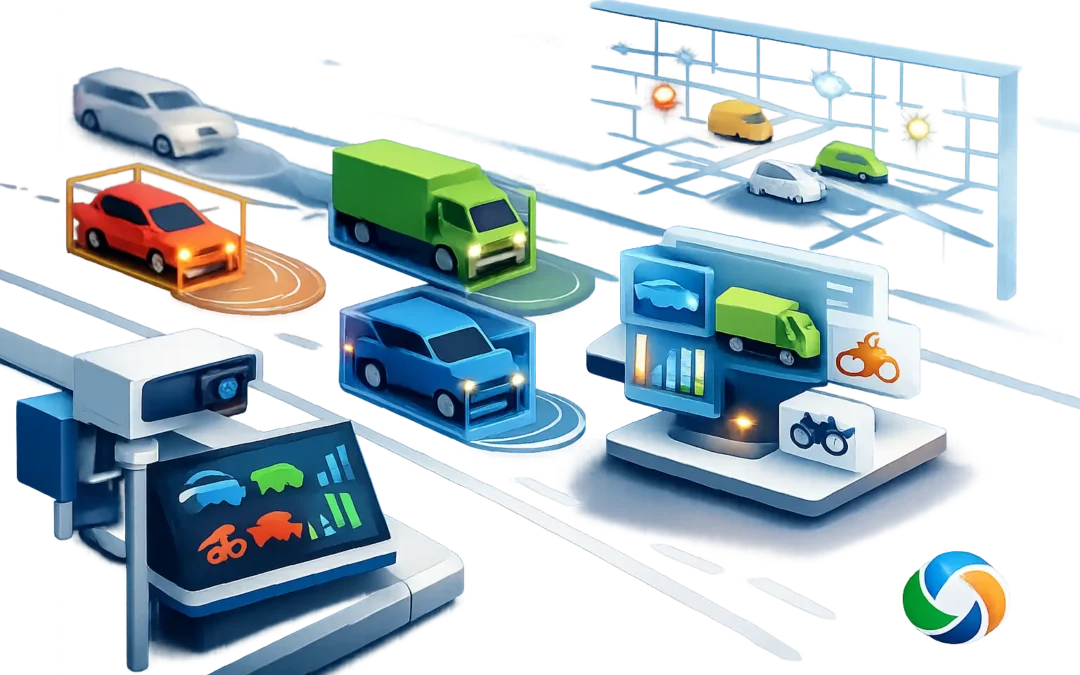
A traffic count that records only a total flow can indicate pressure on a route. A count that distinguishes cars, vans, buses, articulated lorries, motorcycles and cycles can explain that pressure and support a defensible response. This guide to traffic counter classifiers sets out how classification systems work, where their limits lie and how transport teams can specify data that is genuinely useful for network decisions.
For highways authorities, consultants and contractors, classification is not a reporting extra. It informs scheme design, traffic regulation orders, active travel planning, pavement assessments, collision investigation and signal strategy. The value depends on matching the detector and configuration to the question being asked.
What a traffic counter classifier does
A traffic counter classifier detects road users passing a defined location, records their movements and assigns each observation to a vehicle or road-user class. Depending on the technology and deployment, the data may include volume, speed, direction, lane, time gap, vehicle length and the class allocated.
The output normally groups road users into categories based on physical size, profile, movement or visual characteristics. A practical system may distinguish cars from light goods vehicles, rigid lorries from articulated lorries, buses from coaches, and motorcycles from larger vehicles. Solutions designed for mixed transport environments can also identify cyclists and pedestrians where the site geometry and detection zone support reliable separation.
This distinction matters because two roads with the same annual average daily traffic can impose very different operational demands. A route carrying a high share of heavy goods vehicles requires a different maintenance, safety and capacity response from a route dominated by cars. Equally, a cycle route affected by occasional vehicle incursion needs data that shows the interaction, not merely a single aggregate count.
Why classification quality matters
Classification data is often used well beyond the initial survey. It may become the baseline for a business case, a before-and-after assessment, a junction capacity model or a road safety intervention. Errors introduced at the point of detection can therefore affect later decisions.
Accuracy is not simply a headline percentage. A classifier can perform strongly for standard passenger cars in free-flow conditions while finding it more difficult to separate closely following vehicles, unusual vehicle profiles or vulnerable road users at congested urban sites. The relevant measure is whether the system produces dependable results for the classes, traffic conditions and decisions that matter at that location.
For example, an authority assessing lorry routing needs confidence in heavy vehicle classification and direction of travel. A school street scheme may place greater emphasis on time-of-day flows, motorcycles, cycles and pedestrian activity. At a signal-controlled junction, lane-by-lane movement data can be more valuable than a broad carriageway total.
Choosing the right detection technology
Above-ground technologies avoid the carriageway cutting, lane closures and reinstatement associated with inductive loops and pneumatic tubes. They can be installed more quickly, repositioned when requirements change and maintained without repeat excavation. The right choice still depends on the road environment.
Radar classifiers
Radar detects moving objects using reflected radio waves. It is well suited to speed measurement, approaching vehicle detection and classification based on attributes such as speed, length and profile. Radar can operate in darkness and is generally less affected by lighting changes than camera-based systems.
For high-speed roads and rural approaches, radar provides a practical means of gathering directional traffic data from a roadside mounting position. It can be particularly effective where reliable detection is required without entering the carriageway. However, classification performance depends on the model, mounting position, traffic mix and whether vehicles are freely spaced. Dense queues and vehicles travelling side by side can limit the ability to separate individual road users.
AI video classifiers
AI-powered video detection uses image analysis to identify and track road users within configured zones. Its principal advantage is visual classification: it can differentiate vehicle types and identify cyclists and pedestrians in locations where length-based methods alone may be insufficient.
Video is especially useful at junctions, town-centre corridors, bus priority locations and active travel schemes, where the movement of different users must be understood together. It can also provide a valuable visual reference during commissioning and validation. Its performance, however, must account for camera height, viewing angle, occlusion, glare, weather, night-time conditions and objects blocking the field of view. Site design and configuration are as important as the camera itself.
Wireless and temporary traffic sensors
Wireless traffic sensors can support shorter surveys, pre-scheme studies and locations where a permanent roadside installation is not required. Their suitability depends on the classification detail needed and the available mounting arrangement. They can be useful for building an evidence base quickly, but temporary deployments require disciplined validation, secure installation and clear procedures for retrieving and processing the data.
A guide to traffic counter classifiers: specifying the data first
The best procurement starting point is not a preferred sensor. It is a precise definition of the decision the data must support. This prevents a common problem: collecting large volumes of traffic information that cannot answer the operational question.
Set the required classes before selecting the technology. If the objective is a freight strategy, define the vehicle categories needed and whether axle-based classification is necessary. If the objective is cycle safety at a junction, establish whether the system must distinguish cyclists from motorcycles, measure turning movements and report conflict-relevant time periods.
Then define the granularity of the output. This may include lane, direction, movement, speed band and aggregation interval. Five-minute data can reveal peak spreading and queue discharge patterns that disappear in daily totals. Conversely, highly granular data adds storage and analysis requirements, so it should be proportionate to the scheme.
A specification should also state the expected traffic conditions. Include peak congestion, lane discipline, site speed, lighting, roadside clutter, vehicle mix and seasonal activity where relevant. A detector that works well on a clear rural A-road may need a different installation approach at a constrained urban junction with buses, delivery vehicles, cyclists and frequent pedestrian movements.
Installation and commissioning are part of accuracy
Non-intrusive detection reduces disruption, but it does not remove the need for careful survey and commissioning. Detector height, lateral position, angle, detection zone dimensions and line of sight all influence the result. A poorly placed sensor can create blind areas, merge adjacent lanes or misinterpret turning traffic.
Before installation, assess poles and mounting assets, power and communications, visibility, vegetation growth, parking activity and future changes to the road layout. At a video site, consider sun path and headlamp glare. At a radar site, identify roadside furniture or barriers that may create unwanted reflections. These details are usually cheaper to resolve before installation than after data collection has begun.
Commissioning should include observed or independently recorded validation samples. Compare the classifier output with a manual count or reference video across representative periods, not only a quiet midday interval. Review exceptions rather than relying solely on total count agreement. A system can match the overall total while allocating too many vans as cars or undercounting cyclists in a particular movement.
Turning classified counts into action
Raw counts become useful when they are presented in a form that matches the decision. Traffic engineers may need directional peak-hour demand and turning movements. Road safety teams may need speeding distributions by class, particularly where larger vehicles have different stopping distances and collision consequences. Asset managers may require a reliable heavy vehicle proportion to inform pavement planning.
For network management, combining classified flow data with speed and occupancy information can reveal whether delay is caused by demand, a specific movement, freight loading activity or an intermittent downstream restriction. This makes interventions more targeted. The answer may be signal timing changes, a revised loading restriction, improved cycle facilities or further investigation, rather than an assumption that additional carriageway capacity is needed.
Data governance also deserves attention. Establish a consistent class dictionary, retain metadata on detector location and configuration, and document changes to the network or equipment. If datasets from several sites are to be compared, identical labels must mean identical things. A “large goods vehicle” category that changes between surveys can undermine trend analysis.
Building a dependable evidence base
Traffic counter classifiers are most effective when treated as a measurement system rather than a standalone device. The detector, site geometry, class definitions, installation, validation and reporting method all contribute to the final result. C & T Technology supports above-ground radar and AI video approaches that help reduce roadworks disruption while providing the evidence needed for safer roads, reduced congestion and more sustainable transport choices.
Start with the question your network needs to answer, test the proposed classification method against real site conditions, and retain the validation record with the data. That discipline gives each count a longer useful life and gives decision-makers greater confidence when action is required.