
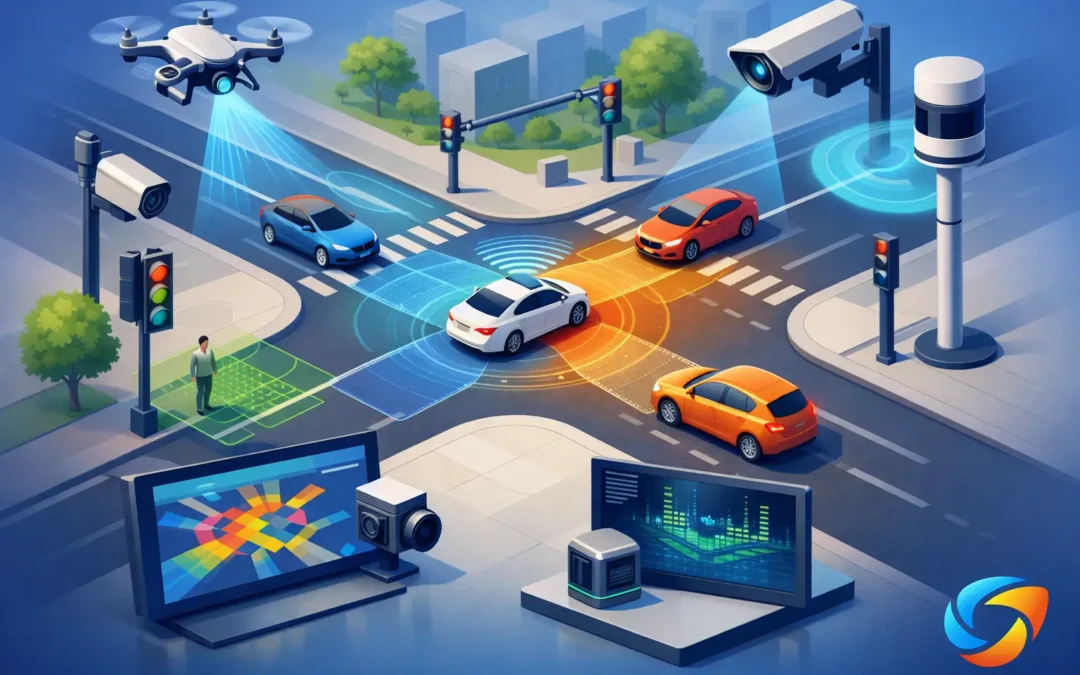
If a junction is underperforming, the problem is often not the controller logic first – it is the quality of detection feeding it. The best junction detection technologies improve more than stop line calls. They shape stage efficiency, reduce wasted green time, support active travel, and give engineers cleaner evidence for network decisions.
For specifiers and traffic managers, the real question is not which detector sounds most advanced. It is which technology can deliver reliable presence, approach and movement data in the physical constraints of the site, without creating unnecessary roadworks, maintenance burden or operational risk. That usually means moving beyond road-embedded detection and assessing above-ground options on performance, install practicality and whole-life resilience.
What matters most at a junction
Junction detection is rarely a single-task application. One site may need vehicle presence at the stop line, advance detection for MOVA or VA logic, cyclist detection on the carriageway, queue monitoring on approaches, and better visibility of pedestrian interactions near conflict points. A detector that performs well in one role may be less effective in another.
This is why technology selection should start with the operational objective. If the priority is traffic signal optimisation, accuracy and low latency matter most. If the site has recurring near misses involving cyclists or turning traffic, classification and tracking become more important. If maintenance access is difficult or resurfacing is planned, non-intrusive installation becomes a major advantage.
The strongest solutions are those that support several of these requirements at once, while remaining straightforward to specify, install and maintain.
Best junction detection technologies in current use
AI-powered video detection
AI video has become one of the most capable options for complex junction environments. Unlike traditional video detection, current systems use trained models to distinguish vehicles, cycles and pedestrians with far greater consistency. That matters at busy urban junctions where multiple road users occupy the same field of view and demand patterns change throughout the day.
Its main strength is flexibility. Detection zones can often be configured and refined without cutting into the road surface, making it well suited to upgrades, temporary staging changes and sites where embedded loops would be disruptive. Video can also provide richer outputs than a simple call, including tracking, counting, classification and event-based analytics.
There are trade-offs. Performance still depends on camera positioning, field of view and scene complexity. Poor mounting locations, occlusion by larger vehicles, low winter sun and heavy rain can all affect results if the system is not properly specified. For that reason, AI video is at its best when supported by good survey work and realistic expectations about line of sight.
Radar detection
Radar is one of the most dependable technologies for junction detection, particularly where all-weather operation and low maintenance are priorities. It performs well in poor visibility and does not rely on image quality, which makes it attractive for exposed locations and sites with variable lighting conditions.
At junctions, radar is commonly used for vehicle approach detection, stop line presence, queue measurement and cyclist detection, depending on the unit and setup. It is especially effective where engineers want non-intrusive detection with stable performance and minimal susceptibility to dirt, glare or darkness.
The limitation is that radar does not always offer the same scene-level detail as AI video. Some applications require highly nuanced classification or visual verification, and in those cases radar may need to be paired with other technologies. Even so, for many signal control tasks, its consistency and installation simplicity make it one of the strongest contenders.
Wireless magnetometer and other wireless sensors
Wireless traffic sensors can be useful where civil works need to be kept to an absolute minimum or where temporary and semi-permanent monitoring is required. They can support junction studies, before-and-after measurement and selected detection applications without the infrastructure burden associated with conventional embedded systems.
Their appeal is practical rather than glamorous. Installation can be quicker, lane closures can be shorter, and disruption to the network can be reduced. For authorities balancing programme pressure with operational continuity, that matters.
However, they are not automatically the best fit for every permanent signal-controlled junction. Battery life, communications architecture, mounting conditions and the exact detection task all need careful review. In some high-complexity junction control scenarios, radar or AI video may offer broader functionality and easier future adaptation.
Thermal and specialist imaging technologies
Thermal detection has a role at sites where visible-light imaging struggles, particularly in poor lighting or where pedestrian presence is a key concern. It can be effective for detecting vulnerable road users without depending on ambient light levels.
That said, thermal is usually a more specialist answer than a default one. It tends to be selected for particular operational or safety challenges rather than as a general-purpose solution across a junction portfolio. Where vehicle classification, broad-area monitoring or standard signal integration are the main objectives, other technologies are often more practical.
Why above-ground systems are replacing loops
For years, inductive loops were treated as the default answer for junction detection. They still have a place, but the drawbacks are now harder to justify on many schemes. Installation requires intervention in the carriageway, which means traffic management, programme risk and future vulnerability when the road surface deteriorates or is resurfaced.
Above-ground detection changes that equation. Radar and AI video systems can usually be installed faster, adjusted more easily and maintained with far less disruption. For authorities trying to improve network performance without creating new delays through installation and repair works, this is a major operational gain.
There is also a data advantage. Legacy loop systems are fundamentally limited in what they can tell you. Modern above-ground detectors can provide a much richer picture of what is happening at the junction, supporting signal optimisation, safety assessment and evidence-based intervention planning.
Choosing the best junction detection technologies for the site
The best junction detection technologies are not selected in the abstract. They are selected against site conditions, control strategy and long-term maintenance reality.
At a standard signalised junction with a need for dependable vehicle and cyclist detection, radar is often a very strong fit. It offers stable operation and avoids the lifecycle issues associated with carriageway cuts. At a busy urban node with buses, cyclists, pedestrians and frequent geometry changes, AI video may offer greater flexibility and richer analytics. At locations where engineers need a quick-to-deploy sensor with minimal physical intervention, wireless options may be appropriate for specific tasks.
It also depends on whether the requirement is operational detection, data collection, or both. Some systems are excellent at producing calls for signal control but less useful for network diagnostics. Others can help teams understand demand patterns, queueing behaviour and conflict points as well as feeding the controller. That distinction matters during specification, because the technology that solves today’s detection issue may not support tomorrow’s asset management or road safety objectives.
Specification pitfalls worth avoiding
One of the most common mistakes is specifying by habit. If a previous junction used loops, it is easy for loops to reappear in the next design without proper challenge. The same happens when one detector type is treated as universally suitable, regardless of geometry, mounting opportunities or user mix.
Another issue is underestimating commissioning. Even the best hardware needs correct positioning, sensible zone design and proper validation against the signal strategy. A detector is only as useful as the engineering around it.
It is also worth resisting the temptation to focus only on initial installation convenience. A detector that is easy to fit but difficult to maintain, recalibrate or expand may create more operational drag over time than one with a slightly more involved setup. Good specification balances installation efficiency with long-term network resilience.
A more intelligent direction for junction control
Across the UK and Republic of Ireland, the direction of travel is clear. Junctions are expected to do more than move general traffic. They must respond better to cycles and pedestrians, support emissions reduction strategies, reduce avoidable delay and provide cleaner data to justify intervention. Detection technology now plays a central role in delivering those outcomes.
That is why the most effective deployments increasingly combine non-intrusive sensing with analytics and technical support, rather than treating detection as a standalone component. C & T Technology has built its approach around that model, helping transport professionals replace legacy embedded methods with above-ground solutions that are easier to deploy and better aligned with modern network management.
For most authorities and contractors, the right next step is not asking which detector is newest. It is asking which one will still be giving you dependable, actionable junction intelligence after the scheme is commissioned and the road is back in service.