
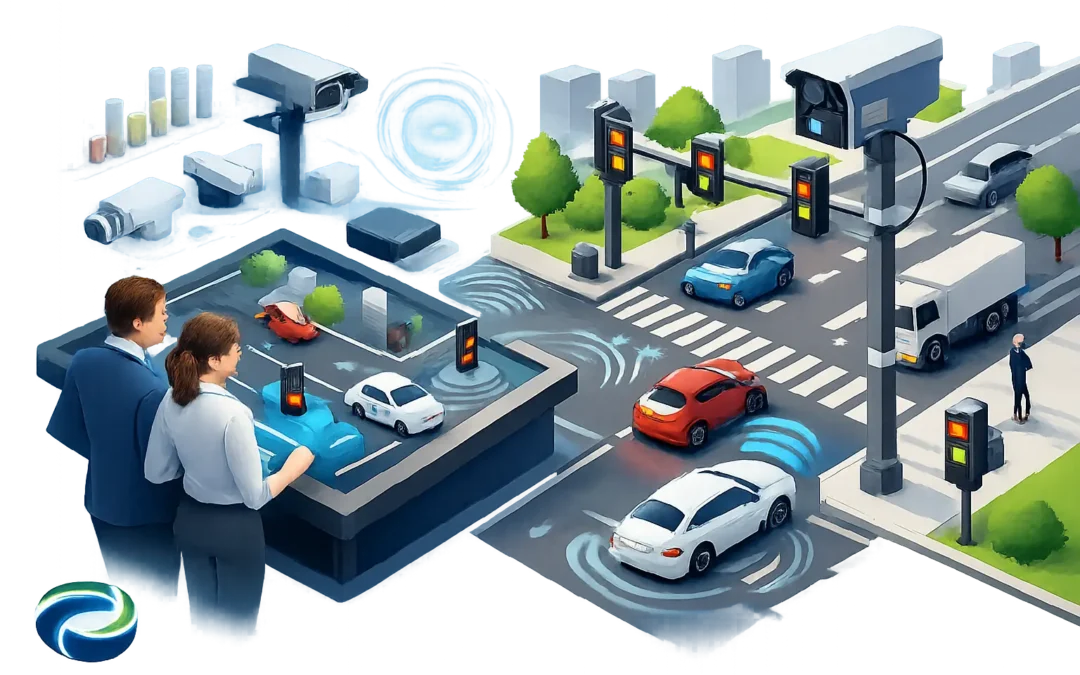
A detector specification can look sound on a drawing yet fail at the point that matters most: the stop line, crossing, cycle approach or congested lane where a real road user must be detected reliably. Traffic detector consultancy services address that gap between product selection and operational performance. They give highways authorities, signal engineers and contractors the technical basis to specify detection that works for the site, the control strategy and the people using the network.
For many networks, the question is no longer whether to replace ageing inductive loops. It is how to select and configure above-ground detection without transferring risk from the carriageway to the controller cabinet. The right consultancy process considers detection objectives, geometry, visibility, communications, installation constraints and maintenance from the outset.
Start with the operational problem, not the detector
Traffic detection is often procured as a component. In practice, it is part of a wider traffic management decision. A radar sensor, AI video detector or wireless sensor only creates value when its output is suitable for the action it triggers.
At a signalised junction, that may mean reliable presence detection to prevent unnecessary green time being allocated to an empty approach. On a cycle scheme, it may mean recognising a rider early enough to call or extend a stage without detecting adjacent traffic. For a speed management scheme, the priority may be accurate approaching-speed data and a clear response from a speed information display. Each outcome requires different detection zones, mounting positions and performance criteria.
A consultancy-led assessment turns broad requirements such as reduced congestion or safer crossings into measurable operating requirements. These can include lane-by-lane occupancy, queue length, vehicle classification, bicycle detection, direction of travel, speed thresholds and data availability. This avoids a common failure mode: specifying a capable device without defining what the system must reliably do in the local environment.
What traffic detector consultancy services should cover
Effective traffic detector consultancy services are not limited to recommending a sensor. They provide a route from site evidence to a deployable, supportable system. The depth required will depend on the scheme, but the process should examine the following connected areas.
Site survey and detection geometry
Road layouts introduce constraints that data sheets cannot resolve. Lane widths, approach angles, street furniture, stop-line positions, kerbside activity, gradients and sightlines all affect where a detector can be mounted and what it can observe. Vegetation, parked vehicles, bus stops and turning movements may also introduce occlusion or unwanted targets for video-based systems.
A competent survey establishes suitable installation locations and confirms whether the proposed technology has a realistic field of view. It should also consider safe access for installation and future maintenance. Above-ground solutions can remove the need for carriageway cutting, but they still need practical mounting, cable routing or wireless communications arrangements.
Technology selection based on the application
No single technology is the best choice for every location. Radar is highly effective where dependable vehicle detection, speed measurement and all-weather operation are priorities. It can be particularly suitable for stop-line presence, approach detection and vehicle-actuated applications where lighting conditions may vary.
AI-powered video detection offers a different set of strengths. It can distinguish between road-user types, monitor multiple zones and support applications where vehicle, bicycle and pedestrian movements need to be understood separately. Its performance depends on camera placement, scene complexity, lighting and careful configuration. It is not simply a camera installed on a pole.
Wireless traffic sensors may be appropriate where rapid deployment, temporary monitoring or minimal civil works are central to the brief. Their suitability will depend on the data required, the operating life expected and the environment in which they are deployed. Consultancy should make these trade-offs explicit rather than presenting a technology as universally interchangeable.
Controller and communications integration
Detection must arrive at the right system in the right format and at the required time. That can involve relay outputs, IP communications, serial interfaces, controller inputs, cloud platforms or a combination of these. The implications are significant where existing signal controllers, UTC systems or data platforms are involved.
Consultancy should therefore confirm interface requirements early. It should define which detector events are needed, how faults are reported, how settings are protected and how the system will be commissioned. This is especially important when replacing loops, as legacy detector logic may not reflect the operating capability of modern radar or AI video equipment.
Data, validation and acceptance criteria
Detection projects should be judged by evidence, not only by successful installation. Before deployment, the authority or project team should agree what good performance looks like. That could include successful calls from specific approaches, detection of cyclists in a defined zone, classification accuracy, data completeness or reduced lost time at a junction.
Validation should cover representative operating conditions. Peak traffic, darkness, rain, low sun, queues and unusual vehicle movements can all expose weaknesses that a quiet daytime test will miss. A defined commissioning and acceptance process gives the client confidence that settings are correct and establishes a baseline for future optimisation.
Why non-intrusive detection changes the project equation
Inductive loops remain familiar, but they can create disruption disproportionate to the task. Carriageway cutting requires traffic management, exposes the road surface to reinstatement risk and can make future alterations more expensive. A loop failure can also mean returning to the carriageway for investigation and repair.
Above-ground radar, video and wireless technologies change that maintenance and installation model. Installation can often be completed with less disruption to traffic, fewer carriageway interventions and better access for future adjustment. These are material advantages for busy urban corridors, recently resurfaced roads and locations where lane closures are difficult to secure.
That does not mean non-intrusive detection is automatically simpler. A poorly positioned radar unit can miss a critical area, while an inadequately commissioned camera can generate unreliable classifications. The benefit comes from combining suitable technology with a site-specific design, clear configuration and documented validation.
Design for all road users, not only motor traffic
A detection strategy that responds well to cars but inconsistently to bicycles or pedestrians can undermine wider network objectives. This is increasingly relevant where authorities are improving active travel routes, introducing low-traffic measures or reviewing junction performance through a safety lens.
Consultancy should test how different road users interact with the detection area. A cyclist may approach offset from the general traffic lane, filter towards the stop line or wait in an advanced stop area. A pedestrian crossing may need demand detection that is visible, accessible and coordinated with signal timings. Buses and lorries may require classification or extended detection zones because of their length and movement profile.
The practical aim is not maximum sensitivity everywhere. Excessive detection can hold stages unnecessarily, create false calls and reduce junction efficiency. The aim is appropriate sensitivity in the zones that support the intended control decision.
Using detector data beyond the immediate control task
Modern detectors can support more than a single signal input. Traffic counts, approach speeds, occupancy, classification and directional movement data can help engineers understand how a location performs over time. This can strengthen before-and-after evaluations, identify recurring congestion and provide evidence for safety or operational interventions.
The value of that data depends on consistency. Consultancy should establish how information will be collected, retained, checked and interpreted. A data platform may be appropriate for network-level monitoring, while a smaller scheme may only require periodic exported reports. In either case, the focus should remain on decisions the data will support, rather than collecting metrics with no operational use.
For transport teams managing constrained budgets and competing priorities, this evidence can help distinguish between a timing issue, a detection gap and a capacity problem. It also enables changes to be evaluated against observed traffic behaviour rather than assumptions.
Questions to resolve before specification
Before a detector is specified, project teams should be able to answer several practical questions. What decision will the detector trigger? Which road users must be detected, and where? What site conditions could affect performance? How will the system interface with existing control equipment? Finally, how will installation, commissioning and ongoing performance be verified?
These questions are particularly valuable when the project combines several objectives, such as reducing vehicle delay while improving cyclist priority and gathering classified traffic data. In such cases, a single sensor may be suitable, or a mixed approach may provide more dependable results.
C & T Technology applies this practical approach across radar, AI video, wireless sensing and traffic analytics, helping project teams move from a stated requirement to a detection solution that can be installed, tested and maintained with confidence.
The most useful consultancy outcome is not a longer equipment schedule. It is a detection design that gives each junction, crossing or corridor the information it needs to make better decisions – with less disruption to the road network and clearer evidence of performance.