
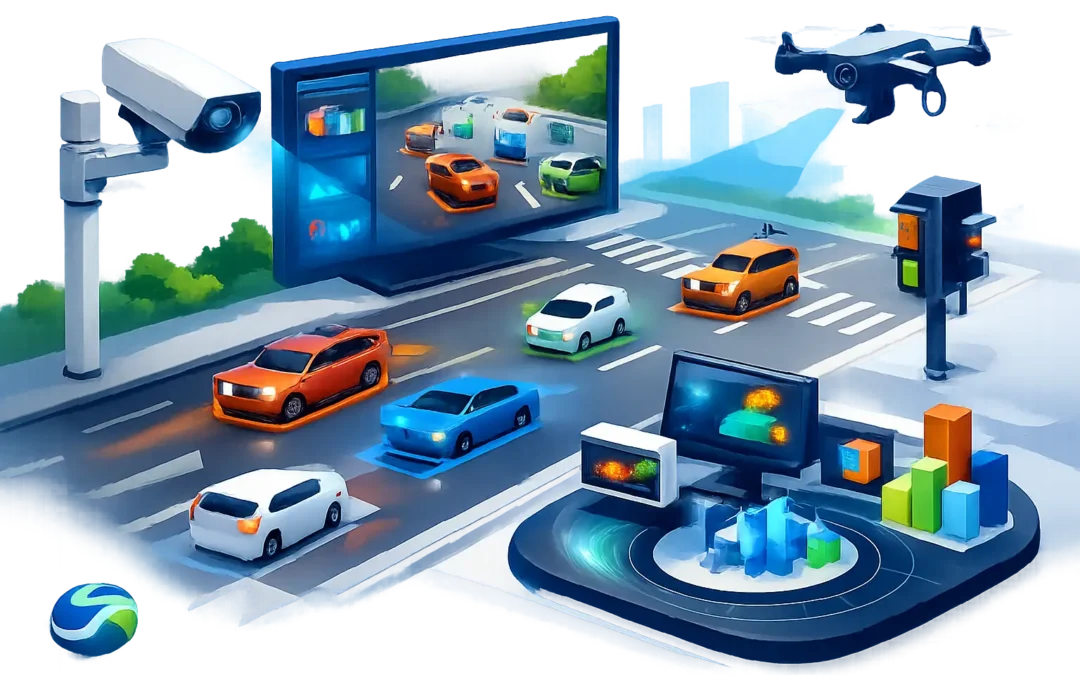
A detector fails at a busy junction and the problem rarely stays local. Signal stages run inefficiently, queues build, bus reliability slips, and safety teams lose confidence in the data behind their interventions. That is why video traffic measurement systems have moved from a niche option to a serious part of modern traffic monitoring strategy. For authorities and consultants trying to improve network performance without repeated carriageway intervention, they offer a practical route to better data and faster deployment.
What video traffic measurement systems actually do
At their core, video traffic measurement systems use camera-based sensing and software analytics to observe road users and convert movement into actionable traffic data. That usually means vehicle counts, turning movements, queue lengths, occupancy, speed estimation, classification and, depending on the system, detection of cyclists and pedestrians.
The real value is not the camera alone. It is the processing layer that interprets what the camera sees. Older image-based systems were often sensitive to shadows, headlight glare and variable weather. Current AI-enabled platforms are markedly stronger because they identify objects by learned characteristics rather than relying only on simple pixel change. For engineers, that improves confidence in the output and extends the number of sites where video is a viable specification.
This matters most where traditional road-embedded detection creates friction. Inductive loops can perform well, but they are disruptive to install, vulnerable when the carriageway deteriorates, and awkward to alter if lane layouts or stop-line positions change. Above-ground video detection avoids saw-cutting the road surface and gives more flexibility when schemes evolve.
Where video traffic measurement systems fit best
Video is not a universal answer, and good scheme design starts by being honest about that. The strongest applications are usually those where broad area observation is useful, multiple road user types must be tracked, or network managers need richer data than a simple presence pulse.
Signalised junctions are an obvious fit. A well-positioned video detector can monitor several lanes, turning movements and waiting areas from one mounting point. That makes it attractive where the aim is not just call and extend detection, but also performance monitoring. Engineers can use the same sensing layer to understand saturation, queue build-up and stage demand trends.
Video is also effective for road safety and active travel schemes. If a council wants to understand whether a new crossing point is changing pedestrian behaviour, or whether a cycle lane is attracting measurable uptake, video analytics can provide a much more complete picture than legacy vehicle-only detection. That broader detection capability supports better evidence for scheme refinement.
Temporary monitoring is another strong use case. Because the equipment is above ground and relatively quick to deploy, it can be used to capture before-and-after data during trials, diversions or short-term traffic management changes. In these situations, avoiding invasive installation is often as valuable as the data itself.
The operational advantages over embedded detection
The case for video is usually won on operational grounds before technical ones. Installation is faster and safer because there is no need to cut the carriageway or occupy the road to the same extent. That reduces disruption to the public and simplifies deployment planning, especially on strategic or sensitive corridors.
Maintenance can also be more straightforward. If a road surface is resurfaced, relined or altered as part of another scheme, embedded loops may need replacement or recalibration. A camera-based system mounted on existing street furniture is less exposed to that type of intervention. For asset managers looking at whole-life resilience rather than just initial specification, that difference is significant.
Then there is adaptability. Road networks change constantly. Lanes are reallocated, stop-lines move, temporary works appear, and priorities shift towards buses, cycles or pedestrian safety. Video traffic measurement systems can often be reconfigured in software to reflect those changes. That is a practical advantage for authorities trying to future-proof detection choices.
Accuracy depends on design, not just technology
It is tempting to treat video as a plug-and-play solution, but performance still depends heavily on design quality. Camera height, viewing angle, lens selection, lighting conditions and occlusion all affect the result. A poorly positioned camera overlooking a congested multilane approach may struggle if large vehicles regularly mask smaller road users. The technology can be capable, yet the installation geometry undermines it.
This is where technical support matters. A detector should be specified around the operational task, not simply selected from a catalogue. Counting mid-block traffic is different from actuating a signal stage at a complex junction. Measuring cyclist presence on an approach lane is different again. Each application needs suitable fields of view, detection zones and data outputs.
Environmental conditions also deserve realistic consideration. Heavy rain, low winter sun, night-time glare and partial obstruction from foliage or street furniture can all influence effectiveness. Modern AI analytics handle these variables far better than earlier systems, but they do not remove the need for careful site assessment. The right question is not whether video works in poor conditions. It is how well a given system performs at a specific site, with a specific objective and a specific tolerance for missed or false detections.
Data quality is the real differentiator
For many transport professionals, the appeal of video is not simply detection but measurement. There is a difference. Basic detection answers whether something is there. Measurement tells you what is happening over time and whether the network is improving.
A useful system should produce traffic data that can support operational decisions, scheme evaluation and reporting. That may include classified counts by vehicle type, directional flow by movement, occupancy trends, queue profiles or cycle and pedestrian activity by period. If the output is trapped in a closed interface or needs too much manual interpretation, the practical benefit drops quickly.
The better approach is to view video traffic measurement systems as part of a wider data architecture. Detection hardware, analytics software and data management need to work together. When they do, traffic teams can move beyond isolated counts and start comparing site performance, validating interventions and identifying emerging issues earlier.
For local authorities under pressure to evidence outcomes, this is increasingly important. Network management is not just about keeping signals running. It is about showing where congestion is increasing, whether safety-led changes are delivering, and how different road users are affected by network decisions.
When radar or mixed sensing may be the better choice
Video is strong, but not every site should be specified as camera-only. Radar can be more resilient in some environments, particularly where visibility constraints or lighting conditions are consistently problematic. It can also be highly effective for speed measurement and for applications where object tracking at range matters more than visual scene interpretation.
In some schemes, a mixed sensing strategy is the best answer. Video may provide classification and broad situational awareness, while radar strengthens detection reliability in more difficult conditions. That kind of specification is often more pragmatic than insisting on a single sensor type across every location.
For specifiers, the lesson is straightforward. Start with the operational requirement, the site conditions and the output needed by the authority. Then choose the sensing method that fits. The objective is not to back a fashionable technology. It is to secure dependable detection and usable data with the least disruption to the road network.
What buyers and specifiers should ask before deployment
Before selecting a system, it is worth testing five practical issues. First, what exact traffic metrics are required, and at what level of accuracy? Second, can the system detect all relevant road users, not only cars and lorries but also cyclists and pedestrians where needed? Third, how easily can the detection zones be adjusted if the layout changes? Fourth, what are the mounting and power constraints at the site? Fifth, how will the data be accessed, validated and used after installation?
These questions shift procurement away from headline features and towards operational fit. They also help avoid a common problem in traffic technology projects: buying a capable detector and then discovering the data does not align with the network management task.
For organisations moving away from loops and other embedded technologies, that shift is often part of a broader change in mindset. Detection is no longer just an input to signal control. It becomes part of a smarter, less intrusive, more evidence-led approach to managing road space.
C & T Technology works in exactly this space, helping transport professionals replace legacy detection methods with above-ground solutions that are quicker to install, easier to adapt and better aligned with modern traffic analysis needs.
The most useful question is not whether video traffic measurement systems are better than traditional methods in every case. It is where they can give you cleaner data, lower disruption and more control over the way the network is monitored. That is usually where the strongest decisions begin.