
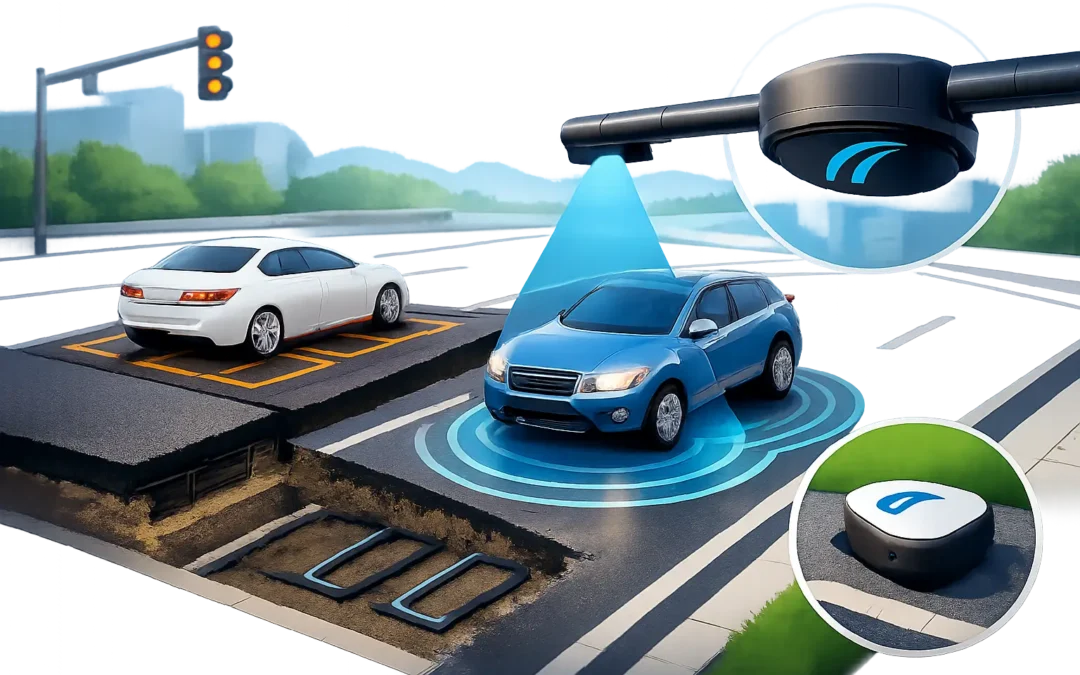
Anyone responsible for keeping a junction, crossing or corridor operating efficiently knows the weak point in traditional detection – it sits in the carriageway. When a traffic detector replacement for inductive loops is being considered, the real issue is not simply swapping one sensor for another. It is whether the network can move to a more accurate, less disruptive and more maintainable form of detection without compromising control strategy, safety or data quality.
Inductive loops have served the industry for decades, but they come with familiar operational penalties. Installation requires intrusive civil works. Reinstatement quality matters. Future resurfacing can destroy the detector. Fault finding is often slow, and replacement usually means traffic management, lane closures and more disruption than most authorities would like. For busy urban networks, strategic routes and sites with repeated maintenance demand, those constraints are no longer minor inconveniences. They affect network availability, asset life and overall scheme performance.
Why replace inductive loops at all?
The case for change tends to build gradually, then become urgent. A loop fails after resurfacing. Detection becomes unreliable in a left-turn lane. A cycle approach is not being picked up consistently. A temporary scheme becomes permanent, but the civil works budget does not stretch to recutting the road. At that point, above-ground detection stops being a nice alternative and becomes the practical option.
This is where a traffic detector replacement for inductive loops needs to be assessed on operational outcomes, not just technology type. The right replacement should reduce carriageway interventions, shorten installation programmes and improve detection coverage for mixed road users. It should also support the controller logic already in place, or at least provide a clear migration path where the control philosophy is changing.
Above-ground detection is especially attractive where roads cannot be repeatedly disturbed. Urban signalised junctions, controlled crossings, temporary traffic management layouts, bridge structures and recently resurfaced sites all benefit from avoiding saw-cuts in the carriageway. The sustainability argument is also stronger than it was a decade ago. Fewer roadworks mean lower material use, less plant time and reduced congestion caused by installation and maintenance activity.
What makes a good traffic detector replacement for inductive loops?
The answer depends on the site, because loops are often being asked to do different jobs. At one junction they are extending green time. At another they are confirming vehicle presence in a stop-line lane. Elsewhere they are supporting MOVA, queue management, cycle detection or data collection. A replacement detector has to match the actual task, not just the footprint of the old installation.
Radar is often the strongest fit where reliable vehicle presence and approach detection are required in all weather, with minimal maintenance burden. It performs well for stop-line detection, passage detection and speed-responsive applications, and it avoids many of the visibility limitations that can affect optical systems. For schemes involving cyclists, specialist radar can also provide more dependable non-intrusive detection than loops, particularly where cycle lanes or advanced stop areas need a cleaner detection strategy.
AI video detection adds a different set of strengths. It can classify road users, cover multiple zones and support more adaptive traffic control logic. At complex junctions, the ability to detect vehicles, cycles and pedestrians within configurable areas can simplify design and improve responsiveness. It is particularly useful where richer analytics are wanted alongside basic actuation. The trade-off is that camera siting, field of view and environmental conditions must be handled properly. Video is not a fit-and-forget technology if it has been poorly specified.
Wireless and magnetometer-based surface or near-surface sensors can also play a role, especially where quick deployment is critical and installation windows are very limited. These options can work well in temporary or constrained environments, although they should still be assessed carefully against long-term maintenance expectations and communication architecture.
Matching the replacement technology to the application
A common mistake is to treat loop replacement as a one-for-one exercise. In practice, the better approach is to review what the site actually needs from detection.
For stop-line presence at a signalised junction, radar can provide stable lane-by-lane detection without disturbing the carriageway. For demand-dependent side roads, both radar and video may be suitable depending on geometry, visibility and the level of classification needed. For pedestrian and cycle facilities, AI video often offers more flexibility, particularly where multiple user groups need to be detected differently. For strategic monitoring and data-rich sites, a broader analytics platform may be as important as the detector itself.
There is also the question of mounting position. Above-ground systems need suitable poles, mast arms or other structures, and the quality of the mounting arrangement affects long-term performance. Specifiers should look beyond detection claims and consider line of sight, occlusion risk, maintenance access, power, communications and controller integration. Replacing loops successfully is usually less about the sensor in isolation and more about the total deployment design.
Installation and maintenance advantages
The practical gains from replacing loops are often immediate. Installation is faster because there is no need to cut the road surface, seal slots or wait on curing and reinstatement processes. Traffic management can often be reduced substantially. On many sites, that is the difference between a straightforward deployment and a programme that becomes difficult to justify operationally.
Maintenance benefits are just as significant. Loop faults can be caused by carriageway wear, utility works, water ingress and resurfacing activity. Above-ground detectors remove that dependency on road condition. Fault diagnosis is generally easier, replacement is less disruptive and maintenance teams are not forced back into the live carriageway for routine detector repairs.
For authorities managing ageing signal assets, this matters. A detector strategy that reduces repeat interventions lowers pressure on maintenance budgets and helps keep junctions available. It also reduces the knock-on congestion that occurs every time a lane has to be closed for remedial work.
Performance, accuracy and the question of confidence
Engineers are right to be cautious about any replacement claim. Loops may be old technology, but their behaviour is well understood. Confidence in a replacement comes from specifying the right detection method, validating the zones properly and understanding where each technology performs best.
Radar is generally strong where reliable presence detection is needed under variable weather and lighting conditions. Video can offer much richer scene interpretation, but its performance depends more heavily on camera position, cleanliness and scene complexity. Neither technology is universally better. The right decision depends on junction layout, road user mix and the role the detector plays within the control strategy.
That is why expert support matters. Detector replacement should not be approached as a catalogue purchase. It needs a site-led assessment, controller compatibility review and an understanding of what success looks like once the system is live. In the UK and Republic of Ireland, where local authority networks often combine legacy infrastructure with modernisation goals, the ability to bridge old and new detection methods is particularly valuable.
Beyond loop replacement: building a better detection strategy
The strongest schemes use loop replacement as an opportunity to improve the wider network, not merely maintain the status quo. If a junction already requires intervention, it may be the right moment to review whether detection coverage is adequate, whether cycle demand is being captured correctly, or whether data from the site could support wider network optimisation.
This is where specialist suppliers such as C & T Technology can add real value. The best outcome is rarely achieved by replacing failed loops with the nearest non-intrusive equivalent. It comes from combining suitable detection hardware with practical application knowledge, analytics capability and support through specification, installation and commissioning.
Road authorities and contractors do not need more complexity. They need dependable detection that can be installed quickly, maintained safely and trusted in operation. Replacing inductive loops with radar, AI video or other above-ground technologies can deliver exactly that, but only when the choice is made around the site’s real operational needs.
If your network still relies on detectors buried in the carriageway, the question is no longer whether alternatives exist. It is whether each future maintenance event is an opportunity to keep patching a legacy method, or to move towards a detection approach that is safer, smarter and easier to live with.