
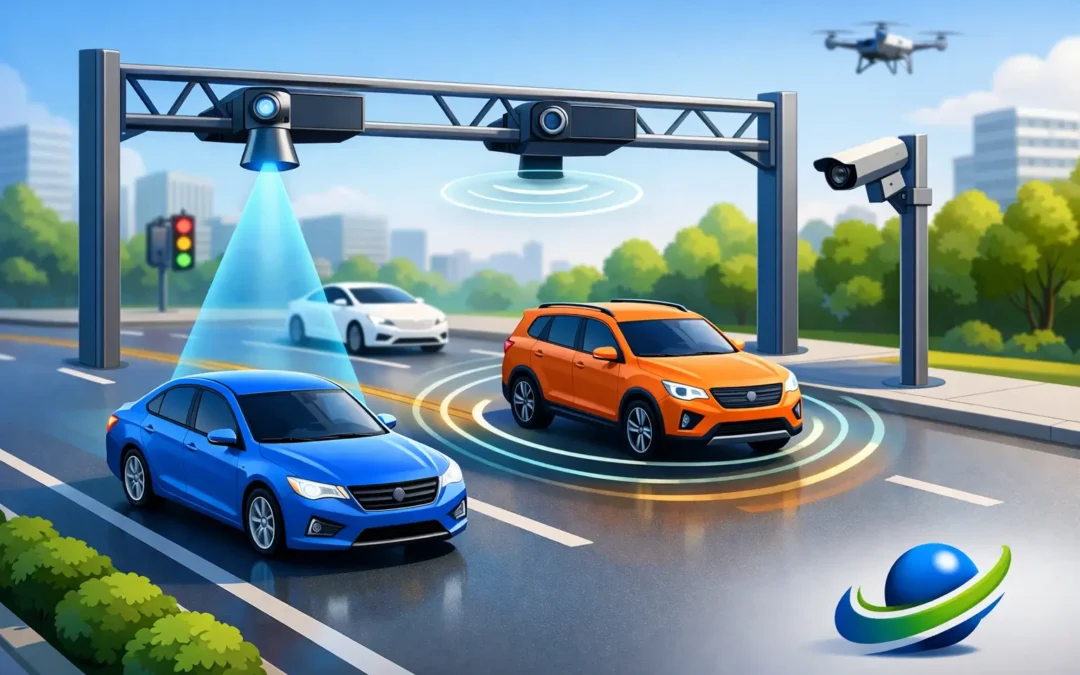
A junction can have a fully optimised signal plan and still perform poorly if its detector fails to recognise a waiting cyclist, misses a queue, or remains occupied after traffic has cleared. That is the practical question behind what is non-intrusive vehicle detection: how can a road authority obtain dependable real-time traffic data without cutting into the carriageway?
Non-intrusive vehicle detection uses sensors mounted above, beside or on the surface of the road to identify road users and measure traffic activity. Rather than relying on inductive loops installed beneath the road surface, it typically uses radar, AI-powered video, wireless sensors or a combination of technologies. The result is detection that can be installed, maintained and adapted with substantially less disruption to the road network.
For highways teams, contractors and signal engineers, the distinction matters. Detection is not simply a technical component at a junction. It informs signal demand, pedestrian and cycle provision, queue management, traffic counts, safety interventions and the evidence used to plan future network improvements.
What is non-intrusive vehicle detection used for?
At its core, non-intrusive detection observes traffic from outside the carriageway structure. A radar detector may be installed on a signal pole or roadside post and configured to detect approaching, departing or stationary vehicles within defined lanes or zones. An AI video detector uses a camera image and trained analytics to classify and track vehicles, cyclists and pedestrians. Wireless sensors can be fixed to the road surface, avoiding the saw-cutting and reinstatement associated with buried loops.
The system converts those observations into usable outputs. At a signal-controlled junction, that may be a call for a green stage, an extension to a running stage or confirmation that a vehicle has cleared a conflict area. On a strategic route, it may provide speed, occupancy, queue length, vehicle class and directional movement data. For road safety work, it can reveal where vulnerable road users are waiting, crossing or interacting with turning traffic.
Unlike a loop, which principally detects the presence of conductive metal above a fixed point, above-ground technologies can cover an area. This enables more detailed information about movement and behaviour, subject to the sensor type, mounting position and site conditions.
Why move away from road-embedded loops?
Inductive loops remain familiar and can be effective where they are correctly installed and protected from damage. However, their limitations are operational as well as technical. Installation usually requires carriageway cutting, traffic management, cabling and reinstatement. Subsequent resurfacing, utility activity, water ingress and road deterioration can damage loops or their feeder cables, creating faults that may not be immediately visible.
Non-intrusive systems address many of these constraints. A pole-mounted radar or video detector can often be installed without opening the carriageway, reducing lane closures, programme risk and disruption to road users. This is particularly valuable on busy urban corridors, at constrained junctions, on recently resurfaced roads and where access windows are short.
There is also a sustainability benefit. Avoiding repeated carriageway excavation reduces material use, waste and the emissions associated with roadworks. Less time working in live traffic can improve safety for installation and maintenance teams as well.
That said, above-ground detection is not automatically the right answer for every location. A detector must have a suitable mounting point, clear field of view and reliable power and communications arrangement. Technology selection should follow the operational requirement, rather than a blanket preference for a particular sensor.
The main non-intrusive detection technologies
Radar detection
Radar emits radio waves and analyses the reflected signal to detect objects and measure their range, speed and direction. Modern traffic radar is particularly well suited to stop-line and advance detection, queue monitoring, speed measurement and presence detection across multiple lanes.
Its key strength is consistency in poor light and challenging weather. Radar does not depend on visible contrast in the way a camera does, making it valuable for sites affected by darkness, glare, shadows or headlight variation. It can also be configured to detect stationary vehicles, an essential capability for many signal-control applications.
The trade-off is that radar generally provides less visual context than video. While some radar systems classify road users effectively, a camera-based system may be more appropriate where the authority needs detailed movement analysis, pedestrian detection or visual verification of unusual events.
AI-powered video detection
Video detection combines a camera with edge-based or centralised analytics. The software identifies and tracks road users within defined detection zones, allowing the system to distinguish between cars, buses, lorries, motorcycles, cyclists and pedestrians where the chosen solution supports those classes.
This makes video highly flexible. Detection zones can often be adjusted remotely to reflect revised lane markings, new cycle facilities or changes to junction staging. It can provide rich data on turning movements, queues and active travel, helping engineers understand not only whether traffic is present but how the junction is being used.
Performance depends on correct commissioning. Camera height, angle, lighting, occlusion from large vehicles or vegetation, and the quality of the communications connection all require attention. Privacy must also be considered from the outset. For most traffic-control applications, the requirement is anonymous object detection and aggregated data, not the identification of individuals or registration marks.
Wireless and surface-mounted sensors
Wireless traffic sensors offer another route away from buried cabling. Depending on the technology, they can provide vehicle presence, counts, speed or classification from compact devices installed on or adjacent to the road surface.
They are useful where a pole-mounted solution is impractical, where rapid deployment is required, or where an existing site needs additional detection without major civil works. Their suitability depends on the expected traffic loading, installation environment, battery life or power provision, and the quantity of data required. They should be assessed as part of the whole detection design, not treated as a direct one-for-one replacement for every loop installation.
From detection to better traffic operation
The value of non-intrusive detection lies in what the network can do with the information. At a traffic signal junction, accurate approach and stop-line detection can reduce unnecessary green time, respond more effectively to fluctuating demand and avoid holding a stage when no traffic is present. This can reduce delay for all road users without compromising safety.
For cyclists, dependable detection is especially significant. Conventional loops may not consistently recognise all bicycle types or positions within a lane. Properly specified radar or AI video detection can create dedicated cycle zones and support earlier or more reliable calls, helping authorities deliver safer, more responsive active-travel infrastructure.
On corridors and networks, live data supports a wider view. Queue length and journey speed can indicate emerging congestion before it becomes a serious operational issue. Directional counts and classification data can test whether a scheme has changed traffic patterns. Speed information displays and monitoring systems can target enforcement, education or engineering measures where they will have the greatest effect.
Specifying the right system for the site
A good specification begins with the decision the detector needs to support. Is the requirement a simple vehicle call at a stop line, multi-lane advance detection, cycle and pedestrian priority, queue measurement, speed monitoring, or network analytics? Each use case changes the required accuracy, detection area, outputs and integration needs.
Site survey is equally important. Engineers should assess mounting locations, detection angles, lane geometry, street furniture, overhead obstructions, vegetation, lighting conditions, power, communications and controller interface. A detector that performs well in a clear test environment may need different positioning at a complex urban junction with buses, turning traffic and frequent occlusion.
Integration should be considered early. The selected technology must provide the correct inputs for the signal controller, traffic management platform or data system. It should also allow practical commissioning, remote diagnostics and future adjustment. Detection zones, sensitivity settings and classification rules may need refinement once real traffic behaviour is observed.
For schemes across the UK and Ireland, local operating practice, controller estate and maintenance capability can be as important as the sensor specification itself. C & T Technology supports this process by combining above-ground detection technologies with the traffic-management expertise needed to apply them effectively on site.
A more adaptable approach to road detection
Non-intrusive vehicle detection is not merely a way to avoid cutting loops into the carriageway. It is an opportunity to make detection more informative, maintainable and responsive to changing road use. The best installations pair the right sensor with a clear operational purpose, careful survey work and commissioning that reflects the realities of the junction.
When detection is treated as part of the wider traffic-management strategy, authorities can reduce disruption at installation, improve confidence in their data and create safer, more efficient decisions for every movement through the network.