
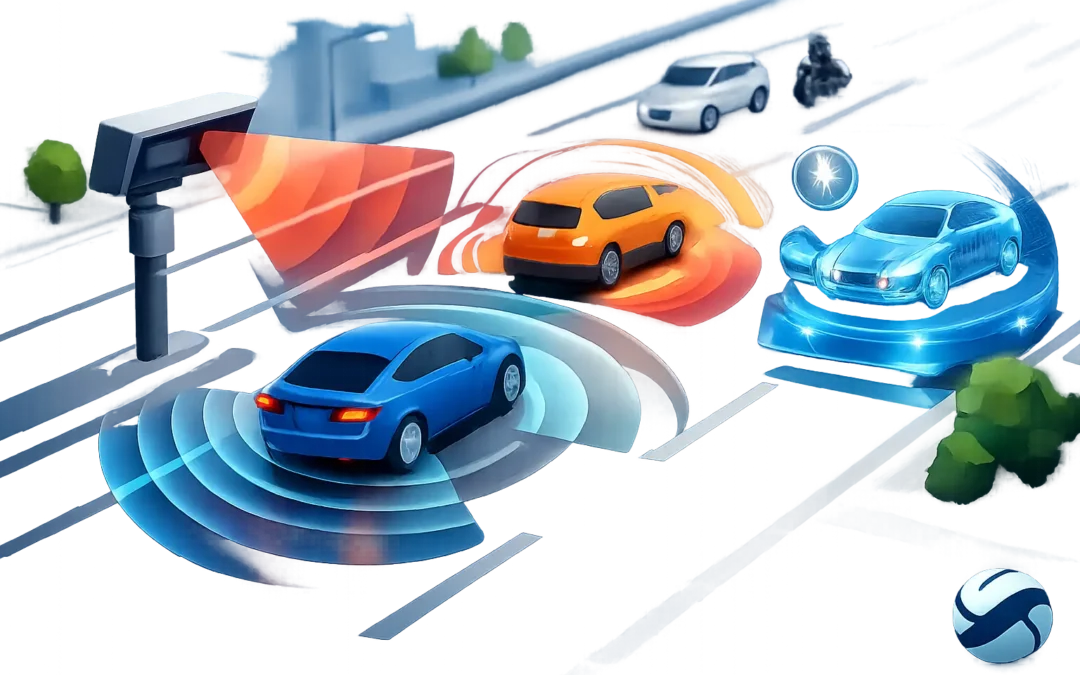
A failed loop cut, a lane closure to reinstate detection, and a signal junction running below capacity for days – that chain of events is still familiar across many networks. Radar vehicle detection systems address exactly that problem. They give traffic engineers and network operators a way to detect vehicles accurately from above ground, without cutting into the carriageway and without inheriting the maintenance burden that comes with embedded infrastructure.
For authorities and contractors under pressure to improve flow, reduce disruption and support active travel, that matters. Detection is no longer just a signal input. It is a source of operational intelligence, and the quality of that intelligence affects everything from stop line performance to queue management and corridor strategy.
What radar vehicle detection systems do
At their core, radar vehicle detection systems use radio waves to detect the presence, movement, speed and position of vehicles within defined detection zones. Mounted above ground on poles, signal heads or roadside infrastructure, they monitor one or more lanes and send detection data to traffic signal controllers, warning systems or wider traffic management platforms.
The practical advantage is straightforward. Because the detector sits above the road rather than in it, installation is faster, maintenance is simpler and disruption to traffic is reduced. That makes radar especially attractive where access windows are tight, resurfacing programmes are frequent, or lane closures carry a high operational cost.
Modern systems can do more than basic presence detection. Depending on specification and site conditions, they can support approach detection, queue detection, speed-triggered logic and lane-specific monitoring. On some sites, radar also forms part of a mixed detection strategy alongside AI video or other above-ground sensors, especially where planners want broader situational awareness rather than a single input type.
Why radar vehicle detection systems are replacing loops
Inductive loops still exist on many networks because they have been the default for years. The issue is not that they never work. The issue is the civil engineering, lifecycle maintenance and operational downtime attached to them.
Loop installation requires carriageway cuts, traffic management, reinstatement and future intervention when the road surface degrades or the loop fails. That is manageable on some schemes, but increasingly difficult to justify on busy urban routes, temporary projects or sites where authorities want to minimise carbon impact and roadworker exposure.
Radar changes that equation. It is non-intrusive, so deployment is generally quicker and safer. It is also easier to adapt when lane layouts change, temporary works are introduced or a junction requires reconfiguration. For specifiers focused on whole-life performance rather than a narrow installation view, that flexibility is often one of the strongest arguments.
There are trade-offs, and they should be acknowledged. Radar performance depends on correct mounting position, geometry and configuration. A poor pole location or badly defined detection zone will compromise results, just as poor loop placement would. Above-ground detection is not a shortcut around good design practice. It is a better platform when specified properly.
Where radar performs well in live traffic environments
Signalised junctions and stop line control
Radar is widely used for vehicle actuation at signalised junctions, where reliable approach detection and stop line extension have a direct effect on efficiency. If a detector can identify vehicles earlier and more consistently, the controller has better information to allocate green time and reduce wasted stages.
This is particularly useful on approaches where demand varies sharply through the day. A detector that adapts well to fluctuating flow can help prevent undercalling on lightly trafficked approaches and unnecessary delay on heavier movements.
Queue monitoring and congestion management
On constrained urban corridors, queue detection is often as valuable as simple presence detection. Radar can be configured to monitor occupancy and movement across defined areas, giving operators a better picture of how queues develop and dissipate. That supports more responsive control strategies, whether the goal is to protect a junction, prevent blocking back or manage progression.
Speed-sensitive applications
Radar is naturally suited to measuring vehicle movement, so it can support applications where speed matters as well as presence. That may include warning logic, speed-informed traffic management or data capture for wider network analysis. The precise use case depends on controller integration and project objectives, but the underlying strength is the same: radar detects movement well.
The operational benefits go beyond installation
It is easy to focus on the civil works saving because that is the most visible difference. In practice, the larger benefit is often operational resilience.
Above-ground radar can usually be accessed, adjusted and maintained without invasive roadworks. If a detection zone needs refining, that can often be achieved through configuration rather than excavation. If a site evolves, the system can be repositioned or retuned with far less disruption than embedded alternatives.
That has implications for network performance and maintenance planning. Fewer intrusive interventions mean less traffic management, lower exposure for installation teams and fewer occasions where a failed detector becomes a carriageway works issue. For local authorities and term contractors trying to keep assets available with limited resource, that is a meaningful advantage.
There is also a sustainability case. Avoiding repeated carriageway cutting reduces material use, site time and associated disruption. For organisations under pressure to show more sustainable infrastructure choices, non-intrusive detection aligns well with practical carbon reduction goals.
What to assess when specifying radar vehicle detection systems
Not every radar detector will suit every site, and this is where specification discipline matters. The first consideration is the operational task. Presence detection for a simple approach is different from multi-lane queue monitoring or lane-by-lane classification. The detector must match the function rather than just the mounting opportunity.
The second is site geometry. Mounting height, setback, lane width, street furniture and approach angle all influence the usable field of view. A detector that performs well on an open approach may need careful adjustment in a constrained urban street with close frontage, parked vehicles or unusual alignment.
Controller compatibility also needs early attention. Detection quality is only useful if the output can be integrated effectively into the signal strategy or wider system architecture. That includes communication protocols, input requirements and how easily the detector can be commissioned and fault managed by the asset owner or maintainer.
Then there is the question of weather and environmental complexity. Radar generally performs strongly in conditions that can challenge optical systems, but site-specific validation still matters. High reflections, dense street clutter and mixed traffic environments can all affect how detection zones should be designed.
For that reason, the strongest deployments tend to combine capable hardware with practical traffic engineering input. Technology alone does not deliver better outcomes. Correct application does.
Radar within a wider above-ground detection strategy
Radar should not be treated as an isolated category. It is one part of a broader shift away from embedded detection and towards intelligent, above-ground sensing.
On some schemes, radar is the best primary technology because it offers dependable vehicle detection with low infrastructure disruption. On others, it works best alongside AI video, bicycle detection or traffic analytics platforms, especially where stakeholders need richer multimodal data. The right answer depends on the control objective, the road environment and the level of detail required.
That is why experienced specifiers increasingly look at detection as a system decision rather than a product decision. If the aim is safer roads, reduced congestion and better operational evidence, the detector should be selected for measurable network outcomes, not just legacy familiarity.
C & T Technology has built its approach around that principle, helping authorities and transport professionals move from disruptive in-road detection towards practical above-ground solutions that are easier to deploy and more aligned with modern network demands.
Why this matters for UK and Irish road networks
Across the UK and Republic of Ireland, authorities are being asked to do more with existing road space. Junctions must operate efficiently, active travel movements need better consideration, and maintenance interventions are under constant scrutiny. In that context, radar vehicle detection systems solve more than a technical problem. They help remove one of the recurring operational weaknesses in traditional detection infrastructure.
They also support a more agile way of managing assets. When layouts change, traffic patterns shift or temporary schemes become permanent, non-intrusive detection is easier to adapt. That matters in a network environment where flexibility is no longer a nice extra. It is part of everyday traffic management.
The most effective schemes are not the ones with the most technology. They are the ones where detection is reliable, maintainable and matched to the real behaviour of the site. Radar has become a strong option because it meets those criteria in a practical, field-ready way.
If your network still depends heavily on embedded detection, the right question is no longer whether above-ground radar is viable. It is where replacing legacy detection would remove the most disruption and deliver the clearest operational gain first.