
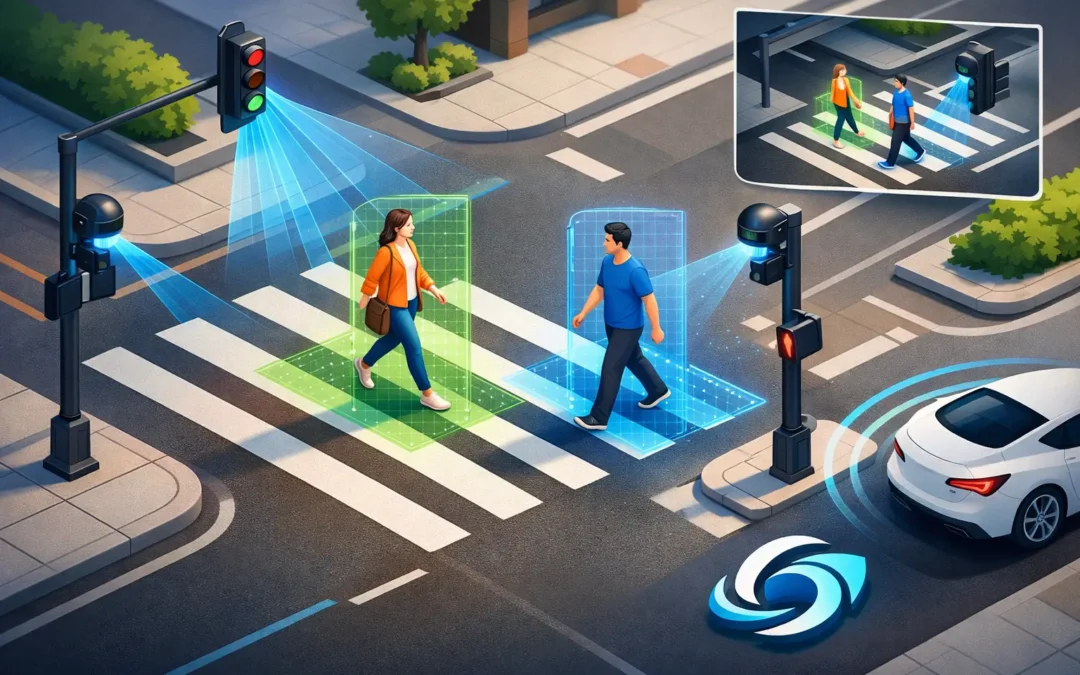
A pedestrian reaches the kerb just after a signal stage has been called. If the controller does not know they are there, the crossing may not respond until the next cycle – or the person may take a risk rather than wait. Pedestrian detection for crossings is therefore not simply an added feature. It is a control input that can directly affect safety, accessibility, delay and public confidence in a junction.
For highways authorities and signal teams, the challenge is to detect real pedestrian demand accurately in an environment that changes by the minute. Footfall varies with school opening times, rail arrivals, weather, nearby events and the behaviour of other road users. A suitable detection strategy must work reliably at the kerbside while fitting within the operational logic of the crossing and the constraints of the site.
What pedestrian detection needs to achieve
At a basic level, a crossing needs to recognise a request for the pedestrian stage. In practice, the operational requirement is more detailed. Detection may need to identify a person approaching the crossing, waiting within a defined zone, entering the carriageway, or still clearing it when the nominal crossing period is due to end.
These different events support different decisions. A call detector can reduce the dependence on a push button at sites where touch-free operation or accessibility is a priority. Presence detection can avoid serving an unnecessary pedestrian phase where somebody has moved away. On-crossing monitoring can inform extension logic, helping controllers protect pedestrians who need more time to complete the movement.
The objective is not to maximise calls. It is to deliver the right response, at the right time, without creating avoidable delay for buses, general traffic, cyclists or other pedestrian movements. That requires clear detection zones, appropriate controller configuration and a technology choice suited to the site.
Why conventional approaches can fall short
Push buttons remain a familiar and useful interface, particularly where a positive pedestrian request is required. However, they do not provide a complete picture of demand. A pedestrian may not press the button, may be unable to reach it easily, or may press it and then leave before the stage is served. The controller is then acting on an incomplete or outdated indication.
Road-embedded detection has similar limitations when applied to a wider traffic management strategy. Inductive loops are installed beneath the road surface, so installation and repair can require carriageway occupation, cutting and reinstatement. They are intended principally for vehicles and cannot provide the spatial awareness needed to understand pedestrian presence at a kerb or movement across a crossing.
Above-ground sensors offer a different approach. AI-powered video detection can classify and track road users within defined areas, while radar can provide dependable movement and presence information in conditions where camera performance may be affected. Neither technology is automatically right for every crossing. The practical benefit comes from selecting the sensing method, field of view and logic for the actual operational problem.
Pedestrian detection for crossings: choosing the right sensing method
Video analytics are particularly valuable where the authority needs a detailed view of pedestrian activity. Correctly configured AI video systems can distinguish pedestrians from cycles and vehicles, define virtual detection zones and provide useful data on movements, occupancy and conflict-prone locations. This makes video well suited to complex urban junctions, shared-use crossings and sites where detection is part of a wider traffic analytics programme.
The quality of the installation matters as much as the algorithm. Camera position must minimise occlusion from street furniture, queuing vehicles, buses and groups of pedestrians. Low sun, headlight glare, night-time scenes, rain and shadows should all be assessed during design. A wide field of view is not always preferable if it makes the intended waiting area too small in the image to deliver consistent classification.
Radar can be a strong option where all-weather operation and detection of movement are the key priorities. It can complement video at exposed locations, on higher-speed approaches or where visual conditions are challenging. The trade-off is that radar will not generally provide the same visual classification detail or operational evidence as an AI video detector. A combined approach may be justified on complex sites, but only where each sensor contributes a defined control or monitoring function.
Passive infrared and other specialist sensors can also have a place in particular applications. The specification should start with the decision the signal controller needs to make, rather than with a preferred device. Is the requirement to register a call, cancel an abandoned call, extend clearance time, measure footfall, or identify vulnerable pedestrian movements? These are related tasks, but they are not identical.
Detection zones and signal logic must work together
A well-positioned detector can still produce poor outcomes if its zones and controller logic are not aligned. The waiting zone needs to reflect how people actually approach and wait at the crossing. At a busy station frontage, for example, pedestrians may gather back from the tactile paving until the traffic clears. At a school crossing, children may arrive in groups and move unpredictably around the pole and guardrailing.
Zones should be designed to avoid false activation from people walking parallel to the carriageway, waiting for a bus, standing outside a shop or using an adjacent cycle facility. Equally, they must not be so narrow that a person waiting slightly away from the expected position goes undetected. Site observation before installation is essential, and post-installation adjustment should be expected rather than treated as a failure.
For crossing clearance, the logic should be conservative and transparent. Detection may trigger an extension only when somebody remains in the relevant monitored area, with sensible maximum limits that protect junction capacity. A detector should support the approved controller strategy, not create uncertain or unbounded extensions. Signal engineers need defined fallback behaviour if a detector becomes unavailable, along with monitoring that identifies faults before they affect public safety.
Installation without unnecessary disruption
Above-ground pedestrian detection is attractive because it can reduce civil works. Sensors mounted on existing poles or purpose-designed street furniture avoid cutting into the carriageway and the disruption associated with loop installation. That can shorten deployment programmes, reduce traffic management requirements and make future alterations less intrusive.
This advantage does not remove the need for careful survey work. Power, communications, mounting height, cable routes, controller interfaces and maintenance access all need confirming early. Where existing assets are used, their structural condition and line of sight should be assessed. A detector installed quickly but positioned poorly will create an avoidable commissioning problem.
For local authorities managing a varied estate, standardising principles can help. Consistent zone naming, configuration records, controller input mapping and acceptance testing make it easier to support systems across multiple sites. C & T Technology applies this practical focus to above-ground detection, combining equipment selection with the traffic systems expertise needed to turn sensor data into useful control decisions.
Measuring performance after commissioning
Commissioning should establish more than whether the detector generates an input. The meaningful question is whether it produces the intended crossing outcome under real conditions. Testing should cover peak footfall, quiet periods, darkness, rain where possible, groups, people using mobility aids, cyclists near the crossing and vehicles that may obscure the view.
Useful performance measures include missed demand, false calls, detection-to-stage response time, crossing extensions, detector availability and changes in pedestrian delay. Video-based systems may also provide anonymised counts and movement data that help teams understand whether a revised signal plan is improving the site as intended.
There is a balance to manage. Very sensitive detection may capture every possible pedestrian but generate calls that interrupt traffic unnecessarily. Tighter settings may protect capacity but fail to serve legitimate demand. The right threshold depends on the crossing type, traffic volumes, nearby land use, vulnerable users and the authority’s safety objectives.
Design for the person at the kerb
The strongest pedestrian detection schemes begin with an ordinary but critical question: what happens to the person waiting to cross? When detection is designed around their real behaviour, then integrated properly with signal control, it can reduce uncertainty, improve accessibility and support safer decisions at the kerbside.
For the network operator, that same intelligence means fewer assumptions, better evidence and a practical route away from disruptive road-embedded infrastructure. The value lies not in adding another sensor, but in making every pedestrian stage more responsive to the people it is there to serve.