
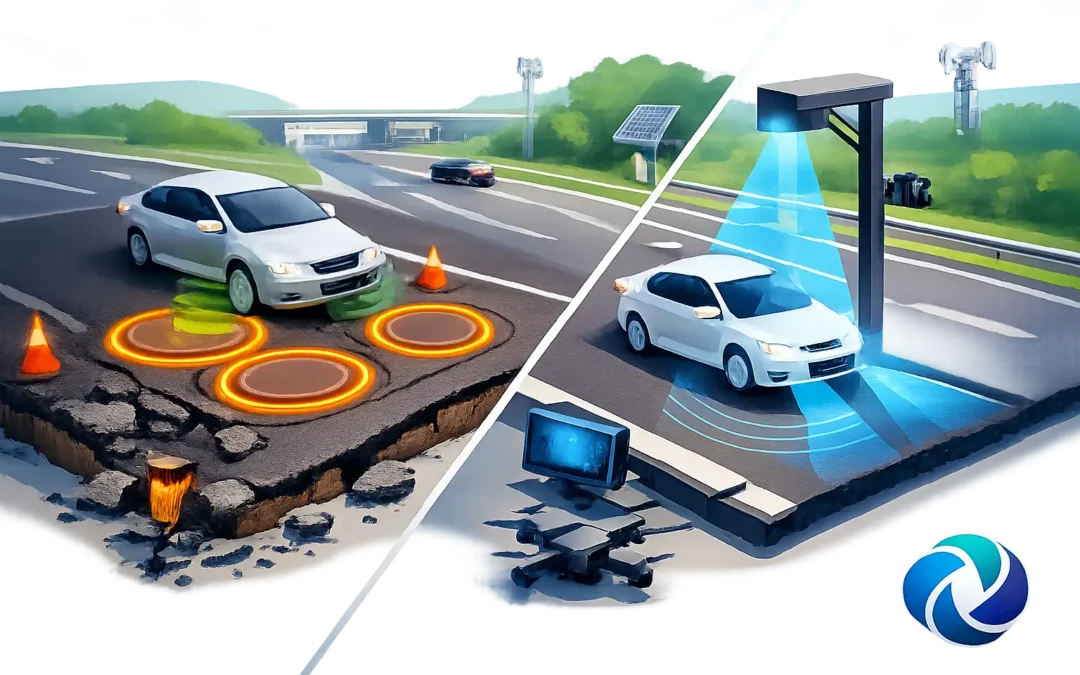
A failed inductive loop rarely arrives at a convenient time. It may reveal itself as a missed call at a side-road junction, erratic SCOOT operation, poor cyclist actuation, or a signal fault that requires lane closures simply to investigate. The question of when should loops be replaced is therefore not just a maintenance decision. It is a decision about network resilience, road user safety and the disruption created by the repair method itself.
For many authorities, inductive loops remain a familiar part of the traffic control estate. They can perform effectively where they are correctly installed, protected from carriageway deterioration and matched to the task. However, their location beneath the road surface makes every installation, fault investigation and replacement dependent on disruptive civil work. Above-ground radar, AI video and wireless detection provide a credible alternative where detection requirements, asset condition and operational constraints justify a change.
When should loops be replaced rather than repaired?
Replacement should be considered when a loop fault is no longer an isolated issue, but evidence of a wider operational or asset-management problem. A single damaged feeder cable may be repairable. Repeated detector faults at the same junction, particularly after resurfacing or utility activity, indicate that continuing to reinstate loops may be preserving a vulnerability rather than solving it.
The strongest trigger is repeated failure. Intermittent detection, unexplained call losses, insulation faults and recurring controller alarms consume engineer time and undermine confidence in signal operation. Each intervention can require traffic management, saw-cutting, reinstatement and testing. The direct repair is only part of the impact. Queues, diversions, work-zone exposure and programme uncertainty all affect the true whole-life burden.
Carriageway works are another sensible decision point. If resurfacing, reconstruction, drainage work or major utility intervention is already planned, the authority has an opportunity to review whether road-embedded detection should be reinstalled at all. Re-cutting loops into a newly surfaced carriageway can introduce future maintenance points at exactly the moment the network should be gaining a more durable asset.
A change in detection requirement also matters. Traditional loops are principally vehicle-presence detectors. They may be less suitable where a junction needs reliable detection across several lanes, accurate approach monitoring, cycle detection, pedestrian activity insight or classification data. If the control strategy has evolved beyond simple vehicle actuation, replacing loops with a sensor capable of richer data can improve the quality of the decision being made at the controller.
Assess the operational consequence, not only the fault
An inductive loop can appear electrically healthy while delivering poor operational outcomes. A detector may be positioned too close to a stop line for the required strategy, struggle with certain road users, or provide only a limited view of approaching traffic. Before specifying a like-for-like replacement, assess what the junction actually needs to know.
At a busy urban signal junction, the priority may be dependable presence detection and reduced false calls. On a high-speed rural approach, advance detection and speed measurement may better support safe signal timing. At a cycling corridor, the key requirement may be dependable detection of bicycles without forcing riders into a narrow position over a specific loop. Near schools, crossings or mixed-use routes, video analytics may help distinguish vehicles, cyclists and pedestrians so that signal operation reflects real demand.
This assessment should cover the operational effects of poor detection: unnecessary green time, side-road delay, late gap-out, queuing back through adjacent junctions, unreliable bus priority or vulnerable road users being missed. These are measurable network issues, not merely detector issues. A replacement scheme should be specified against the outcome required, including detection zones, latency, classification, environmental conditions and controller interface.
Signs that a non-intrusive alternative is justified
There is a strong case for above-ground detection where several conditions apply at once:
- Loop faults recur or cannot be located without intrusive investigation.
- Lane closures or excavation would create unacceptable congestion, safety exposure or public disruption.
- The site is due for resurfacing, redesign or a change in traffic signal staging.
- Existing loops do not reliably detect cyclists, motorcycles or vehicles across the required approach area.
- The junction requires speed, queue, direction or classification data that loops cannot provide on their own.
- Temporary traffic management, poor access or restricted working hours make carriageway cutting impractical.
Not every site needs every capability. The point is to avoid treating a detector fault as a narrow electrical repair when it is also an opportunity to remove roadworks from the future maintenance plan.
Choose the detection technology around the application
Above-ground detection is not a single product category. Radar, AI-powered video and wireless sensors have different strengths, and the correct choice depends on the site geometry, detection purpose and prevailing conditions.
Radar detection is often well suited to vehicle and bicycle detection on approaches where reliable operation is needed in darkness and adverse weather. It can monitor multiple detection zones without cutting the carriageway and can provide speed and direction information where this supports the control strategy. For stop-line and approach applications, careful configuration is essential to ensure the detection area matches lane layout, turning movements and the desired extension logic.
AI video detection is valuable where the authority needs more context. A properly designed camera installation can identify and track different road users, support virtual detection zones and provide operational insight beyond a simple presence output. This can be particularly useful at complex junctions, active travel schemes and locations where understanding movements or occupancy informs a wider traffic management response. Camera positioning, lighting, occlusion risks and data governance must be considered early, rather than treated as installation details.
Wireless traffic sensors can provide a practical route where rapid deployment and minimal civil engineering are the primary requirements. They can be useful for monitoring, counts and targeted data collection, including sites where a permanent loop installation would be disproportionate. Their suitability depends on communications architecture, battery life expectations and the required level of real-time control integration.
For some locations, a combined approach is appropriate. Radar may provide reliable approach actuation, while video analytics supplies classification or movement data for monitoring and optimisation. The aim is not to install the most complex technology. It is to deploy detection that produces dependable, usable information for the task.
Plan replacement as a control-system change
Replacing loops should be treated as a detection design exercise, not simply a hardware substitution. The existing loop layout often reflects historic signal staging and traffic patterns that may no longer apply. Surveying the site allows detection zones to be designed around current lane use, queue behaviour, cycle facilities, pedestrian crossing movements and visibility constraints.
Integration with the signal controller is equally important. Confirm the required inputs and outputs, fail-safe behaviour, detector channel mapping, communications method and maintenance access before installation. Engineers should also agree how performance will be validated. That may include checking stop-line calls, approach extension, bicycle actuation, queue response and operation in both peak and off-peak conditions.
Commissioning should include real traffic, not only a bench test. A detector can communicate correctly with a controller yet still be poorly configured for an approach geometry or traffic mix. Reviewing detector logs and traffic data after the initial period helps refine zones and timing parameters, particularly where a new detection method enables more responsive control.
Where retaining loops can still be sensible
Replacement is not automatically the right answer. If loops are relatively new, reliable, protected by sound carriageway condition and adequately support the junction strategy, retaining them may be reasonable. This is particularly true where there is no foreseeable carriageway work, the site has straightforward vehicle actuation requirements and the operational risk of failure is low.
There are also locations where mounting positions, power availability, sightlines or local environmental constraints make an above-ground installation more complex. These factors should inform a site-specific appraisal. The practical advantage of non-intrusive detection is substantial, but only when it is correctly selected, installed and maintained.
The better question is not whether inductive loops are obsolete. It is whether their continued use at a particular site delivers the reliability, detection quality and maintenance profile the road network now requires.
For authorities managing ageing signal assets, planned resurfacing programmes and rising expectations around active travel, that question deserves to be asked before the next emergency loop repair. A well-timed move to above-ground detection can turn a reactive maintenance event into a safer, more intelligent and more sustainable improvement to the junction.