
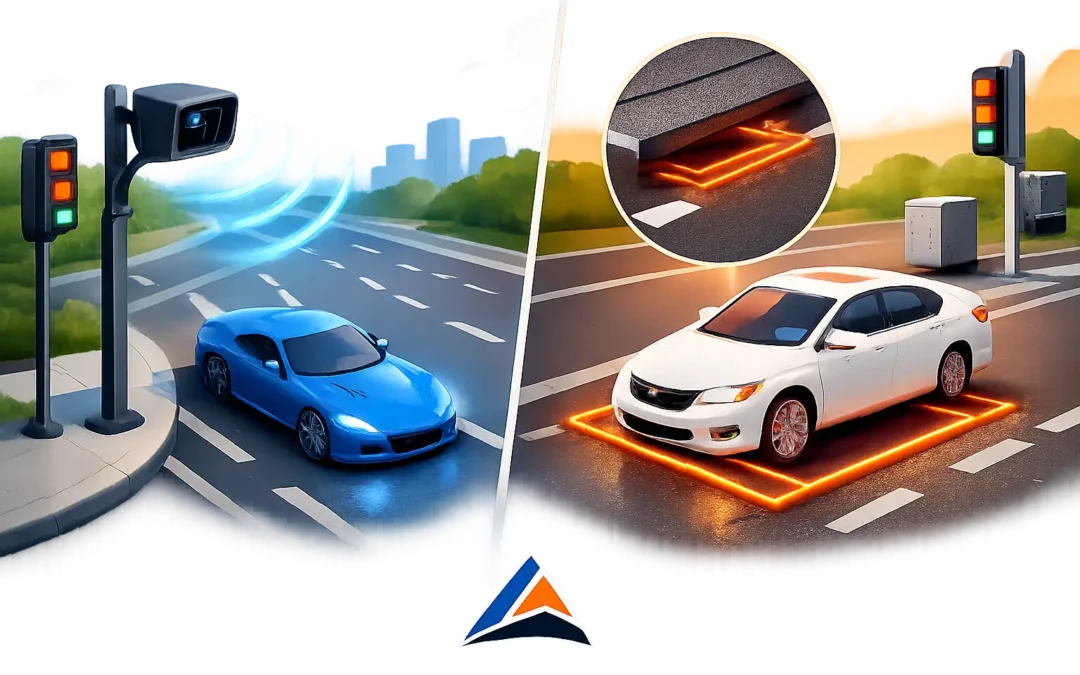
A failed detector at a signalised junction is rarely a minor fault. It can leave a side road waiting unnecessarily, weaken bus priority, create avoidable queues or prevent an accurate picture of demand from reaching the controller. The choice between radar detectors vs inductive loops therefore affects far more than the detection point itself. It affects network availability, safety, maintenance planning and the disruption required to keep traffic control operating as intended.
Inductive loops have served traffic management well for decades. They remain familiar to designers, contractors and maintenance teams, and can provide dependable vehicle presence detection in the right application. However, they are road-embedded assets. That physical constraint is increasingly significant where authorities need to minimise carriageway interventions, protect recently resurfaced roads and deploy better traffic intelligence without extended lane closures.
Above-ground radar detection offers a different operating model: detection equipment is mounted beside or above the carriageway, configured to cover defined lanes or approaches, and maintained without cutting into the road surface. The practical advantages are clear, but radar is not simply a like-for-like replacement in every location. A sound specification starts with the control objective, the site geometry and the quality of data required.
How inductive loops detect traffic
An inductive loop is a wire loop installed in a saw-cut slot in the carriageway and connected to a detector unit. When a metallic vehicle passes over or stops within the loop, it changes the loop’s inductance. The detector interprets that change as a vehicle presence or passage.
This is a direct and established method of detection. Loops can be placed accurately at a stop line, on an approach or within a specific lane, making them useful for functions such as demand-dependent signal operation, queue detection and stop-line presence. For many conventional signal installations, their behaviour is well understood.
The limitation is not the fundamental principle. It is the installation environment. Cutting slots, laying cable, sealing the road surface and reinstating the carriageway all require traffic management and time on site. Where loops are installed in a newly surfaced road, the intervention can also compromise the surface and create a future maintenance point.
Loop performance can be affected by deterioration in the saw-cut seal, cable damage, utility works, resurfacing and repeated loading. Finding a fault may require investigation at the roadside and in the carriageway, while replacement usually means another disruptive intervention. Detection of cycles and smaller vehicles can also demand careful loop design and sensitivity settings, particularly where reliable active travel detection is a priority.
Radar detectors vs inductive loops: the practical difference
The central difference is where the asset sits. Inductive loops detect changes immediately within the road surface. Radar detectors observe traffic from above ground using radio waves, typically measuring vehicle movement, range and speed to identify traffic within configured detection zones.
For a highways authority, this changes the delivery programme. A radar detector can normally be mounted on an existing signal pole, lighting column or purpose-designed structure, subject to suitable sight lines and structural considerations. The carriageway remains intact. Installation can often be completed with reduced traffic management compared with a road-cutting programme, which is particularly valuable on busy urban routes, strategic approaches and locations where roadspace is tightly controlled.
Radar can also cover multiple lanes and detection zones from a single mounting position. A correctly specified unit may provide approaching vehicle detection, presence at the stop line, queue monitoring and speed information across an approach. This can reduce the number of separate field devices required, while giving engineers more flexibility to refine zones through configuration rather than civil works.
That flexibility matters when traffic patterns change. A lane reassignment, junction alteration or new cycle facility may require loop positions to be replaced or supplemented. With radar, many adjustments can be made by revising the detection layout and commissioning settings, provided the sensor position still provides suitable coverage.
Installation disruption and whole-life maintenance
The most visible benefit of above-ground detection is the removal of carriageway cutting. This means less exposure for installation crews, fewer lane closures and less disruption to road users. It also avoids the carbon and material impacts associated with repeated saw-cutting and reinstatement.
The operational benefit continues after commissioning. When a radar detector requires inspection, replacement or reconfiguration, work is generally undertaken from the verge, footway or a safe roadside position. Access planning is still essential, particularly on high-speed roads or constrained junctions, but maintenance does not ordinarily require opening the carriageway.
By contrast, a loop fault may be simple electrically but difficult operationally. The repair can involve booking traffic management, cutting the road and reinstating the surface, with associated disruption to a live network. On routes with frequent utility activity or poor pavement condition, this becomes a recurring risk rather than a one-off inconvenience.
This does not mean every loop will fail prematurely, nor that every radar installation is maintenance-free. Radar units require secure mounting, correct alignment, clean power and communications arrangements, and periodic checks. The difference is that their failure modes are generally more accessible to diagnose and resolve.
Detection performance: specify the outcome, not the technology
Neither technology should be selected on familiarity alone. The correct question is what the detector must achieve for the controller and the wider network.
At a simple stop line, a loop may provide highly localised presence detection. In some constrained layouts, this remains appropriate, particularly where there is a proven loop design, stable road surface and no need for wider approach data. However, if the objective includes earlier call generation, speed-responsive control, queue measurement or multi-lane coverage, radar can provide considerably more usable information from one above-ground device.
Radar is particularly effective where detection must extend upstream from the junction. It can distinguish vehicles by distance and speed, allowing a controller strategy to respond to approaching traffic rather than only a vehicle sitting on a fixed point in the road. This supports more responsive signal operation, better management of congested approaches and improved evidence for traffic engineering decisions.
For vulnerable road users, the assessment must be equally specific. Radar solutions designed for vehicle and bicycle detection can support cycle calls where conventional loops may be difficult to optimise. Yet site conditions matter. Cyclists, pedestrians, turning movements, parked vehicles and closely spaced lanes all require careful zone design and validation. Where detailed classification, pedestrian activity or complex turning behaviour must be understood, AI-powered video detection may complement or be more suitable than radar.
Site conditions that influence the decision
Radar needs a clear and stable view of the traffic stream. Mounting height, angle, road curvature, gradients, street furniture and adjacent traffic movements all influence performance. A poorly positioned radar will not be improved simply by changing configuration. Early site assessment is therefore essential.
Inductive loops are less dependent on line of sight but more dependent on pavement condition and access to the carriageway. They can also be difficult to retain through resurfacing schemes, alterations to road markings or future excavation. The apparent simplicity of a loop installation can conceal long-term constraints at sites with a busy maintenance history.
Signal integration should also be considered at the outset. Detection outputs, controller compatibility, fail-safe requirements, timing strategy and remote monitoring all need to align with the authority’s operating standards. A detector is only valuable when its information is translated into reliable control actions and can be diagnosed quickly when behaviour changes.
Moving from fixed detection to usable traffic intelligence
The strongest case for radar is not just that it avoids road cuts. It is that above-ground detection can turn a fixed point of presence into a broader view of traffic behaviour. Speed, approach demand, lane occupancy and queue development can inform operational decisions as well as signal actuation.
This is especially relevant for authorities seeking safer roads and reduced congestion without committing to major civil works. Reliable detection helps prevent wasted green time, reduces unnecessary stopping and supports more proportionate responses to changing demand. When the same approach can also support traffic counting and classification, the value extends from real-time control into network planning.
C & T Technology works with transport professionals to assess these requirements in practical terms: what must be detected, where detection must occur, how the controller will use it and how the asset will be maintained over its life. That approach avoids specifying radar merely because it is newer, or retaining loops simply because they are familiar.
For many new schemes and renewals, radar provides a compelling route to non-intrusive, adaptable detection with less disruption to the carriageway. Where a loop remains the most suitable answer, it should be chosen deliberately. The most effective traffic network is not built around a preferred sensor type, but around dependable detection that gives every control decision the evidence it needs.