
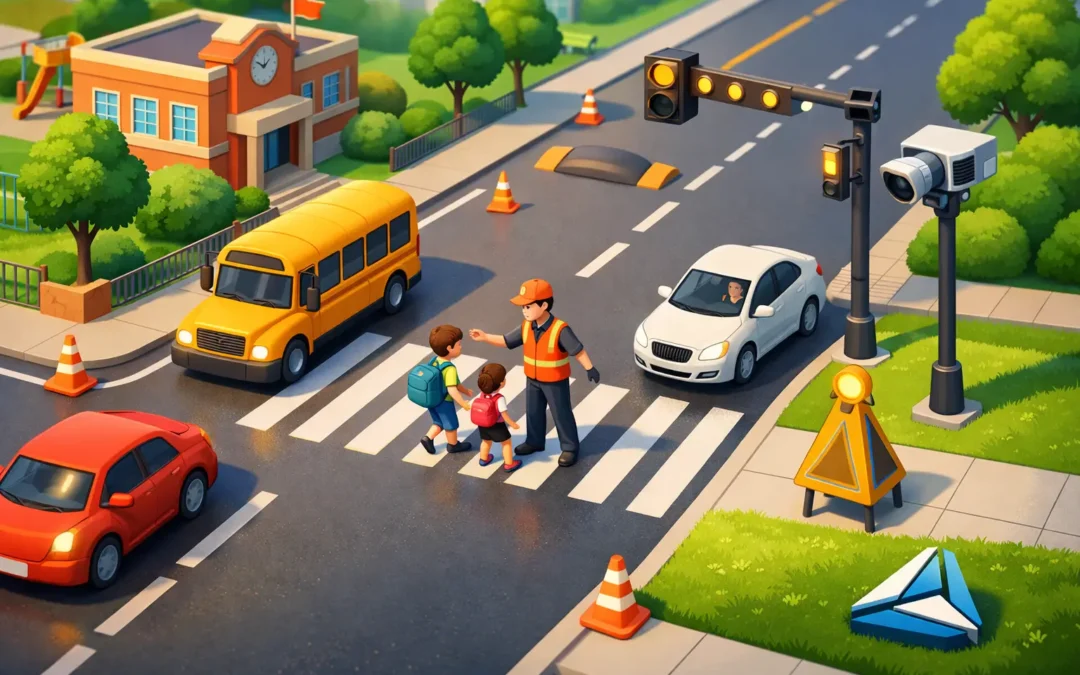
The most hazardous moment outside a school is rarely the middle of the day. It is the compressed period around drop-off and collection, when children step between parked vehicles, parents make short manoeuvres and through-traffic meets a changing streetscape. Effective school zone compliance is therefore not simply a question of placing a sign. It depends on creating a credible, measurable environment in which drivers recognise the restriction, modify their behaviour and are supported by road layouts and traffic control that work under real conditions.
For highways authorities and road safety teams, that requires more than periodic speed surveys. It requires dependable detection, an understanding of when risk is highest, and interventions that can be monitored and refined without repeated carriageway disruption.
Why school zone compliance is difficult to sustain
School areas generate conflicting demands within a short time window. Pedestrians, cyclists, buses, parked vehicles, delivery activity and general traffic all compete for limited road space. A signed 20 mph limit or timed restriction may be clear on paper, yet compliance can weaken where drivers perceive the road as wide, lightly trafficked or poorly supervised.
The issue is also dynamic. Conditions at 08:35 on a wet Tuesday can be very different from those at 15:20 on a dry Friday. Vehicle approach speeds, queuing, crossing activity and visibility all vary. A single annual survey can identify a problem, but it cannot show whether an intervention is influencing behaviour consistently across the school week or whether the most serious risk has simply moved to another approach.
This is where reliable above-ground detection has a practical advantage. Radar and AI video systems can provide continuous insight without cutting the carriageway for inductive loops. That reduces installation disruption at sensitive locations and allows authorities to assess conditions before, during and after a scheme is introduced.
Start with the behaviour that creates risk
The objective should not be to collect data for its own sake. School zone measures should address the behaviours most likely to expose children and other vulnerable road users to harm. Depending on the site, this may mean excessive approach speed, failure to observe a timed motor-vehicle restriction, vehicles stopping in unsafe positions, or congestion that obscures crossing movements.
A useful assessment considers speed distribution rather than an average alone. Mean speed can appear acceptable while a smaller proportion of vehicles continues to travel well above the intended limit. The 85th percentile speed, maximum recorded speeds and the volume of vehicles exceeding a defined threshold offer a clearer picture of whether the site feels and operates safely.
Classification adds further value. A lorry, bus, motorcycle, private car and cycle do not create the same operational or safety effects. Understanding vehicle mix can help engineers distinguish a general speeding issue from one associated with particular vehicle types or journey patterns. At locations near schools serving larger catchments, this may also reveal whether peak-period traffic is being displaced from nearby principal routes.
Detection must work in the real street environment
A school frontage is not a controlled laboratory. Detection equipment must perform despite parked vehicles, variable light, rain, low winter sun, closely spaced traffic and complex pedestrian activity. The technology selected should match the decision to be made.
Radar is highly effective for measuring approaching and receding vehicle speed, volume and classification, and it can support speed information displays with immediate driver feedback. Its above-ground installation makes it well suited to temporary assessments, permanent monitoring and sites where opening the road is impractical or undesirable.
AI-powered video detection provides a different level of situational understanding. Properly specified and configured, it can detect vehicles, cyclists and pedestrians, monitor occupancy and queues, and provide inputs for signal control or operational review. At crossings and junctions near schools, this can help authorities examine whether pedestrian demand is being served efficiently and whether vehicle movements are creating avoidable conflict.
Neither approach is automatically right for every site. Radar may be the more proportionate choice where the key requirement is accurate speed and volume data. Video may be appropriate where road-user movements, queues or multiple detection zones must be understood. In many schemes, combining the two creates a stronger evidence base: radar establishes speed behaviour, while video helps explain the conditions behind it.
Make compliance visible, credible and responsive
Drivers are more likely to comply when the road environment communicates a consistent message. Signs, carriageway markings, gateway treatments and speed information displays should reinforce rather than contradict each other. A speed display is particularly useful when it presents timely, legible feedback at a point where a driver can still reduce speed safely.
However, a display should not be treated as a set-and-forget device. Its effectiveness depends on siting, approach visibility, activation range and the local driving environment. If it activates too late, is obscured by parking, or is positioned after the point of greatest pedestrian activity, its operational value will be limited.
Data enables this to be tested. Before-and-after monitoring can show whether speeds fall only in the first weeks following installation or whether improvement is sustained. It can also identify times when the display is most needed. Some school approaches carry high traffic throughout the day; others experience a sharp but predictable peak. Configuring interventions around actual risk periods can improve relevance while avoiding unnecessary visual clutter.
For timed School Street schemes, detection and analytics can also support operational assurance. Authorities need to understand whether prohibited movements are occurring, how traffic redistributes during restriction periods and whether adjacent roads require complementary measures. The aim is not simply to move vehicles away from a school gate, but to reduce risk across the immediate network.
Build an evidence-led implementation plan
A sound school zone programme usually begins with a baseline period long enough to capture normal variation. This should include school-term conditions, typical drop-off and collection periods, and where possible adverse weather or reduced daylight. Engineers can then establish speed profiles, traffic volumes, vehicle classifications and queue behaviour before selecting interventions.
The next step is to set a clear operational measure of success. That might be a reduction in the proportion of vehicles exceeding 20 mph, lower approach speeds at the crossing point, reduced queuing on a key arm, or improved response to pedestrian demand. Specific measures prevent a scheme from being judged on anecdote alone.
Deployment should consider practical constraints from the outset. Above-ground sensors can often be mounted without excavation, allowing installation to be completed more quickly and with less impact on traffic, school access and neighbouring residents. This is valuable where work windows are short or road closures would create disproportionate disruption.
Once in place, data should be reviewed at defined intervals. Early results may show a need to adjust detector zones, display thresholds, signal timings or signage. This is not evidence that the scheme has failed. It is how a responsive traffic management approach converts initial installation into a more effective long-term outcome.
Avoid the common gaps in school zone schemes
A frequent weakness is treating speed as the only measure of safety. Lower speeds matter, but a school environment may still be difficult to navigate if pedestrian crossing demand is poorly understood, sightlines are blocked by stopping vehicles, or traffic queues back through a junction. Detection should support a broader view of the site.
Another gap is relying on data that cannot be trusted or interpreted easily. Sensors should be selected for the required detection task, installed with suitable positioning and verified after commissioning. A vehicle count that includes unreliable classifications, or a camera view compromised by glare and occlusion, can lead to poor decisions with unwarranted confidence.
Finally, schemes can lose value when monitoring ends immediately after delivery. School travel patterns change with new housing, altered catchments, revised bus routes and seasonal conditions. Periodic review helps authorities identify whether compliance remains stable and where investment should be directed next.
School zone compliance is a network responsibility
The school gate may be the focal point, but the safety outcome is shaped by the approaches, crossings, junctions and traffic choices surrounding it. Better detection makes those relationships visible. It gives road safety teams the evidence to target interventions, traffic signal professionals the information to refine operation, and highways authorities a practical way to demonstrate performance over time.
For C & T Technology, the value of non-intrusive radar and AI video is not limited to faster installation. It is the ability to turn a complex, short-duration safety problem into usable operational intelligence. When compliance is measured accurately and acted upon consistently, safer journeys to school become a practical network outcome rather than a seasonal aspiration.