
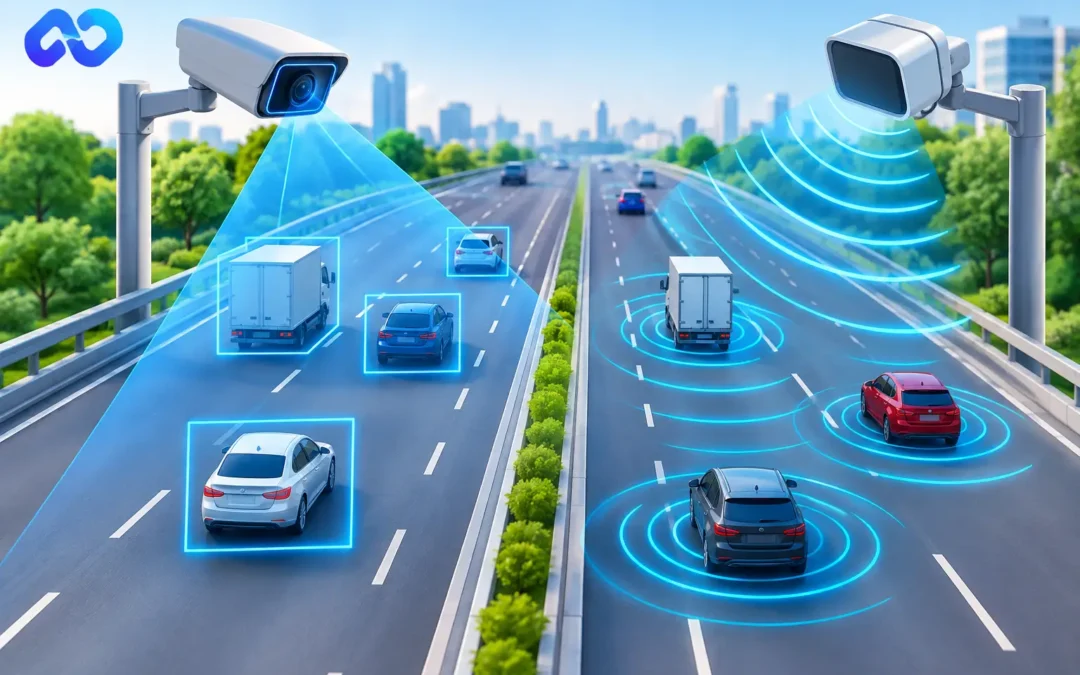
A missed call at a signalised junction is rarely just a detector issue. It can mean unnecessary delay, poor bus priority, cyclists waiting through another stage, and a network that appears less responsive than it should. The decision between AI cameras versus radar therefore needs to start with the operational outcome required, not with a preference for a particular sensor type.
Both technologies provide non-intrusive, above-ground detection that avoids the disruption, lane closures and recurring maintenance associated with inductive loops. Yet they collect different evidence from the road environment. Radar measures movement and range exceptionally well. AI video interprets a scene, identifying road users and traffic conditions in ways radar alone cannot. The right choice depends on what the controller, safety scheme or traffic management team needs to know – and how reliably it must know it in that location.
AI Cameras Versus Radar: The Core Difference
Radar detects objects using reflected radio waves. For traffic applications, this enables measurement of presence, range, speed and direction. A radar detector can monitor approaching traffic over a defined zone, provide advance detection for signal control, and distinguish moving road users with strong consistency across day and night conditions.
An AI camera uses video imagery and machine-learning models to detect, classify and track objects within its field of view. It can identify vehicles, cyclists and pedestrians, while also providing richer situational information such as queue extent, turning movements, lane occupancy and potentially stopped vehicles. Its value is not simply that it can “see” the junction. It can translate a view of the junction into usable traffic data and control inputs.
This distinction matters during specification. If the requirement is reliable approach speed and vehicle presence at distance, radar is often a direct and efficient answer. If the requirement includes mode-specific detection, queue measurement, turning counts or safety analytics, AI video is likely to offer more useful data.
Where Radar Performs Best
Radar is particularly effective where detection must remain dependable through darkness, glare and changing light. It does not depend on visible contrast in the same way as a camera. This makes it well suited to high-speed approaches, rural junctions, signal-controlled crossings and priority applications where advance warning and accurate speed measurement are central to the control strategy.
For example, on an approach to a signalised junction, radar can detect an approaching vehicle well before it reaches the stop line. That information can support more responsive stage selection, reduce wasted green time and help maintain progression along a corridor. In speed-sensitive locations, it can also provide the speed and range data needed for speed activation or driver feedback systems.
Radar’s focused detection zones are also useful where the controller requires clear, dependable calls rather than broad scene interpretation. It can operate in rain, fog and low light, although severe environmental conditions, mounting position and the presence of large reflecting objects must still be considered. No sensor is immune to poor siting.
Its limitation is context. Radar can identify movement patterns and, depending on the device and configuration, offer classification capability. However, it does not provide the same visual understanding of a complex scene as AI video. Distinguishing a cyclist from a small motorcycle, understanding a turning movement, or measuring a queue across several lanes may require information that radar alone cannot provide with sufficient confidence.
Where AI Video Adds More Value
AI-powered cameras are strongest where a scheme needs detailed road-user classification and wider junction intelligence. At an urban junction, for instance, an AI video detector can be configured to identify cyclists in an approach lane, pedestrians at a crossing, vehicles in designated lanes and queues extending towards an upstream junction.
This makes video particularly valuable for active travel schemes, complex signalised junctions and locations where traffic engineers need more than a binary demand input. A properly configured system can support cyclist priority, pedestrian demand, bus lane monitoring, queue management and turning-movement analysis from the same field of view.
AI video also gives engineers a practical route to richer data without installing multiple road-embedded sensors. The ability to understand lane use and movement by class supports evidence-led scheme reviews. It can reveal whether a long wait is caused by genuine demand, blocked exits, poor lane discipline or an ineffective control plan.
However, video performance depends on the quality of the image and the suitability of the installation. Low sun, headlamp flare, shadows, heavy rain, snow, condensation on the lens and obscuration by large vehicles can affect detection. Modern AI models can manage many of these challenges far better than earlier video systems, but they do not remove the need for careful camera positioning, appropriate lighting assessment and ongoing verification.
Detection Accuracy Is a System Question
Comparisons between technologies often focus on headline accuracy figures. In practice, useful accuracy depends on the complete installation: mounting height, viewing angle, detection-zone design, road geometry, controller interface, local traffic behaviour and maintenance access.
A camera mounted too low may lose sight of cyclists behind queuing vehicles. A radar mounted without regard to roadside furniture or adjacent lanes may detect traffic outside the intended approach. At a skewed junction, a narrow field of view may be insufficient for video tracking, while a poorly defined radar zone may create unwanted calls.
The question for specifiers should be: what is the consequence of a missed detection or a false call? For a minor vehicle-actuated side road, occasional additional demand may be tolerable. For a cyclist detection system at a high-risk junction, a missed call can directly undermine safety and user confidence. For a coordinated urban corridor, repeated false calls can reduce capacity and compromise progression.
Performance criteria should therefore be tied to the application. Define the road users to be detected, the detection distance, the lanes or areas involved, expected speeds, operating periods and the response required from the control system. This creates a measurable basis for selecting and commissioning the detector.
Weather, Lighting and Road Geometry
Radar has a clear advantage where lighting is difficult or highly variable. It continues to operate after dark and is less affected by direct sunlight, making it a strong option for demanding all-weather vehicle detection. It is also valuable where the detector needs to cover a long approach without relying on a clear visual image.
AI cameras have their own advantages in constrained urban environments. Their wide-area coverage can reduce the number of separate detection points needed, particularly where several modes and movements must be assessed. But they need an unobstructed view of the relevant road space. Trees in leaf, street furniture, parked vehicles, temporary works and high-sided lorries can all change the scene over time.
Site surveys should consider seasonal change as well as the conditions visible on the day. A camera view that is clear in winter may be partially obscured by foliage in summer. A radar installation that performs well during free-flow traffic may need adjustment when queuing traffic regularly occupies adjacent lanes.
The Case for Combined Detection
For many schemes, AI cameras versus radar is the wrong framing. The strongest solution is often AI cameras and radar, each used where its detection characteristics add value.
Radar can provide dependable approaching-vehicle detection and speed data, while AI video supplies classification, queue information and coverage for vulnerable road users. At a complex junction, this combination can give the controller both the certainty of targeted approach detection and the context needed to manage multiple modes safely.
A hybrid approach also provides useful resilience. Where a camera’s view is temporarily compromised by glare or an obstruction, radar can maintain a critical vehicle input. Where radar identifies an object but the control strategy needs to know whether it is a cyclist, car or pedestrian, AI video can provide the classification layer.
This is not an argument for adding technology without purpose. Each detector should address a defined operational need. Unnecessary inputs can complicate commissioning and fault finding. The objective is a detection design that is simpler for the controller to act on, even when the sensing technology behind it is more capable.
How to Specify the Right Technology
Start with the traffic problem, then work back to the detector. Consider whether the scheme needs vehicle presence, speed, classification, queue length, turning movements, pedestrian demand or cyclist priority. Identify the decision that the controller or operator will make from each input.
Next, assess the site. Road alignment, approach speed, signal pole locations, lighting, roadside clutter, likely occlusion and available communications will all influence the choice. Above-ground systems can be installed far more quickly than road-embedded detection, but proper design and commissioning remain essential to achieve the intended result.
Finally, plan for validation. Detection zones should be tested against real traffic conditions, including peak queues, darkness and the road users the scheme is intended to serve. Record acceptance criteria at the outset so that installers, engineers and maintenance teams share the same definition of success.
The best detector is not the one with the longest feature list. It is the one that supplies reliable, actionable information at the point where the network needs to make a better decision – helping traffic move efficiently while giving every road user the detection they should expect.