
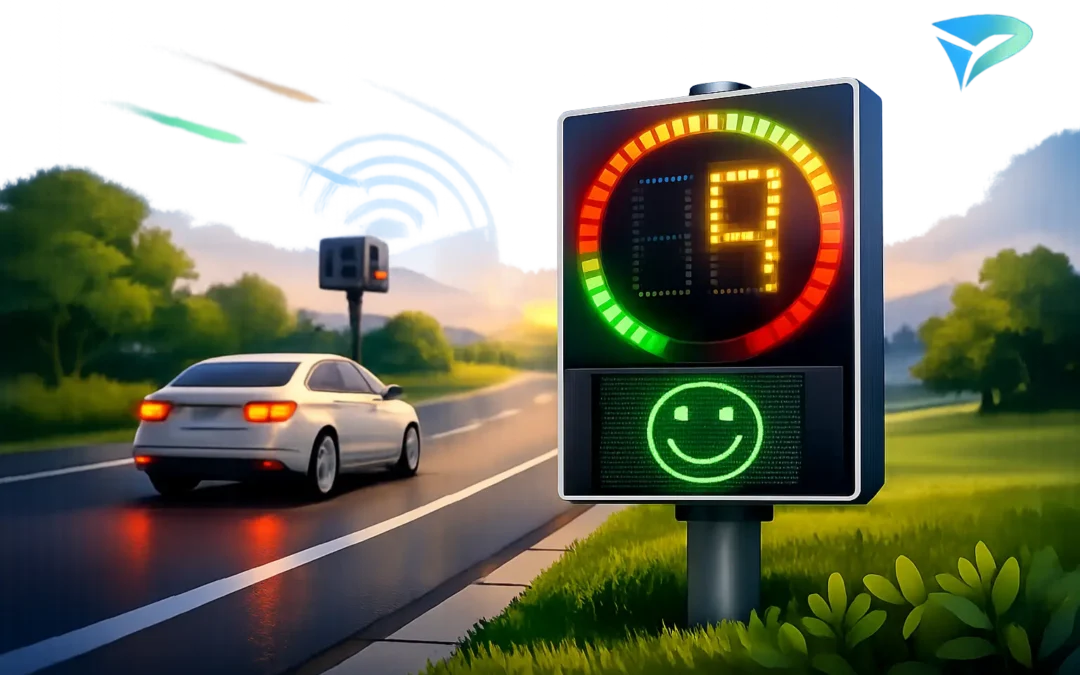
A speed information display sign is often judged in the first few days after installation. If average approach speeds drop, drivers respond and complaints ease, the scheme is seen as a success. If speeds remain stubborn, visibility is poor or the sign generates little useful data, it quickly becomes another roadside asset with limited operational value. For highways teams and road safety professionals, that difference usually comes down to specification, siting and how well the sign fits the actual traffic problem.
What speed information display signs are designed to do
Speed information display signs are used to influence driver behaviour at the point of approach. The principle is simple enough: detect an oncoming vehicle, measure its speed, and present a clear visual message that prompts the driver to slow down. In practice, however, performance depends on more than showing a number in red.
The most effective signs combine accurate detection with clear, legible display logic and a deployment strategy tied to a specific road safety objective. That might be reducing speeds outside a school, improving compliance at village gateways, addressing repeated complaints on a distributor road or supporting a wider speed management programme. When the objective is clear, the sign can be selected and configured properly. When it is not, expectations often become unrealistic.
These signs are not a substitute for enforcement, and they are not intended to solve every speeding issue in isolation. Their role is to provide an immediate behavioural prompt, particularly where driver inattention or poor speed awareness is part of the problem. On the right site, that can be very effective.
Why some speed information display signs perform better than others
There is a tendency to treat all speed display signs as broadly similar. For specifiers and network managers, that is rarely a safe assumption. Detection quality, display brightness, trigger logic, housing durability, power management and data capability all affect operational performance.
Detection accuracy matters first. If a sign reacts late, misses vehicles or displays inconsistent speeds, driver confidence in the message is reduced. On roads with mixed traffic, including cycles, buses and heavy vehicles, the detection technology must cope with varying approach speeds and vehicle profiles. Radar-based systems are often preferred because they can be installed above ground with minimal disruption and configured for reliable speed measurement without cutting into the carriageway.
Visibility matters just as much. A sign that is technically accurate but poorly positioned, obscured by roadside furniture or difficult to read in strong daylight will have limited value. Display design needs to suit the road environment. Some locations benefit from a simple speed roundel response, while others require a clearer warning message for drivers who are consistently entering too fast.
Then there is the question of persistence. Some signs deliver a short-term reduction in speeds after installation, then become part of the background. That does not make them ineffective, but it does mean the wider strategy matters. Rotation between sites, integration with data-led monitoring, and periodic review of activation settings can help maintain impact.
Choosing the right sign for the road environment
The correct specification depends heavily on road type, traffic mix and the problem being addressed. A lightly trafficked rural approach with a visible speed transition presents a different challenge from a busy urban corridor where drivers are reacting to multiple signals, parked vehicles and pedestrian activity.
On lower-speed local roads, the key requirement is often visibility and behavioural reinforcement. Drivers may not be intentionally speeding; they may simply be carrying excess speed into a settlement or past a sensitive frontage. In those cases, a well-sited sign with a bright display and dependable activation can support lower mean speeds and improve local compliance.
On higher-speed approaches, detection range and message timing become more critical. If the sign activates too late, the driver has less opportunity to respond smoothly. If it activates too early or too often, the message loses authority. The ideal set-up depends on prevailing speed, sight lines and approach geometry.
For schemes near schools, active travel corridors or village entries, there may also be a broader policy objective. The sign is not only reducing speed at one point; it is contributing to a safer, more self-explaining road environment. In these cases, the technical choice still matters, but so does how the sign complements other measures rather than competing with them.
The value of non-intrusive installation
For many authorities and contractors, the installation method is not a secondary detail. It directly affects programme risk, traffic management requirements, maintenance exposure and carbon impact. This is one reason above-ground technologies have become increasingly attractive.
Traditional road-embedded systems can involve carriageway intervention, lane closures and future maintenance complexity. By contrast, non-intrusive speed information display signs with above-ground detection can often be deployed faster and with less disruption to road users. That matters on busy routes where access windows are tight and where repeated interventions carry operational and safety consequences.
There is also a whole-life consideration. A sign that can be installed, adjusted and maintained without disturbing the road structure gives asset owners greater flexibility. If a site needs optimisation after deployment, that can usually be done more efficiently than with embedded infrastructure.
For transport professionals balancing safety outcomes with practical delivery constraints, this is not a marginal advantage. It can be the difference between a scheme that is straightforward to implement and one that is delayed by civil works, possession requirements or avoidable complexity.
Data turns a sign into a traffic management tool
A speed display sign can be treated as a standalone behavioural device, but that approach misses part of its value. Where data capture is available, the sign becomes a source of evidence for scheme validation, stakeholder reporting and future network decisions.
This is particularly useful where local concern is high and decision-making needs to be grounded in measured traffic conditions rather than anecdotal reports. Speed data before and after deployment can show whether the sign is changing driver behaviour, at what times non-compliance is most common, and whether further intervention is justified.
For councils and highways teams, that evidence supports a more disciplined approach to road safety investment. It can help distinguish between sites that need engineering, sites that need monitoring and sites where a visible behavioural measure is enough. It also strengthens communication with elected members and communities who want to see a practical response.
The quality of that data still matters. If detection is unreliable or reporting is limited, the sign may offer reassurance without giving a solid basis for evaluation. A well-specified system should support operational learning, not just roadside presence.
Common specification mistakes
The most common mistake is buying for the headline function rather than the operational requirement. A sign that displays speed is not necessarily a sign that will perform well on a specific site.
Underspecifying detection is a frequent issue, especially where the road carries mixed traffic or where geometry is less forgiving. Another is poor placement. Even a good sign can underperform if mounted where the approach is cluttered, where drivers see it too late or where adjacent features dilute the message.
There is also a tendency to overlook maintenance and asset management. Power source, battery performance, remote access, enclosure quality and ease of configuration all affect how sustainable the installation will be over time. For authorities managing multiple sites, these operational details become increasingly important.
A further mistake is expecting a sign to act as enforcement by another name. It will influence many drivers, but not all. Where excessive speeding is persistent and deliberate, a speed information display sign may still be worthwhile, but it should be positioned as part of a wider intervention rather than the sole answer.
When a speed information display sign is the right choice
These signs are particularly useful where the objective is to prompt immediate speed awareness without introducing intrusive infrastructure or lengthy installation programmes. They are well suited to targeted safety schemes, complaint-led interventions, village approaches, schools and corridors where modest speed reduction can produce meaningful safety benefit.
They are less compelling where the core issue is not speed awareness but broader road design, poor alignment, limited visibility or behaviour that requires formal enforcement. That is why site assessment remains essential. Good results usually come from matching the technology to a clearly understood problem, not from treating signs as a default fix.
For technically informed buyers, the best deployments tend to share the same characteristics: reliable above-ground detection, clear display logic, minimal installation disruption, and data that helps verify the outcome. That is where specialist traffic technology providers such as C & T Technology bring practical value – not simply in supplying equipment, but in aligning it with real network conditions and measurable objectives.
The useful question is not whether speed display signs work in general. It is whether the sign, detection method and site strategy are right for the road in front of you. Get that right, and a relatively compact roadside asset can make a visible difference to driver behaviour and give you stronger evidence for the next decision.