
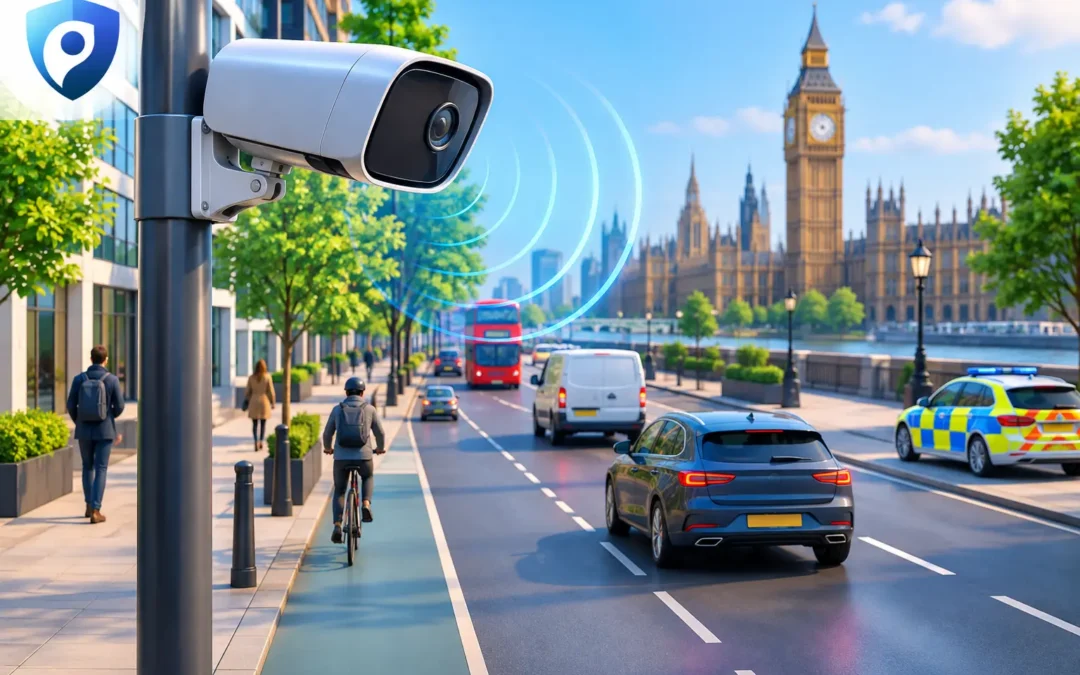
A detector failure at an urban junction is rarely just a maintenance issue. It can leave side-road traffic waiting unnecessarily, extend pedestrian delay, weaken cycle priority or force engineers to make operational decisions from incomplete data. UK urban radar deployment gives authorities a practical route away from road-embedded detection, providing above-ground measurement that can be installed and maintained without repeated carriageway intervention.
For local authorities and their delivery partners, the attraction is not radar for its own sake. It is dependable presence, approach and speed data that supports safer, more efficient operation on streets where space, traffic mix and public expectations are continually changing. The most successful deployments begin with the operational problem – then select, position and configure the detector to answer it.
Why urban detection needs a different approach
Urban networks are difficult detection environments. A single site may carry buses pulling away from stops, general traffic queuing across a stop line, cyclists filtering towards an advanced stop line, pedestrians waiting at a crossing and delivery vehicles stopping close to the junction. Detection must work within restricted sight lines, street furniture, parked vehicles and changing traffic conditions.
Inductive loops can provide effective detection, but their location in the carriageway introduces an unavoidable operational burden. Installation or repair requires surfacing intervention, traffic management and a return visit whenever the road is resurfaced or the loop is damaged. On heavily used routes, those works can create congestion, noise and disruption out of proportion to the small component being repaired.
Above-ground radar changes the maintenance model. Mounted on a signal pole, lighting column or dedicated mast, the detector can be accessed without cutting the road surface. This can reduce installation programmes, avoid reinstatement risk and preserve a recently resurfaced carriageway. It also gives teams more flexibility when junction layouts, cycle facilities or signal staging are altered.
That advantage should not be treated as an automatic specification decision. Radar must still be selected against the required detection zone, road geometry, controller interface and intended traffic modes. A unit well suited to vehicle approach detection may not be the right answer where detailed classification or positive pedestrian detection is the primary requirement.
What a UK urban radar deployment should achieve
A well-designed UK urban radar deployment should deliver an operational outcome that can be observed and measured. For a signal junction, that may mean accurately extending green time for an approaching vehicle, cancelling an unused stage, detecting queue presence or providing a speed input for safety interventions. On a corridor, it may mean collecting approach speeds and traffic volumes to identify where delay or risk is concentrated.
Radar is particularly valuable where reliable detection is needed over a defined area rather than at a single point in the road. Configured detection zones can distinguish approaches, monitor moving traffic and identify stationary or slow-moving vehicles, depending on the product and application. This makes it useful for junction control, warning systems, speed management and traffic studies.
For authorities progressing active travel schemes, radar can also form part of a wider detection strategy. Bicycle-capable radar provides a non-intrusive option where a cycle lane, crossing approach or shared corridor needs demand-responsive operation. The key question is not simply whether the device can detect cyclists. Engineers need to assess detection consistency at lower speeds, zone placement, interactions with adjacent traffic and the way an activation is translated into signal control.
Data quality matters as much as detection. A traffic count that cannot distinguish the direction of travel, a speed dataset distorted by poor positioning, or an occupancy measure that does not reflect actual queues will not support sound scheme decisions. Clear acceptance criteria should therefore be agreed before installation, including what is being detected, where, at which speeds and how results will be validated.
Start with the operational case, not the device
The strongest schemes are specified from a site survey and a defined use case. A busy signalised junction and a neighbourhood speed reduction scheme may both use radar, but they require different detection behaviour, mounting positions and outputs.
Junction control and demand management
At a junction, the design team should establish whether the objective is presence detection, extension detection, queue management or advance approach detection. These functions have different consequences for zone length and placement. A detector configured too far from the stop line may call a demand before a vehicle has committed to the movement. Set too close, it may not give the controller sufficient time to respond effectively.
Queue detection needs particular care in urban environments. Vehicle queues do not always form neatly within a lane, especially near bus stops, loading areas or filtered cycle movements. Site observations at different times of day are essential. They reveal whether vehicles stop in the intended zone, whether adjacent movements create unwanted detections and whether a pole-mounted view can be maintained after new signs or vegetation are introduced.
Speed management and road safety
Radar speed measurement can support speed indication displays, targeted monitoring and evidence-led road safety interventions. On streets with vulnerable road users, the value lies in understanding real approach behaviour rather than relying solely on periodic observations.
The installation position should represent the behaviour being measured. A device located too close to a junction may record acceleration away from the signals rather than approach speeds. On a street with parking activity, the detection field must also be arranged to minimise irrelevant returns from manoeuvring vehicles. These details are not minor commissioning adjustments – they determine whether the data can be used with confidence.
Cycling and mixed-traffic environments
Cyclists challenge simplistic detection assumptions. Their lower speed, varied road position and ability to filter through queues mean that a vehicle-focused zone can miss the moment that matters operationally. A cycle detection design should consider the actual path riders take, including entry into an advanced stop line, approach to a crossing and movement through segregated infrastructure.
There are sites where radar is an excellent answer and others where AI-powered video detection provides more useful scene understanding. Video can support detailed object classification and tailored zones where the environment is complex, while radar offers dependable performance without relying on visual contrast or lighting in the same way. Combining technologies can be appropriate where the control strategy demands complementary strengths rather than a single detector doing every job.
Installation benefits only count when commissioning is rigorous
Non-intrusive installation can reduce disruption, but quick installation should never mean rushed configuration. Mounting height, angle, lateral position and the surrounding street scene influence radar performance. A pole that appears convenient may introduce obstruction from signal heads, signs, mature trees or turning vehicles.
Commissioning should include live observation of representative traffic movements, not only a desktop review of configured zones. The team should test free-flowing traffic, queues, slow-moving vehicles, buses where relevant and cyclists where they are in scope. It is also sensible to review performance at night and in poor weather where the site has known operational sensitivities.
Integration requires equal attention. Engineers need confirmation of power arrangements, communications, controller compatibility and fail-safe behaviour. A detector can be technically accurate but operationally ineffective if the controller logic does not use its output in the intended way. Documentation should record final zones, settings, interfaces and validation results, giving maintenance teams a reliable baseline for future changes.
Measuring whole-life value on the street
The value of above-ground detection is often most visible over the life of the asset. Fewer carriageway cuts can mean fewer lane closures, less reinstatement work and fewer occasions when a fault affects both detection and the road surface. For a network manager, that can reduce risk to road users and roadworkers while helping protect network availability.
There is also a sustainability case. Avoiding repeated excavation reduces the material, vehicle movements and disruption associated with roadworks. More responsive signal operation can reduce avoidable delay and idling, although outcomes depend on the wider signal strategy, traffic demand and junction capacity. Radar should be treated as an enabling technology, not a substitute for sound traffic engineering.
C & T Technology supports this approach by pairing above-ground detection technology with practical application knowledge. The objective is not to replace one legacy component with another. It is to give traffic teams usable detection and reliable data that improves decisions at the kerbside, at the controller and across the network.
A productive next step is to identify the urban sites where loop failures, planned resurfacing, unreliable cycle detection or recurring maintenance closures are already creating operational pressure. Those locations provide the clearest opportunity to test whether a carefully specified radar solution can deliver safer roads, reduced congestion and a more sustainable maintenance approach.