
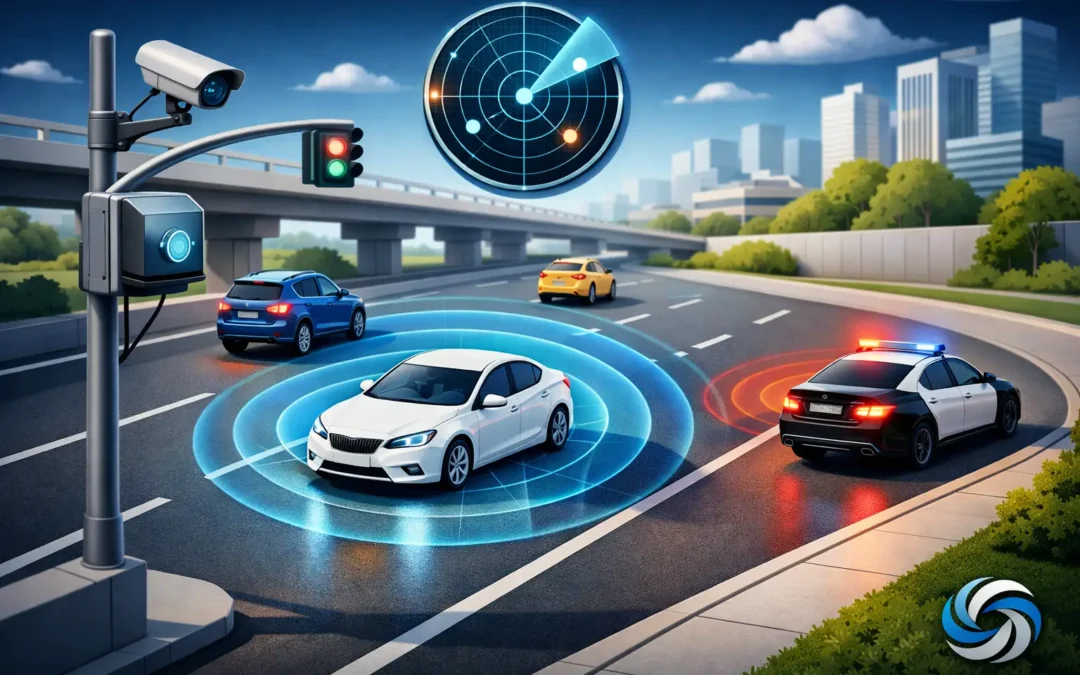
A missed vehicle call at a signalised junction is not a minor technical defect. It can extend delay, encourage risky manoeuvres, reduce confidence in active travel provision and undermine the performance of an otherwise well-designed junction. This guide to radar traffic detection explains how above-ground radar can provide dependable presence, approach and speed data without the road closures, reinstatement risk and maintenance burden associated with inductive loops.
What radar traffic detection does
Traffic radar transmits radio waves and analyses the returned signal from moving or stationary road users. Depending on the unit, its configuration and its location, radar can detect approaching vehicles, maintain a presence call in a defined zone, measure speed, estimate range and direction, and distinguish broad classes of road user.
For traffic control, the key point is that radar is not simply a speed-measurement device. A suitably specified detector can create virtual detection zones over one or more lanes, allowing a signal controller or traffic management system to receive the information it needs at the appropriate time. That might be an extending call for an approaching vehicle, a demand on a side road, confirmation that a queue has cleared, or an alert where a vehicle is travelling at an unsuitable speed.
Because the sensor is mounted on a pole, mast arm or other roadside structure, installation avoids cutting the carriageway. This is particularly valuable where resurfacing is planned, lane possessions are difficult to obtain, or the site contains utilities and legacy loop infrastructure of uncertain condition.
How radar detection works in practice
Most traffic radar systems use Doppler and frequency-modulated continuous-wave principles to determine a target’s movement, range and relative speed. The detector processes reflections and applies configuration rules to identify targets within defined areas. These areas are often referred to as zones, and can be shaped to match lanes, stop lines, approach paths or conflict areas.
A detector may be configured to ignore traffic beyond a set range, reject targets travelling in the wrong direction, or focus on a particular lane. This matters at constrained urban junctions, where traffic on adjacent arms, bus lanes or parallel carriageways must not create false calls. The ability to define zones in software gives engineers greater flexibility than a fixed loop cut, but it does not remove the need for careful design.
Radar is often deployed for vehicle detection at signal-controlled junctions, pedestrian crossings with vehicle actuation, roundabout approaches, rural side roads, bridge and tunnel approaches, speed management schemes, queue monitoring and cycle detection applications. It can also support data collection where agencies need an evidence base for scheme design, safety reviews or performance monitoring.
Presence, passage and advance detection
These functions are frequently confused, yet they place different demands on the detector.
Presence detection confirms that a road user remains in a zone. At a stop line, it can prevent a demand from dropping out while a vehicle waits for a green signal. Passage detection records a target moving through a point or short zone. It is useful for counts and certain operational triggers, but it does not prove that a vehicle remains at the stop line.
Advance detection gives the controller time to respond before the vehicle reaches the junction. The required distance depends on approach speed, signal strategy, gradient, lane use and the controller’s intergreen requirements. A high-speed rural approach may require an earlier and more stable call than a congested urban approach, where queues, turning traffic and short headways dominate.
Where radar is the right choice
Radar is particularly effective where maintaining the road surface is costly or disruptive. A replacement scheme can often be delivered without saw-cutting, trenching or reinstating loops, reducing both time on site and exposure to traffic management risk. For authorities managing ageing loop assets, this can materially improve whole-life resilience.
It also performs well in poor light and adverse weather conditions that can challenge some visual technologies. Rain, fog and darkness do not prevent radar from detecting vehicles in the way they can affect conventional camera-based detection. That said, radar is not automatically the best answer for every detection task.
Where detailed classification, pedestrian movement, turning-path analysis or visual verification is essential, AI video may provide richer information. At complex sites, a combined approach can be the strongest option: radar delivers consistent vehicle detection and speed data, while video supplies detailed scene understanding. The correct choice depends on the operational decision that the data must support, rather than on the sensor type alone.
Cyclists require particular consideration. Their smaller radar cross-section, variable position within the lane and lower speeds mean that the detector, mounting arrangement and zone design must be suitable for the intended cycling movement. A product capable of bicycle detection should still be validated at the actual site, especially where cycles share carriageway space with larger vehicles or approach at oblique angles.
A guide to radar traffic detection specification
A good specification starts with the traffic problem, not a product description. Define what must be detected, where it must be detected, how quickly the output is required and what should happen when detection occurs. A detector that produces an accurate speed value may still be unsuitable if it cannot maintain a reliable stopped-vehicle call at the stop line.
For each approach, establish whether the operational requirement is presence, passage, advance call, queue measurement, speed thresholding or a combination of these. Then consider lane geometry, approach alignment, speed environment, road user mix, adjacent traffic and potential sources of unwanted targets. A detector looking across several lanes may need more careful zone separation than one covering a single straight approach.
The following specification questions are worth resolving before installation:
- What road users must be detected: cars, buses, lorries, motorcycles, cyclists or a defined combination?
- Is stationary detection required, and for how long must the call be held?
- Which lanes, directions and approach distances require independent zones?
- What output or communications interface is needed for the signal controller, sign or data platform?
- Is the detector required to support speed data, counts, classification or remote configuration as well as control?
- What mounting height, offset and field of view are achievable without obstructing signs, signals or maintenance access?
The answers should be translated into measurable acceptance criteria. For example, state the lane coverage, target type, detection range, response time and integration behaviour required at the controller. This gives installers, suppliers and maintenance teams a common basis for testing and reduces the risk of a system being judged only by whether it powers up.
Mounting and geometry determine performance
The most capable radar detector cannot compensate for poor sight lines or unsuitable mounting geometry. Height, lateral offset, tilt, aiming angle and distance from the detection area all affect target separation and zone accuracy. These considerations are especially important where a detector must distinguish a nearside cycle lane from general traffic, or detect vehicles waiting close together in multiple lanes.
A site survey should identify poles, mast arms, trees, signs and street furniture that could obstruct the radar field or complicate access. It should also assess approach curvature, gradients, road surface changes and nearby metal structures. Guardrails, parked vehicles and large roadside signs can create reflections or masking effects in certain geometries, so configuration should be based on observed traffic conditions rather than a drawing alone.
Installation teams should have a clear commissioning process. This normally includes confirming the physical alignment, setting zones, observing live targets in each lane, checking call outputs at the controller and testing likely edge cases. HGVs in adjacent lanes, turning traffic, cyclists, queues and vehicles travelling away from the junction can all reveal whether the detection logic is properly tuned.
Integration, maintenance and data value
For signal applications, radar must integrate cleanly with the controller strategy. The design should define whether outputs are volt-free contacts, digital inputs, serial communications or a networked interface, together with fail-safe behaviour and fault reporting. A detector installation is only useful if the controller receives a stable, intelligible input and responds as intended.
Above-ground detection simplifies maintenance because equipment can usually be accessed without opening the carriageway. It also makes later adjustment more practical when traffic patterns change following development, active travel schemes or signal timing reviews. However, non-intrusive does not mean maintenance-free. Sensors should be inspected for alignment, physical damage, contamination, power integrity and communications health, while configuration records should be retained for future support.
The data generated by radar can support more than immediate control. Speed distributions, directional counts, occupancy indicators and classified movements can help traffic teams identify recurring congestion, assess scheme outcomes and prioritise interventions. The quality of that evidence depends on the original configuration, which is why detection zones and data definitions should be documented from day one.
C & T Technology supports highways teams with radar, AI video and traffic data solutions designed around the practical realities of UK and Irish road networks. The most effective deployments begin with a clear operational objective, then match the sensor, mounting arrangement and integration method to that objective.
A well-planned radar installation does more than replace a failed loop. It gives the network a more adaptable way to see approaching traffic, respond to actual demand and evolve without repeatedly disturbing the road surface.