
A cyclist waiting through two full signal stages at an empty junction is more than a minor annoyance. It is a detection failure that affects compliance, safety and confidence in the network. That is why cycle detection technology for traffic signals has moved from a specialist add-on to a serious design and upgrade priority for authorities aiming to support active travel without compromising operational performance.
For signal engineers and network managers, the issue is rarely whether cyclists should be detected. The real question is how to achieve reliable detection across varied layouts, weather conditions and user behaviours, while avoiding the disruption and maintenance burden associated with road-cutting. That is where above-ground detection has become increasingly valuable.
Why cycle detection at signals is still a live issue
Many junctions were never designed with modern cycling movements in mind. Legacy detection strategies often focused on motor traffic, with cycle demand handled by push-buttons, fixed staging or on-carriageway loops that could be inconsistent in real-world use. For a rider approaching off-centre, stopping outside the loop footprint or using a non-standard cycle type, that can quickly become a problem.
The operational effects are wider than missed calls. Poor cycle detection can increase red-light non-compliance, create hesitation at stop lines and reduce the attractiveness of segregated or semi-segregated cycling routes. At signal-controlled crossings and side-road entries, it can also affect intergreen efficiency and stage optimisation if demand is either under-detected or held too long.
For authorities under pressure to improve safety, reduce congestion and support decarbonisation targets, detection quality matters. A signal strategy is only as effective as the demand data feeding it.
How cycle detection technology for traffic signals works
In practical terms, cycle detection technology for traffic signals is designed to identify the presence, approach, waiting position or movement of cycles at key points in the junction. Depending on the site objective, the system may need to perform one task well or several tasks at once.
At the simplest level, detection can place a demand call when a cyclist enters an approach zone. More advanced setups can extend green if a cyclist is still clearing the junction, distinguish cycles from motor vehicles, or monitor occupancy within an advanced stop area, nearside cycle lane or shared crossing environment.
This is where technology choice becomes important. Inductive loops have historically been used for cycle detection, but they require slots to be cut into the carriageway. Installation brings traffic management, reinstatement work and future maintenance risk. Sensitivity can also vary with loop geometry, pavement condition and the bicycle itself.
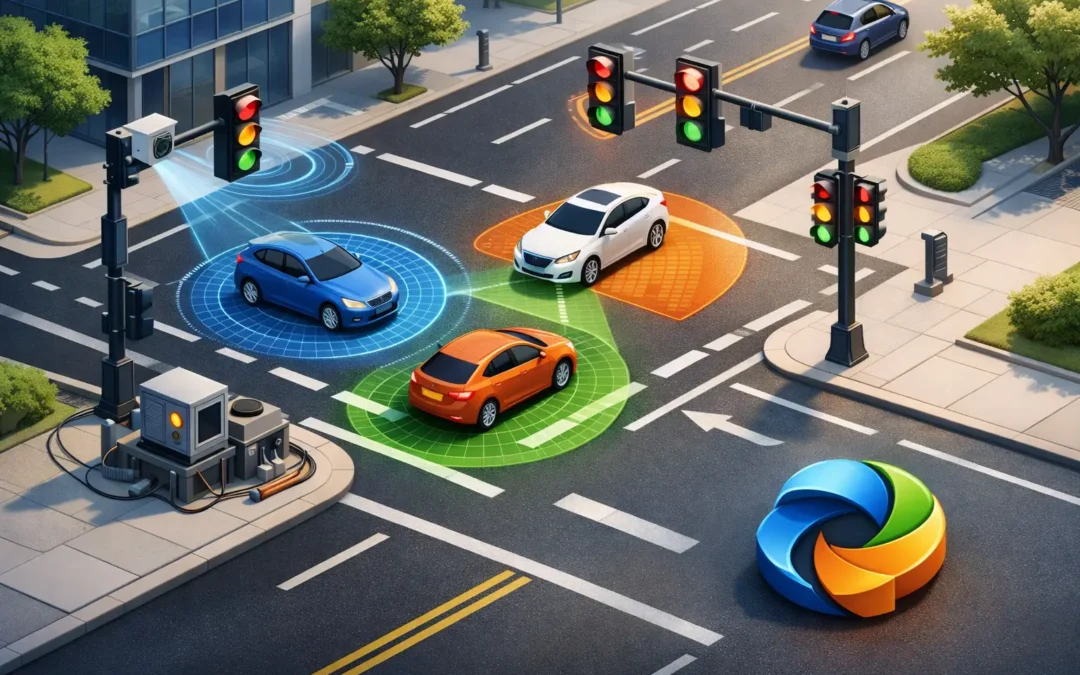
Above-ground alternatives such as radar and AI-enabled video detection avoid those constraints. They can be mounted on poles or signal infrastructure, configured remotely in many cases, and adjusted as layouts evolve. For networks trying to minimise roadworks and shorten deployment programmes, that is a substantial operational advantage.
The main technologies in use today
Radar detection
Radar is particularly effective where reliable presence and movement detection are needed in difficult environmental conditions. It performs well in darkness and is generally less affected by lighting variation than camera-based systems. For cycle approaches, radar can be configured to detect direction, speed and occupancy within defined zones.
That makes it well suited to stop-line detection, advance approach detection and extension logic. It can also be useful where cyclists share space with other road users but need separate detection rules.
The trade-off is that radar performance depends on careful zone setup and a clear understanding of the site geometry. At highly complex urban junctions, detection areas may need careful tuning to avoid unwanted calls from adjacent lanes or crossing movements.
AI-powered video detection
AI video detection adds classification intelligence that can be extremely useful at mixed-mode junctions. Instead of simply registering movement, it can identify bicycles as a distinct class and track them through defined areas. That opens up more nuanced signal strategies, especially where cyclists, pedestrians and vehicles interact in close proximity.
Video can be a strong option for schemes involving cycle gates, early release stages, segregated tracks or complex stop-line arrangements. It also provides visual verification, which helps with setup, diagnostics and post-installation review.
As with any camera-based system, context matters. Lighting, shadows, street clutter and mounting position all influence performance, although modern systems are far more capable than earlier video detection generations. The key is not to specify video in the abstract, but to assess whether the site conditions support dependable classification over time.
Wireless and hybrid detection approaches
In some locations, a hybrid approach offers the best result. Radar may be used for dependable approach detection, while AI video supports classification and analytics. Wireless sensors can also have a role where civil works need to be minimised and temporary or lower-disruption deployment is a priority.
For many authorities, the most effective strategy is not a single detector type used everywhere, but a toolkit that can be matched to junction function, cycling provision and maintenance constraints.
What good cycle detection should achieve
The benchmark is not simply whether a cyclist is detected eventually. Good detection should support a better operational outcome.
At a minimum, the system should identify cyclists consistently across common riding positions and bicycle types, including non-standard cycles where feasible. It should place demands promptly enough to avoid unnecessary waiting and maintain detection reliably at the stop line without forcing riders into an exact position that may be unclear or uncomfortable.
Beyond that, better systems help engineers refine stage logic. A detector that can distinguish a cyclist from a general traffic vehicle allows more precise control of green time allocation. A detector that can measure approach and clearance supports safer, more efficient timings. A detector linked to analytics can show whether the strategy is working as intended.
This is one of the strongest arguments for modern above-ground systems. They are not just substitutes for loops. They can provide richer operational data that supports signal optimisation and longer-term network planning.
Specifying cycle detection technology for traffic signals
Specification should start with function, not product category. The first question is what the signal controller needs the detector to do at that specific site. Is the goal to call a cycle phase, extend green, detect waiting cyclists in a mandatory lane, or differentiate cycles from general traffic on a shared approach?
The geometry then matters. A narrow on-road feeder lane is a very different detection problem from a bidirectional cycle track crossing a side road. Mounting opportunities, line of sight, street furniture, pole position and possible occlusion all need to be considered early. Too often, poor performance comes from trying to force a detector into a location that does not suit the task.
Engineers should also think about future change. Junctions evolve. Kerb lines move, lanes are reallocated and temporary works become permanent layouts. Above-ground systems offer a clear advantage here because detection zones can often be reconfigured without invasive carriageway works.
For UK and Irish authorities working within active travel programmes, this flexibility is particularly useful. Schemes are often delivered in phases, and detection infrastructure needs to keep pace without repeated excavation.
Installation, maintenance and whole-life implications
Detection performance is only part of the procurement decision. Installation burden and maintainability matter just as much.
Road-embedded loops still have a place in some applications, but they bring practical constraints. Carriageway cutting requires traffic management, creates disruption and introduces a long-term maintenance interface with the road surface. If the pavement fails or utility works disturb the area, detection reliability can deteriorate.
Above-ground cycle detection reduces those dependencies. Installation is typically faster, less disruptive and safer for operatives because it avoids intrusive road works. Maintenance access is also simpler. Fault-finding, adjustment and replacement can often be carried out without returning to the carriageway with saw-cutting equipment and reinstatement crews.
That shift has network value beyond the detector itself. Less disruption means fewer lane closures, lower exposure to worksite risk and less impact on traffic flow during deployment and maintenance.
A more practical standard for modern junctions
There is no single detector that suits every site. Some junctions need high-confidence stop-line presence detection. Others need classification, analytics or multi-zone logic across separate cycle facilities. The right answer depends on control strategy, geometry and operational priorities.
What has changed is the expectation. Cyclists should no longer be treated as difficult-to-detect edge cases within signal design. Modern cycle detection technology for traffic signals can deliver reliable demand input, support safer staging and reduce dependence on intrusive infrastructure. For authorities serious about network efficiency and active travel performance, that is no longer a future option. It is a practical standard worth specifying properly.
The best results come when detection is treated as part of junction performance, not an isolated hardware choice.