
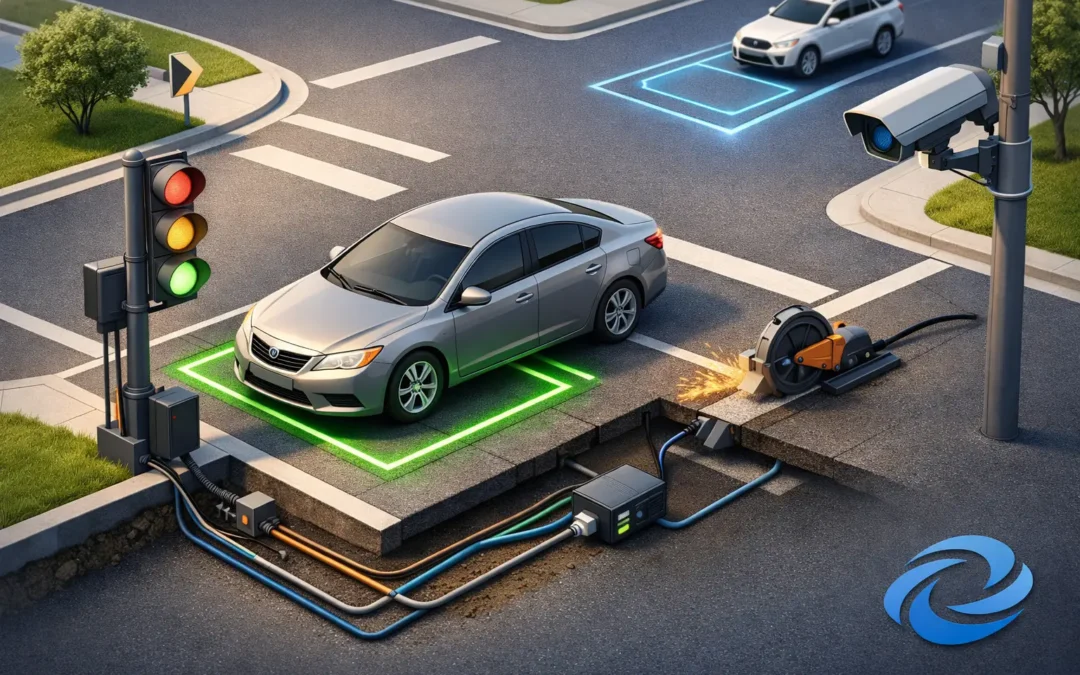
If your loops are failing every winter, missing cyclists at stop lines, or forcing repeat carriageway closures for repair, the question is no longer whether change is needed. It is how to upgrade loop detection in a way that improves operational performance without creating new problems elsewhere in the network.
For most authorities and contractors, this is not just a detector replacement exercise. It affects signal performance, safety, installation risk, maintenance planning and the quality of traffic data feeding wider network decisions. Legacy inductive loops can still perform adequately in some locations, but they bring obvious constraints. They require intrusive installation, they are vulnerable to road surface degradation, and they can be difficult to adapt when layouts, demand patterns or mode priorities change.
Why upgrading loop detection is now a network issue
Loop replacement used to be treated as a local maintenance task. In practice, it has become a wider traffic management issue because detection now has to do more than simply register the presence of a vehicle. Junctions are expected to respond more intelligently, detect multiple modes more reliably and provide better evidence for traffic engineering decisions.
That matters at signalised junctions, puffin crossings, cycle crossings, urban corridors and temporary deployments alike. If detection is inaccurate or unavailable, the result is not only technical underperformance. It can mean unnecessary delay, poor stage extension, unreliable demand response and weaker safety outcomes for cyclists and pedestrians.
Above-ground alternatives such as radar, AI video and wireless sensors have changed the upgrade conversation because they remove the need to cut into the road surface. That reduces disruption, shortens installation time and avoids some of the recurring maintenance burden that comes with road-embedded assets. The trade-off is that the upgrade must be designed properly. Simply swapping one detector for another without reviewing geometry, detection zones, controller integration and operational intent often leads to mediocre results.
How to upgrade loop detection without repeating old limitations
The most effective upgrades start with the function of the site, not the technology. A high-speed approach, a congested urban stop line, a bus-priority junction and a cycle-sensitive crossing do not need the same detection strategy. The first question should be what the detector needs to achieve operationally.
At one site, the priority may be dependable vehicle presence and queue detection for MOVA or adaptive control. At another, the key requirement may be accurate cycle detection at the stop line without false calls from adjacent lanes. Some locations need classification data as well as actuation. Others need a detector that can be installed quickly with minimal traffic management because possession windows are tight.
Once that operational requirement is clear, the upgrade path becomes more straightforward. Radar is often well suited where all-weather performance, lane-specific vehicle detection and non-intrusive installation are priorities. AI video can offer richer scene interpretation and support multimode detection, particularly where cyclists and pedestrians need to be detected in more complex environments. Wireless sensors can be useful where cabling constraints, temporary monitoring or rapid deployment shape the project.
The right answer depends on the site. There is no benefit in specifying a highly capable video detector for a location with difficult sightlines and persistent occlusion if radar can achieve the control objective more reliably. Equally, relying on simple vehicle presence detection where a junction actually needs multimodal awareness can limit the value of the upgrade from day one.
Start with a site audit, not a product choice
A proper upgrade begins with the physical and operational reality of the junction. Review what the existing loops are doing, where they are failing and how that failure affects network performance. Look at lane geometry, stop line position, turning movements, approach speeds, street furniture, mounting opportunities and likely sources of occlusion or interference.
This is also the stage to assess the controller strategy and existing detection logic. If the current loop layout was designed around older traffic patterns or a previous staging arrangement, reproducing it with above-ground detectors may preserve inherited inefficiencies. An upgrade is often the right moment to refine detection zones, add cycle-specific calls, improve queue monitoring or separate conflicting movements more intelligently.
Choose technology around operational outcomes
When considering how to upgrade loop detection, the strongest specifications link technology choice to measurable outcomes. These usually include installation disruption, detection accuracy, maintenance exposure, data quality and flexibility for future changes.
Radar detectors are typically attractive where reliable presence and advance detection are needed in a compact form factor. They can work well in poor light and adverse weather, and they avoid carriageway cutting. Video detection is often selected where visual analytics adds value, such as distinguishing users or defining tailored detection zones in complex urban layouts. Wireless traffic sensors can support rapid installation and reduce civil works, particularly where power and communications can be planned efficiently.
Each option has constraints. Video performance depends heavily on camera placement, scene clarity and ongoing configuration. Radar may be preferable in some conditions but still needs careful alignment and commissioning to avoid unwanted detections. Wireless systems can reduce installation effort but should be reviewed in the context of communications resilience and long-term asset management.
Integration matters as much as the detector itself
One of the most common mistakes in loop replacement projects is underestimating integration. Even the best detector will disappoint if outputs, timings and detection logic are not configured correctly at controller level.
That includes confirming how detector calls map into the control strategy, whether the system needs simple presence, passage, count or classification outputs, and how any new data can be used beyond the immediate junction. A detector upgrade can also be an opportunity to improve traffic analytics, support evidence-based scheme reviews and reduce the gap between local fault response and wider network planning.
For signal professionals, this is where technical support and commissioning experience matter. Zone configuration, filtering, detection hold times and sensitivity settings all affect live operation. So does the relationship between the detector field of view and the intended stop line or approach logic. Good commissioning should verify performance under actual traffic conditions, not just confirm that a detector is powered and communicating.
Plan for maintenance reduction, not just installation speed
Fast installation is valuable, but whole-life performance matters more. The strongest case for above-ground detection is often the reduction in recurrent maintenance interventions associated with failed loops, damaged carriageways and repeated road closures.
That said, reduced intrusion does not mean no maintenance. Pole-mounted equipment still needs inspection, cleaning where relevant, firmware management and occasional recalibration. The practical difference is that these activities are generally safer and less disruptive than returning to the carriageway to reinstate embedded loops.
For local authorities and contractors managing constrained resources, this change can have a significant operational effect. Less time spent coordinating lane closures and reinstatement work means more attention can be given to network optimisation rather than repeat asset repair.
How to upgrade loop detection for cyclists and mixed traffic
This is one of the clearest reasons many authorities are moving away from loops. Traditional loop installations can struggle where reliable cycle detection is needed, especially if geometry, surfacing or legacy design limits sensitivity. At the same time, urban junctions increasingly need better multimodal detection to support active travel and safer control strategies.
Above-ground radar and AI video can improve detection of cyclists in the right application, but only if the detection task is clearly defined. Detecting a cyclist in a feeder lane is different from detecting one at the stop line, in an advanced stop area or on a segregated crossing approach. The detector must be positioned and configured around the actual movement that matters to the control strategy.
Mixed traffic environments also demand careful filtering. You want dependable detection of the intended user without nuisance calls from adjacent lanes, footway activity or parked vehicles. That is why specification detail matters. Better technology helps, but configuration is what turns capability into operational benefit.
Building a stronger business case
For decision-makers, the case to upgrade loop detection is usually based on a combination of safety, network performance, maintenance reduction and sustainability. Intrusive detection means more roadworks, more reinstatement activity and more disruption to road users. Non-intrusive alternatives can reduce all three while improving the quality of the detection itself.
There is also a resilience argument. As road layouts evolve to accommodate bus priority, cycling infrastructure, temporary traffic management and more data-driven operation, above-ground systems are easier to adjust than assets buried in the carriageway. That flexibility matters when authorities want to adapt schemes without starting again every time the detection layout needs to change.
For organisations specifying upgrades across multiple sites, consistency also becomes important. A planned migration away from loops can simplify maintenance strategy, improve standardisation and create better visibility of detector performance across the network.
C & T Technology works with authorities and traffic professionals facing exactly this challenge: replacing ageing loop infrastructure with practical, above-ground detection solutions that improve safety, reduce disruption and support smarter road network operation.
Upgrading detection should leave you with more than a working replacement. It should give you a network asset that is easier to maintain, better aligned to current traffic demands and flexible enough for what comes next.