
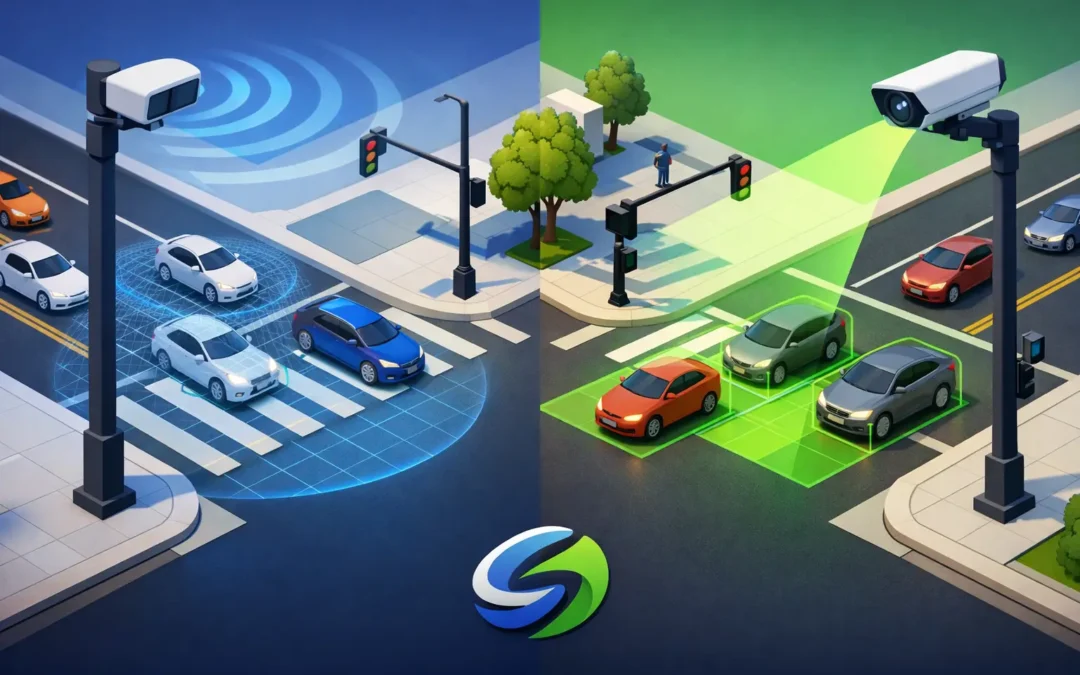
A detector missed call on a busy approach can add seconds to every cycle and quickly turn into a queue problem, a safety problem, or both. That is why radar vs video detection is not a theoretical comparison for traffic engineers. It is a specification decision that affects commissioning time, asset life, maintenance access, detection quality and the confidence operators have in the data.
For many authorities and contractors, the real question is not which technology sounds more advanced. It is which technology will perform consistently on the site in front of them, with the least disruption and the clearest operational benefit. Both radar and video can replace intrusive carriageway detection, but they do not behave in the same way once deployed.
Radar vs video detection: what changes on site?
Above-ground detection removes the need to cut loops into the road surface, which is already a major advantage for safety, installation speed and future maintenance. Within that category, radar and video solve the detection task differently.
Radar sensors transmit radio waves and analyse the returned signal to detect movement, speed, direction and presence. In traffic applications, that makes them well suited to vehicle approach detection, stop line presence, queue monitoring and cycle detection, depending on the sensor and configuration.
Video detection uses a camera feed combined with image processing, increasingly supported by AI-based classification. Instead of reading returned radio signals, it interprets what the camera sees. That opens up richer scene understanding, including distinction between cars, vans, lorries, cyclists and pedestrians where the software and field of view support it.
This difference matters because the strengths and weaknesses of each system come directly from the physics and processing method behind it.
Where radar performs best
Radar is often the more forgiving option where the objective is dependable vehicle detection in difficult environmental conditions. Low light, headlight glare, fog and many wet-weather scenarios tend to be less disruptive to radar than to camera-based detection. For strategic detection zones such as approaches, advanced warning, speed-responsive control or simple presence detection, radar can offer stable performance with comparatively low sensitivity to visual clutter.
It is also strong where the scene is operationally simple but the consequences of missed detection are significant. A rural junction, for example, may not need rich visual analytics. It may need reliable approach detection across multiple lanes with minimal maintenance visits and no carriageway intervention. Radar fits that brief well.
Another practical strength is that radar generally asks less of the mounting environment in terms of image quality. A camera needs an appropriate viewing angle, sufficient contrast and a scene that remains interpretable across day and night conditions. Radar still needs correct alignment and setup, but it is not dependent on visible scene quality in the same way.
That said, radar is not automatically the better answer on every site. If the requirement extends beyond presence and movement into detailed classification or visual verification, its advantages become more specific and its limitations more obvious.
Where video detection has the edge
Video detection is attractive when the network problem is not just detection, but understanding. At complex urban junctions, crossings and shared spaces, the ability to differentiate between road users can be operationally valuable. If a controller strategy needs separate responses for motor traffic, cyclists and pedestrians, a well-specified video system may provide a richer input than radar alone.
This is particularly relevant in locations where active travel infrastructure is being expanded and authorities need more than binary call detection. AI video can support classification, turning movement analysis, occupancy assessment and wider traffic data capture from the same field of view. For teams trying to improve network performance while also collecting evidence for scheme design, that broader dataset can be useful.
Video also offers one advantage that operations teams often value during commissioning and fault investigation: visibility. When an engineer can review what the detector is seeing, zone placement and behaviour are easier to interpret. That can simplify optimisation on complicated junctions where several user groups interact in a constrained space.
The trade-off is that video relies on a clean, usable visual scene. Poor mounting position, lens contamination, low sun, heavy shadowing and severe weather can all influence performance. Modern systems are far better than earlier generations, especially where AI processing is involved, but they are still reading images, not radio returns.
Accuracy depends on the task, not just the sensor
One of the most common mistakes in radar vs video detection discussions is treating accuracy as a single number. In practice, accuracy depends on what you are asking the detector to do.
If the task is vehicle presence on an approach, radar may deliver excellent results with minimal complexity. If the task is distinguishing a cyclist from a motorcycle in a mixed urban scene, advanced video may be more suitable. If the task is queue length estimation across a broad area, either technology may work, but performance will depend on mounting height, geometry, occlusion risk, lane discipline and the quality of commissioning.
Site geometry can change the answer completely. A clear line of approach on a straight arm is very different from a skewed junction with parking activity, bus stops, intermittent lane use and high pedestrian crossing demand. In the first case, radar may be the efficient choice. In the second, video may justify itself because the scene itself is the source of operational complexity.
This is why product selection should start with the traffic objective, not the sensor category. The best detector is the one that solves the control or monitoring problem with the least compromise.
Installation, maintenance and whole-life burden
For authorities moving away from loops, one of the biggest gains is avoiding repeated carriageway works. Both radar and video support that shift, but their maintenance profiles differ.
Radar units are typically compact and focused on a defined detection task. Once installed and aligned correctly, they can offer a relatively low-maintenance solution for many applications. There is no lens image to interpret, no concern about visual sharpness, and generally less sensitivity to lighting changes.
Video systems may require more attention to mounting position, camera angle and cleanliness. A detector that depends on image quality can only perform as well as the scene allows. Tree growth, dirt, vibration and changed street furniture can all affect results over time. None of that rules out video, but it does make asset management more important.
On the other hand, if one video detector can cover several detection zones and provide classification and analytics from the same installation, that broader function may outweigh the extra setup care. It depends whether the authority values simplicity of detection or depth of data more highly on that site.
Weather, lighting and the real UK operating environment
For practitioners in Great Britain and Ireland, weather resilience is not a side issue. It is central to operational performance. Persistent rain, low winter light, surface spray and rapid shifts in visibility all affect detector behaviour.
Radar has a clear advantage where environmental resilience is the priority. It is generally less affected by darkness and visual obscuration, which is why it is often favoured for demanding roadside conditions and safety-led applications where consistent detection matters more than scene interpretation.
Video can perform very well, especially with current AI-enabled platforms, but it still needs a usable image. If a site is regularly affected by glare, shadow, mist or contamination, those conditions should be treated as specification factors rather than afterthoughts. A good camera detector can still succeed there, but only if the mounting strategy and performance expectations are realistic.
Should you choose radar, video, or both?
The strongest answer is sometimes a combined one. Radar and video are not always competing technologies. In some schemes they are complementary.
Radar can provide highly dependable approach or presence detection, while video supplies classification and broader situational analysis. That combination can be particularly effective on junctions where signal responsiveness is critical but planners and operators also need better insight into how different road users are moving through the site.
A hybrid approach is also useful when one part of the junction is visually complex and another is environmentally harsh. Rather than forcing one technology to cover every requirement, the better engineering decision may be to use each where it performs best.
For specifiers, the key questions are straightforward. What must be detected? Which road users matter? What failure modes are acceptable? How easy is access for maintenance? Is the aim only actuation, or also analytics and evidence gathering? Once those questions are answered properly, the technology choice becomes much clearer.
Making the right specification decision
Radar vs video detection should be decided in the context of network outcomes, not product categories. If the need is resilient, non-intrusive detection with strong performance in difficult conditions, radar is often the practical answer. If the site demands richer classification, visual context and multi-user analysis, video may offer more value. Where both needs exist, combining them can produce the strongest operational result.
For traffic authorities, engineers and contractors, the priority should be a detector strategy that reduces disruption, improves reliability and supports better control decisions over time. That means looking beyond headline features and specifying around the realities of the junction, crossing or corridor being managed.
The right detection technology is the one that keeps the network working when conditions are less than ideal, because that is when the quality of the specification really shows.