
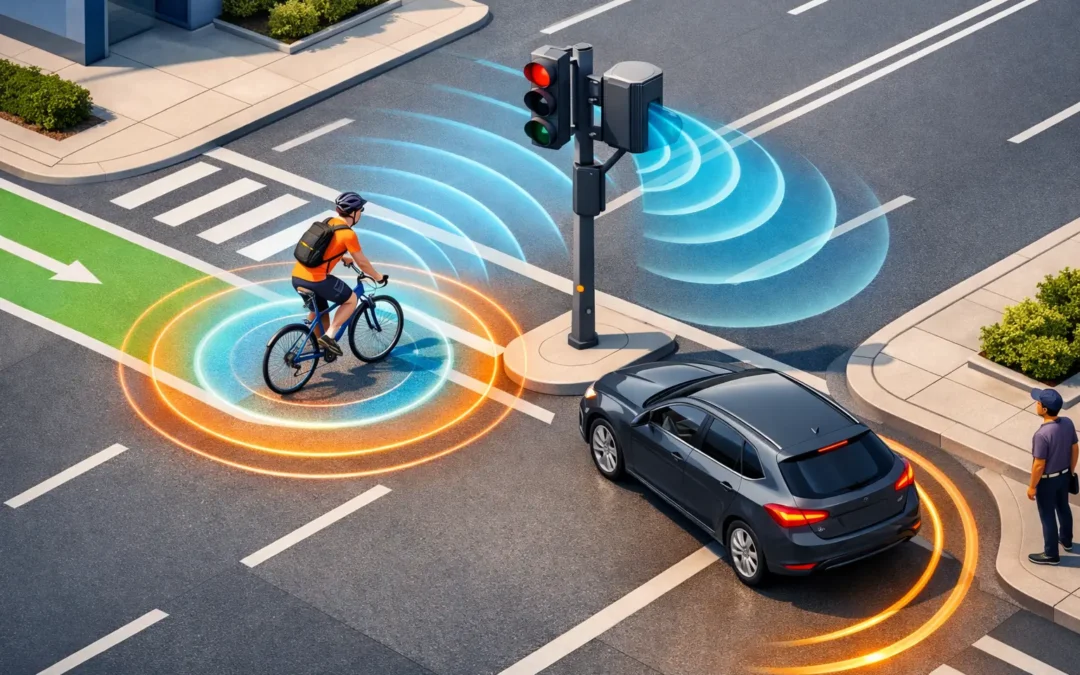
A missed cycle call at a signalised junction is not a minor detection issue. It can mean a rider waiting through multiple stages, taking risks to clear the junction, or being overlooked entirely by a control strategy that was designed around motor traffic. That is why radar bicycle detection at junctions is gaining attention from highways teams looking for more reliable, non-intrusive detection that reflects how people actually move through the network.
For many authorities, the challenge is familiar. Inductive loops can degrade, be damaged by resurfacing, or fail to detect certain bicycle types consistently. Junction layouts evolve, cycling infrastructure is retrofitted, and signal control plans become more dependent on responsive demand. In that context, above-ground radar offers a practical route to better cycle detection without cutting the carriageway every time a site needs to be upgraded.
Why radar bicycle detection at junctions matters
Junctions are where detection performance matters most because the consequences of poor performance are immediate. If a cyclist is not detected on approach, they may not receive a stage extension, an early release, or a demand call at all. If they are detected too late, green time may be inefficiently allocated or the rider may still be left exposed in the intergreen period.
Radar addresses a specific operational problem. It continuously monitors defined approach areas and can identify moving cyclists before they reach the stop line. That gives traffic signal systems a better chance to respond in time, particularly where cycle approaches are segregated, offset from the carriageway, or shared with other light traffic modes.
The safety case is also clear. Better approach detection supports more predictable signal behaviour, reducing uncertainty for cyclists and improving compliance. At busy urban junctions, where interactions between cycles, buses, general traffic and pedestrians are tightly managed, the value of accurate bicycle presence data is not theoretical. It affects delay, stage efficiency and user confidence every day.
How radar bicycle detection works in practice
Above-ground radar units are typically mounted on poles or existing street furniture with a clear view of the approach. Rather than relying on a bicycle to disturb a loop buried in the road surface, the sensor monitors movement within configured detection zones. Those zones can be shaped and tuned to the geometry of the site, the approach speed, and the required call distance.
That flexibility is one of radar’s main strengths. At a straightforward signal approach, the detector can be configured to register cyclists early enough to place a demand or hold a stage. At more complex junctions, it can distinguish between relevant approach paths and adjacent movements that should not trigger the signal logic.
Performance depends on correct design and commissioning. Mounting height, alignment, approach angle and background clutter all matter. So does the control philosophy. A detector may be technically accurate, but if the signal timings do not make effective use of that data, the operational benefit will be limited. Detection should be considered as part of the wider junction strategy, not as a stand-alone component.
Where radar performs well
Radar is particularly effective where road authorities want to avoid civil works, where loop maintenance has become a recurring cost, or where cycle infrastructure has been added after the original signal installation. It also suits sites where approaches need to be monitored over a longer detection area rather than only at the stop line.
This is useful for advanced stop line approaches, segregated cycle tracks, side-road crossings and junctions with variable rider behaviour. Cyclists do not all approach at the same speed, and they do not all occupy the same lateral position. Radar can be configured to reflect that reality more effectively than a fixed embedded loop arrangement.
Where it needs careful assessment
Radar is not a universal answer for every geometry. Dense urban environments can introduce reflectivity challenges, street furniture can obstruct line of sight, and mixed-mode corridors may require careful zone definition to avoid unwanted calls. In some cases, a combined approach using radar and video detection may be the better fit, especially where authorities also want classification, visual verification or pedestrian analytics.
The point is not that one technology always replaces another in every case. It is that radar gives specifiers a strong above-ground option in locations where traditional embedded detection creates cost, disruption or performance limitations.
The installation advantage over inductive loops
For many engineers, the strongest argument for radar bicycle detection at junctions is not only detection quality. It is deployment practicality. Installing or replacing loops means cutting into the road surface, managing lane closures, reinstating the carriageway and accepting the risk that future maintenance or resurfacing will affect performance again.
Radar avoids that cycle. Installation is faster, less disruptive and easier to coordinate within constrained urban programmes. That matters when authorities are under pressure to deliver active travel improvements quickly while keeping junction downtime to a minimum.
There is also a sustainability angle. Reducing excavation, reinstatement materials and traffic management activity can lower the environmental burden associated with detection upgrades. For local authorities balancing network performance with carbon reduction commitments, above-ground detection is increasingly aligned with broader programme objectives.
What highways teams should specify
Good procurement starts with the operational need. Is the requirement simply to register bicycle presence at the stop line, or is it to detect cyclists on approach with enough time to influence stage selection or extension? Is the cycle route segregated, shared, bidirectional or intermittent through the junction? Those questions shape the correct sensor choice and placement.
Detection zone configurability should be high on the specification list. Junction environments change, and the ability to fine-tune zones without invasive works is valuable over the life of the asset. Reliable integration with existing signal controllers is equally important, as is access to commissioning support and performance validation.
Authorities should also ask practical questions about maintenance and resilience. How easy is the unit to align after impact or pole replacement? Can settings be adjusted remotely or only on site? What happens in poor weather, low-light conditions or high-density traffic conditions? A good detector does not just perform in a demonstration. It performs through the realities of year-round network operation.
Measuring success at the junction
The best case for radar is usually built from outcomes, not specifications alone. If a site upgrade reduces missed cycle demands, shortens unnecessary waiting time and improves stage responsiveness without cutting the carriageway, the operational value is evident. Those benefits are measurable through call rates, delay analysis, controller logs and site observation.
It is also worth looking beyond the single junction. When authorities standardise on non-intrusive detection technologies, they gain programme-level advantages in maintenance planning, installation consistency and future adaptability. Junction upgrades become easier to phase, and detection assets are less exposed to carriageway deterioration.
For consultants and contractors, that can simplify delivery risk. For local councils and transport authorities, it can support a more credible long-term strategy for cycle priority and network modernisation.
A smarter fit for modern cycle infrastructure
Cycle provision at junctions is becoming more varied, not less. Parallel crossings, early release stages, hold-the-left arrangements, stepped tracks and protected intersections all place different demands on detection. Legacy methods designed primarily around general traffic are often a poor fit for that complexity.
Radar gives engineers more freedom to detect cyclists where they actually travel rather than where a loop happened to be cut years ago. That is a significant shift. It supports signal operation that is more responsive to current street design, and it reduces the dependency on road-embedded assets that are costly to alter.
For specialist suppliers such as C & T Technology, the opportunity is not simply to provide a detector. It is to help authorities specify, deploy and optimise above-ground detection in a way that improves safety, reduces congestion and cuts installation disruption.
Junctions rarely fail because of one dramatic flaw. More often, they underperform through small compromises that accumulate over time. Better bicycle detection is one of the clearest places to remove those compromises and make the junction work as intended for every user.