
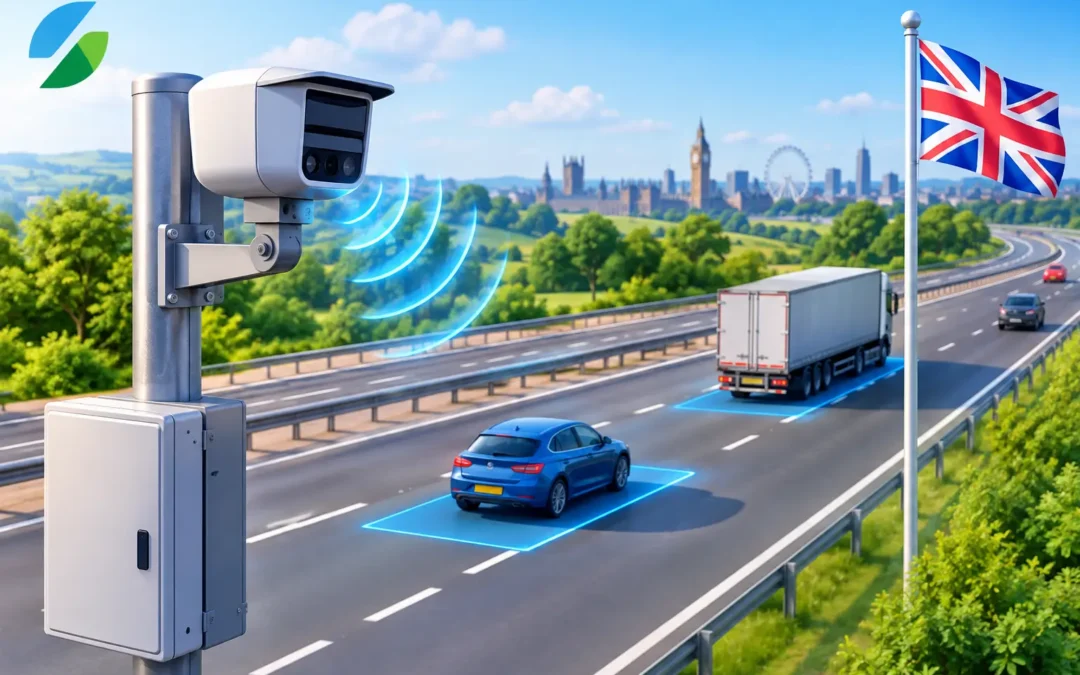
A detector specified only by its published accuracy figure can still fail a scheme. If it cannot interface reliably with the controller, withstand its roadside environment, provide usable data or meet the highway authority’s acceptance requirements, the operational benefit quickly disappears. UK roadside detector standards are therefore not one checklist. They are a framework of statutory requirements, traffic signal specifications, highway authority standards and project-specific performance criteria.
For transport authorities and designers, the objective is straightforward: select detection that supports safe, responsive control without creating unnecessary civil works, lane closures or future maintenance exposure. Above-ground radar, AI video and wireless sensing can meet that objective well, but only when the specification tests the right things.
What UK roadside detector standards actually cover
There is no single British Standard that certifies every detector as suitable for every road. Compliance must be considered at several levels, beginning with the equipment itself and extending to how it performs in a live traffic management system.
At product level, equipment placed on the market must meet the relevant UK regulatory requirements. Depending on the technology and how it is connected, this can include electrical safety, electromagnetic compatibility and radio equipment requirements. Wireless sensors and radar systems need particular attention: radio performance and spectrum use are not minor procurement details, especially where several devices operate close together or where a site contains other communications equipment.
At installation level, the detector, mounting arrangement, cabling, communications and controller interface must be suitable for the highway environment. At system level, the authority needs confidence that the equipment will deliver its intended function: vehicle presence at a stop line, an approaching cyclist, queue length, gap detection, speed measurement, classified count data or a safety-related alert.
The distinction matters. A radar may be technically compliant as radio equipment, for example, while still being unsuitable for a junction if its detection zones cannot be configured to exclude adjacent lanes, crossing movements or roadside clutter.
Signal-controlled junctions need defined interfaces
For schemes connected to traffic signals, the starting point should be the authority’s controller and signal installation requirements. BS EN 50556, covering road traffic signal systems, is relevant to the wider signal system context, alongside the applicable local authority or National Highways specifications and approved product requirements.
The specification should state how the detector will communicate with the controller. A volt-free contact, digital input, serial connection or network interface each has different implications for fault monitoring, configuration, resilience and maintenance. It should also define the required operating states. A simple call demand is not the same as continuous presence, and neither is the same as an extend, queue or speed-related input.
For each detection function, define the detection area, target road users, output logic and permissible response time. A vehicle detector at a stop line may require reliable occupancy during the complete red period. An approach detector used for extension needs stable, timely detection at the specified distance. A cycle facility may need to detect an individual cyclist without repeatedly calling traffic from an adjacent general-traffic lane.
These details are more useful than a generic requirement for high accuracy. They make acceptance testing measurable and reduce the risk of late-stage changes to mounting positions, zones or controller configuration.
Detection must reflect the user and movement
Legacy inductive loops have often been treated as the default reference point for vehicle actuation, but they are not always the best measure of what a modern junction needs to know. They cannot readily distinguish a cyclist from a car, identify an extended queue upstream or support multiple detection zones without additional installation work.
Above-ground detection can provide more information, but it introduces different design considerations. Video detection requires a clear, stable field of view and practical management of glare, headlamp flare, shadows, weather and occlusion. Radar performs well in poor visibility and can accurately measure range and speed, but its field of coverage must be designed to avoid unintended detections. The right choice depends on the movement being managed, the available mounting infrastructure and the consequence of a missed or false detection.
Where vulnerable road users are part of the control strategy, specifications should be explicit. A general statement that cyclists or pedestrians must be detected is not sufficient. Define where they must be detected, whether a stationary user must be held, how long a call must persist and how performance will be witnessed on site.
Roadside installation standards are operational standards
A detector can be non-intrusive without being installation-free. Columns, poles, brackets and cabinets need to be assessed for structural suitability, cable routes and electrical protection need to be planned, and access must be safe for installation and future inspection.
For highway works, project documentation commonly draws on the Manual of Contract Documents for Highway Works and the relevant authority requirements. The Traffic Signs Regulations and General Directions may also shape a scheme where detection is part of a signed or signal-controlled arrangement. The exact document set varies by road authority and contract, which is why a detector schedule should never be copied from a previous scheme without review.
A practical roadside specification should address mounting height and orientation, detector setback, power source, communications method, enclosure protection, earthing arrangements where applicable, and access restrictions. It should state whether the installation must be completed without carriageway excavation or lane closures beyond agreed traffic management. That is a legitimate performance requirement, not merely a contractor preference.
Non-intrusive technology is particularly valuable where loop cutting would affect a newly resurfaced carriageway, a bridge deck, a waterproofed structure, utility-dense ground or a high-traffic route where closures carry a disproportionate network cost. The trade-off is that sightlines and mounting positions must be designed early rather than treated as a final installation detail.
Data, video and cyber requirements cannot be an afterthought
Detection is increasingly specified for data as well as control. Traffic count, classification, speed, occupancy, queue and active travel data can support asset planning, road safety work and network management. To be useful, the data definition must be agreed before procurement.
Specify the measurement interval, vehicle classes, direction of travel, timestamps, data retention, export format, validation method and treatment of missing records. A classifier that places cars, vans and lorries into broad categories may be entirely suitable for a strategic count, but inadequate for a scheme evaluating freight restrictions or bus priority.
For video systems, data protection responsibilities must be considered at design stage. The use of video analytics does not remove the need for a lawful purpose, proportionate camera positioning, retention controls and clear responsibilities for access to recorded imagery. Where personal data is processed, the authority’s governance arrangements and the Information Commissioner’s Office guidance should inform the deployment.
Connected detectors also need an agreed cyber posture. Set out ownership of credentials, permitted remote access routes, update procedures, logging, network segregation and the process for addressing vulnerabilities. A detector that is accessible for remote diagnostics may reduce site visits, but it should not become an unmanaged entry point into operational technology.
Build acceptance testing into the specification
Factory evidence is useful, but roadside acceptance is where performance becomes real. The commissioning plan should test representative traffic conditions, not just a quiet demonstration vehicle driven through a zone once.
For junction detection, tests may include stationary and moving vehicles, lane discrimination, turning movements, cyclists, buses and lorries where relevant, plus behaviour during adverse light or weather conditions. The test should confirm both detector outputs and the resulting controller response. A correctly detected vehicle is of limited value if the configured input does not extend a stage or register presence as intended.
Define fault behaviour as well. The authority needs to know what happens when communications are lost, a camera view is obscured, a wireless sensor battery approaches end of life or a detector is restarted. Safe fallback depends on the application. At a lightly used junction, a failed demand may create avoidable delay; at a safety-critical crossing movement, the impact can be more serious.
Acceptance criteria should include maintainability. Configuration files, zone drawings, as-fitted records, controller input schedules and fault indications should be handed over in a form that maintenance teams can use. This is where technically capable suppliers add value: commissioning should leave the authority with an understandable, supportable system rather than a black box.
Specify the outcome, then prove it
The strongest UK roadside detector standards are outcome-led. They state what the network needs to achieve – reliable calls, safer cycle movements, lower delay, accurate counts or reduced disruption – then set the technical and test requirements needed to prove it.
That approach gives engineers room to move beyond road-embedded loops where a radar, AI video detector or wireless sensor is the better operational choice. More importantly, it ensures that a faster installation also delivers dependable control and data long after the traffic management has been removed.