
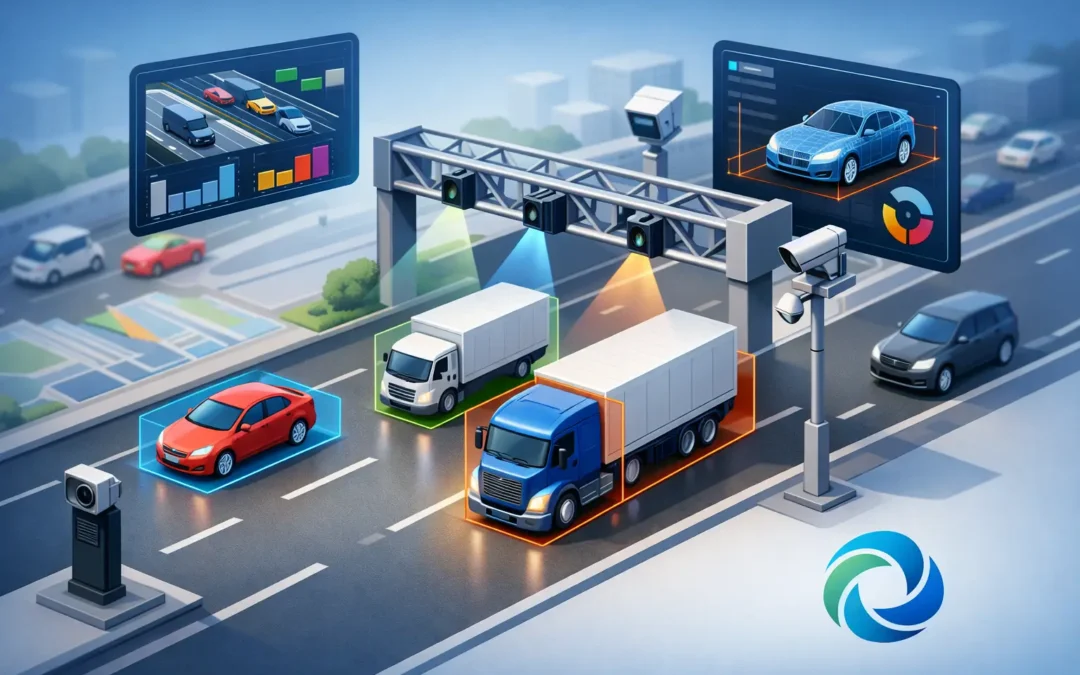
A miscount at a junction does not stay on a spreadsheet. It shows up in poor signal timings, missed capacity issues, weak funding cases and road safety interventions aimed at the wrong problem. That is why traffic counter and classifier systems matter far beyond simple vehicle totals. For authorities and network operators, the quality of count and classification data directly affects how well the road network is understood and managed.
The shift in recent years has been clear. Legacy detection methods, particularly road-embedded systems, can still serve a purpose, but they often bring disruption, traffic management requirements and long-term maintenance complications. For many applications, above-ground detection now offers a more practical route to reliable traffic intelligence, especially where authorities need faster deployment, lower intervention on the carriageway and better coverage of mixed road users.
What traffic counter and classifier systems actually do
At a basic level, traffic counter and classifier systems record how many vehicles pass a point. In practice, the better systems do considerably more than that. They identify classes of road user, separate cars from vans, buses and lorries, and in many cases detect cyclists and pedestrians as well. Depending on the technology used, they may also capture speed, direction of travel, lane occupancy, headway and turning movements.
That broader dataset is what turns a count into operational intelligence. A network manager looking at daily flow alone may spot growth on a corridor. A manager with classification and speed data can see whether the issue is commuter traffic, freight activity, school-related demand or a shift in cycling volumes. The intervention changes accordingly.
This is particularly relevant where networks are under pressure from multiple policy demands. Authorities are expected to keep traffic moving, improve safety, support active travel, reduce emissions and justify investment decisions with evidence. A simple tube count or occasional manual survey may not be enough where the network is changing quickly or where multimodal movement needs to be understood in more detail.
Why classification quality matters as much as count accuracy
A total count can look acceptable while the underlying classification is poor. That creates risk. If larger vehicles are undercounted, pavement wear assumptions and freight impact assessments may be distorted. If cyclists are missed at side roads or crossings, scheme design may fail to reflect real demand. If pedestrian movement is not captured accurately, signal strategies and safety improvements can be built on incomplete evidence.
The trade-off is that classification is harder than counting. Weather, low light, occlusion, lane discipline and road geometry all affect performance. On congested urban networks, closely spaced vehicles can challenge some sensor types. On higher-speed roads, the issue may be tracking vehicles consistently across lanes or distinguishing similar vehicle profiles.
This is where technology choice matters. The right system is not simply the one with the longest feature list. It is the one suited to the site, the survey objective and the operational environment. A temporary survey on a rural road has different requirements from permanent monitoring on a signalised urban corridor.
Traffic counter and classifier systems by technology type
Above-ground systems generally fall into a few main categories, each with strengths and limitations.
Radar-based detection is often well suited where dependable vehicle presence, speed and movement data are needed without cutting into the road surface. It performs well in many weather conditions and can support both temporary and permanent deployment. Depending on the sensor and application, radar can also be effective for cycle detection, which is increasingly important on urban approaches and controlled crossings.
AI video detection adds another layer of intelligence. A well-positioned video system can classify multiple road users, monitor turning movements and cover more complex layouts than simpler point-based detection. This can be especially useful at junctions, shared spaces and sites where authorities need richer behavioural data, not just flow totals. The consideration is that camera placement, line of sight and scene complexity need proper assessment to achieve consistent results.
Wireless traffic sensors are attractive where rapid deployment and minimal civil works are priorities. They can help reduce installation time and avoid the disruption associated with embedded loops. For many authorities, that installation advantage is not a side benefit. It is central to whether a monitoring project is viable at all.
No single technology is best for every site. A straightforward speed and count application may suit radar. A complicated junction with buses, cyclists, pedestrians and turning analysis may justify AI video. In some cases, a mixed approach is the most sensible option.
Where these systems deliver the most value
The strongest use case for traffic counter and classifier systems is not data collection for its own sake. It is better decision-making.
For signal teams, reliable classification data helps refine staging, demand responsiveness and junction performance analysis. If a detector can distinguish cyclists from motor traffic, that can support more responsive control strategies and improve the balance between efficiency and safety.
For road safety teams, count and classification data helps validate whether a perceived issue is actually a pattern. Speeding concerns on a route may be linked to low traffic volumes at certain times rather than all-day conditions. A corridor with recurring collisions may reveal specific interactions involving turning traffic, larger vehicles or vulnerable road users.
For local authorities and consultants developing business cases, higher-quality evidence strengthens the case for intervention. Whether the project involves a crossing upgrade, traffic calming, active travel provision or corridor optimisation, good traffic data reduces guesswork. It also improves post-scheme evaluation, which is increasingly important where schemes need to demonstrate measurable outcomes.
For contractors and delivery partners, above-ground systems can simplify deployment and reduce programme risk. Avoiding invasive carriageway works often means fewer traffic management complications, less exposure on site and faster commissioning.
Replacing embedded loops is often about operations, not fashion
There is sometimes a tendency to frame new detection technology as a straightforward replacement cycle. In reality, the move away from inductive loops is usually driven by operational pressures.
Loops can be effective, but they are tied to the road surface. Installation and repair require intervention in the carriageway. That means disruption, added safety considerations for crews and ongoing vulnerability where surfaces deteriorate or where utility works disturb the pavement. For authorities managing busy networks, those factors matter as much as raw detector performance.
Above-ground alternatives change that equation. They can reduce installation impact, shorten deployment times and lower the maintenance burden associated with buried assets. They also offer greater flexibility where junction layouts change or where monitoring needs evolve. If a site is likely to be reconfigured, a detection solution that can adapt without cutting back into the road has a clear advantage.
That does not mean every loop should be removed or every site should be treated the same way. Some existing infrastructure remains serviceable and appropriate. But for new schemes, renewals and temporary monitoring, non-intrusive detection is increasingly the more practical specification.
What to assess before specifying a system
The first question is not which product to buy. It is what decision the data needs to support. If the aim is annual average daily traffic, the specification may be relatively simple. If the aim is signal optimisation, active travel monitoring or safety analysis, the data requirements become more demanding.
Site conditions then need careful review. Road geometry, lane arrangement, street furniture, lighting, speed environment and likely occlusion all affect sensor choice and placement. A detector that performs well on a straight single carriageway may not be the best fit for a compact urban junction with buses stopping nearby and cyclists filtering through traffic.
Data integration is another practical issue. A high-performing sensor still needs to fit into the authority’s wider workflow. That means considering how data is accessed, exported, visualised and used by operational teams. Systems that support efficient analysis often deliver more value than those that simply generate large volumes of raw data.
Support also matters. Detection performance does not begin and end with hardware. Correct configuration, validation and ongoing technical advice can make a significant difference, particularly on more complex sites. This is where specialist suppliers such as C & T Technology add value beyond product supply alone, helping authorities align detection capability with traffic management outcomes.
Better evidence leads to better roads
Traffic counter and classifier systems are not just counting tools. Used properly, they are part of the evidence base behind safer roads, reduced congestion and more sustainable network management. The best systems help authorities see what is actually happening on the network, not what assumptions suggest ought to be happening.
For decision-makers under pressure to improve performance with limited disruption, the strongest choice is usually the one that combines dependable detection, practical deployment and data that can stand up to scrutiny. When the data is right, traffic management becomes less reactive and far more precise. That is where these systems prove their value.