
A signal junction repeatedly calls a pedestrian phase with no pedestrian present. A rural route needs classified counts before a speed-reduction scheme is designed. A contractor needs reliable detection through temporary works by Monday morning. These are all traffic sensing requirements, but they do not call for the same deployment model. The fixed versus portable traffic sensors decision should be based on the operational question, required data confidence, site constraints and how long the information must remain useful.
For highways authorities and transport professionals, the choice is rarely simply permanent versus temporary. It is a decision about continuity, installation risk, access to power and communications, maintenance exposure, and whether the resulting data can support a control decision, a scheme design or an enforcement-led intervention. Above-ground radar, AI video and wireless sensing technologies have made both approaches more capable, without the disruption associated with road-embedded inductive loops.
What separates fixed and portable traffic sensors?
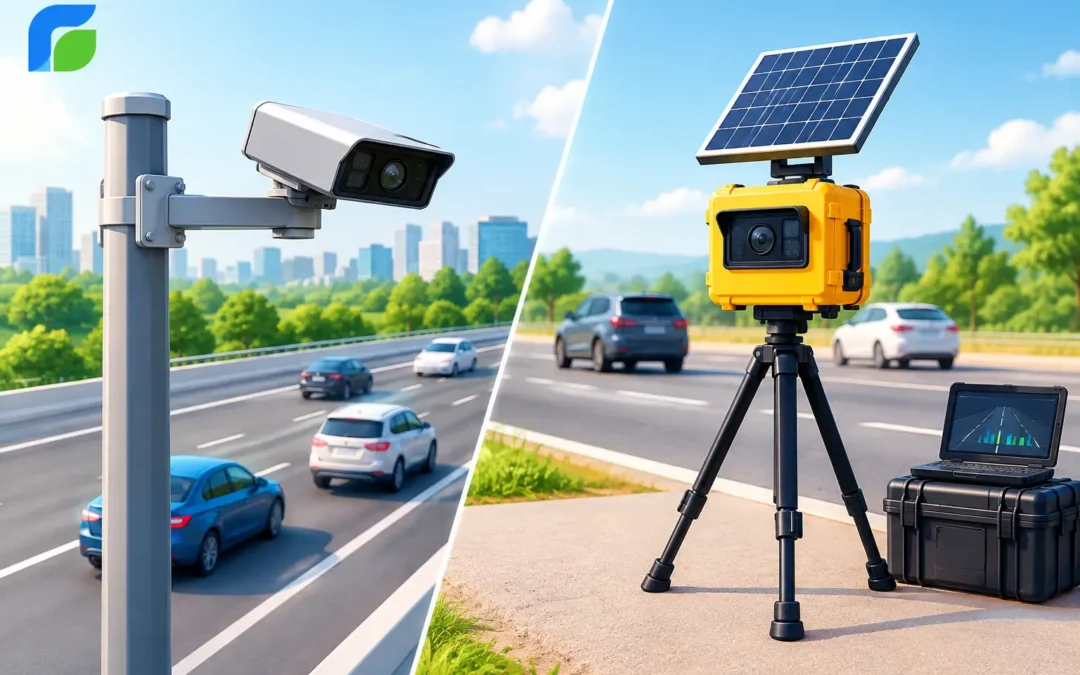
Fixed traffic sensors are installed for an extended period, often as part of a traffic signal installation, permanent monitoring point, active travel scheme or strategic route management system. They are typically pole-mounted or installed on existing roadside infrastructure, with planned power, communications and maintenance arrangements. Their value lies in consistent, long-term detection and an established position within a wider control or data platform.
Portable traffic sensors are designed to be deployed, moved and recovered with minimal civil works. They may be battery-powered, solar-assisted or use temporary power, and commonly transmit data wirelessly. Their strength is speed: a site can be monitored for a survey, trial, temporary traffic management arrangement or targeted investigation without closing a lane to install loops or cutting into the carriageway.
Both can use radar or video-based detection. The meaningful distinction is not necessarily the sensing principle. It is the deployment architecture and the level of permanence needed to deliver a reliable operational outcome.
Fixed versus portable traffic sensors: start with the decision
The most useful specification question is: what decision will this detection support?
Where a detector is expected to influence signal stage demands, extend a green period, provide queue presence, prioritise buses or identify cyclists at a junction, fixed sensing is normally the appropriate route. The data must be available whenever the controller needs it, in all expected operating conditions. Detection zones, mounting position, communications resilience and integration with the controller all require deliberate design.
For short-duration traffic counts, before-and-after surveys, event monitoring or rapid validation of a known problem, portable equipment can provide the evidence far more quickly. A portable radar unit can record approach speeds, volumes and vehicle classes without placing operatives in the carriageway. A temporary video analytics installation can reveal turning movements, queue formation and vulnerable road user activity where existing data is insufficient.
There is also a middle ground. A portable sensor may first establish whether a location warrants intervention, after which a fixed system supports the completed scheme. This staged approach avoids making a permanent investment based on assumptions or a limited manual survey.
Data continuity matters more than headline accuracy
Accuracy is essential, but it should be assessed in the context of the data task. A short survey may tolerate small gaps if it is used to identify broad daily patterns. A permanently monitored junction cannot tolerate intermittent missed calls that affect safety, capacity or user confidence.
Fixed installations provide the strongest basis for continuous datasets. Over weeks, months and years, they can expose seasonal variation, school-term effects, diversionary traffic, recurring congestion and changes following network interventions. This continuity is particularly valuable where authorities need to demonstrate the performance of a scheme or establish a defensible baseline before works begin.
Portable systems provide a detailed snapshot. That can be enough, provided the survey period is representative. A count collected during school holidays, abnormal weather, roadworks or a local event may not reflect normal demand. The answer is not always to install permanent equipment. It may be to extend the temporary survey, repeat it at another time of year or combine it with historic data from nearby sites.
Sensor placement has equal importance. Radar requires a clear and suitable field of view for its configured lanes and detection zones. AI video requires appropriate mounting height, scene coverage and management of glare, shadows, occlusion and night-time conditions. Whether a sensor is fixed or portable, a poorly positioned unit can produce misleading data with great consistency.
Installation disruption and safety at the roadside
Non-intrusive sensing changes the balance of risk. Conventional loops often require carriageway cutting, lane closures, reinstatement and future disruption when loops fail. Above-ground sensors avoid these activities, reducing exposure for installation teams and limiting the impact on road users.
Portable sensors offer the fastest route where access windows are limited or the network cannot tolerate intrusive works. They are well suited to temporary traffic management, works compounds, diversion routes and locations where a survey must begin quickly. Their flexibility also makes them valuable for investigating emerging issues, such as reports of excessive speed or unexpected queueing.
Fixed sensors require more up-front planning, but this should not be confused with slow delivery. Pole-mounted radar and video detectors can often be installed without excavation, particularly where suitable street furniture and power are already available. The key is to assess structural suitability, sight lines, cable routes, communications and safe maintenance access before selecting the device.
At exposed roadside sites, physical security also deserves attention. Portable units need secure mounting and an agreed inspection regime. Fixed installations benefit from a location that protects the equipment from accidental impact while preserving the required detection view.
Power, communications and maintenance shape whole-life performance
A permanent sensor is only as useful as its connection to the system that needs its data. Signal control applications may require direct controller interfaces and reliable communications. Strategic monitoring may require secure transmission to a cloud platform or central traffic management environment. These dependencies should be established at the design stage, not after equipment has been installed.
Portable deployments have different constraints. Battery endurance, solar availability, mobile connectivity and data retrieval arrangements determine how long a unit can remain in service without a visit. A short survey may be straightforward, while a multi-week deployment in winter beneath tree cover requires a more careful power assessment.
Maintenance is not simply a technical issue. It affects operational confidence. Fixed sensors should be selected with remote diagnostics, health monitoring and manageable firmware support in mind. Portable equipment needs clear processes for deployment checks, battery status, data validation and collection. In both cases, remote access can reduce unnecessary site visits and help teams identify faults before data quality is compromised.
Match the sensing technology to the road environment
Radar is particularly effective where reliable vehicle detection, speed measurement, range and adverse-weather performance are priorities. It can support presence detection, queue monitoring and vehicle classification, depending on the device and configuration. Its performance is not dependent on visible light in the same way as video, making it a strong option for many permanent and temporary roadside applications.
AI-powered video adds a different level of scene intelligence. It can distinguish between vehicles, cyclists and pedestrians, measure movements and support detailed junction analysis. This is valuable where the transport question depends on road user type or manoeuvre, rather than simply whether a vehicle is present. Careful assessment of camera view, privacy requirements and environmental conditions remains essential.
Wireless traffic sensors can also support rapid deployments where cabling is impractical. Their suitability depends on the required detection output, mounting arrangement and communications environment. The best approach is not to select a technology because it is portable or fixed, but because it produces the detection output required at that site.
A practical specification framework
Before specifying either model, define the detection objective, survey duration, road user classes, required outputs and decision deadline. Then assess the site: available mounting positions, power, communications coverage, traffic speeds, lane geometry, lighting, vegetation, roadside safety and access restrictions.
Next, establish what happens when data is missing or incorrect. If a missed detection could affect signal operation or create a safety concern, prioritise resilience, diagnostics and permanent integration. If the data supports an initial feasibility study, rapid deployment and representative sampling may carry more weight.
Finally, plan for the information after collection. Data that cannot be exported, interpreted or compared with other sources has limited operational value. A vehicle data management platform can turn sensor outputs into usable evidence for engineers, safety teams and decision-makers, rather than leaving them as isolated counts.
The strongest deployments begin with a clear operational problem, not a preferred device. Portable sensing can provide fast, low-disruption evidence where uncertainty remains. Fixed sensing can provide the dependable, long-term visibility needed to manage a network. Selecting between them should make the next traffic decision clearer, safer and easier to defend.