
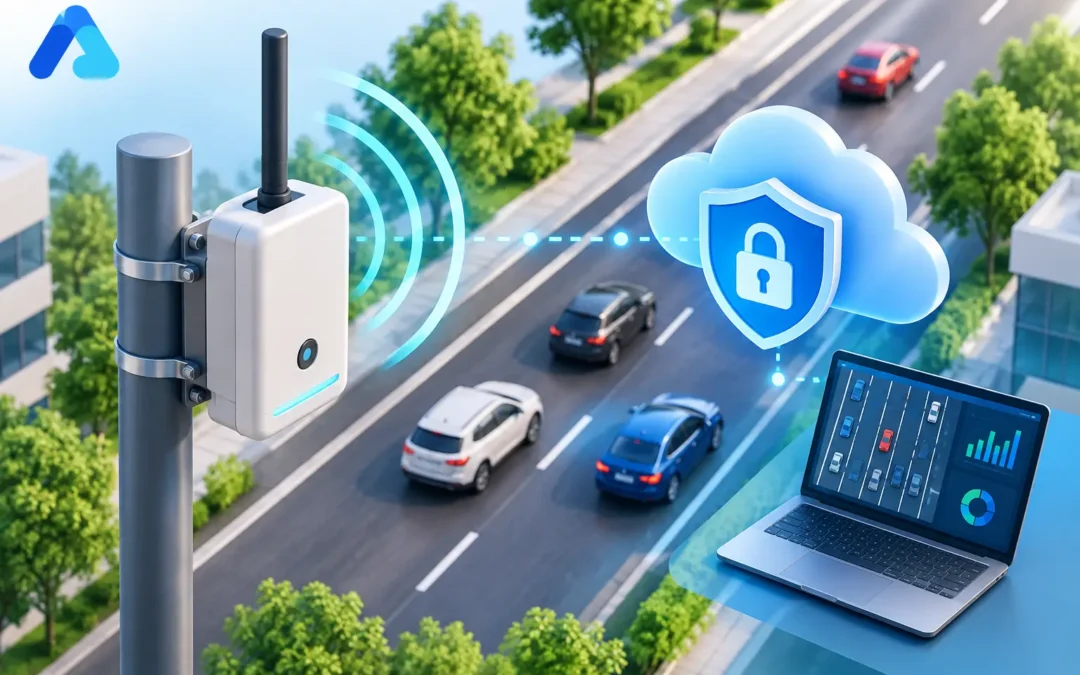
A detector mounted at the roadside can be installed without cutting a carriageway, closing a lane or reinstating an inductive loop. That operational advantage raises a fair technical question for every highways authority: are wireless traffic sensors secure? The short answer is yes, when the sensor, communications path and receiving system are specified, commissioned and managed as one security architecture.
Wireless does not automatically mean exposed. Equally, it does not remove the need for engineering discipline. A sensor that detects vehicles, cycles or pedestrians may feed data into signal control, traffic monitoring or enforcement-related workflows. Its security therefore needs to reflect the consequence of compromised, unavailable or inaccurate data – not simply the fact that it uses radio communications.
Security starts with the traffic use case
The first distinction is between monitoring and control. A wireless traffic counter used to understand speed, flow and classification has a different risk profile from a detector contributing to a signal stage, a priority request or a safety-critical crossing decision. Both require protection, but the latter normally demands tighter controls around authentication, data integrity, availability and system integration.
For a monitoring deployment, the principal concerns are often whether data can be intercepted, altered, falsified or lost. For a control application, engineers must also consider whether a malicious or unauthorised command could affect detector configuration, output states or onward communications to the controller.
This is why security cannot be assessed from a product label alone. Terms such as wireless sensor, radar detector or AI video detector describe a detection method, not the protection applied to it. The practical question is how the entire deployment prevents unauthorised access while continuing to provide dependable detection in a live road environment.
Are wireless traffic sensors secure in real deployments?
They can be highly secure, provided the system is designed to protect data in transit, restrict access to configuration functions and maintain a clear record of device identity and status. The strongest installations treat a roadside sensor as an asset on an operational technology network, rather than as a standalone device that can be fitted and forgotten.
Most established wireless traffic detection solutions use protected communications between the field device and its receiver, gateway or management platform. The exact approach varies by technology and supplier, but the objective is consistent: an intercepted transmission should not provide useful information or allow an attacker to impersonate a trusted device.
Encryption protects the confidentiality of communications. Authentication confirms that the system is communicating with a recognised device or authorised user. Integrity controls help identify data or messages that have been changed in transit. These are separate functions, and a credible security design needs all three.
Availability also matters. Wireless links can be affected by interference, obstructions, power loss and deliberate jamming. No radio technology is immune to physical or environmental constraints. A well-designed system should identify communication loss quickly, report faults clearly and allow the traffic authority to apply an appropriate fallback strategy. At a signal-controlled junction, that may include controller logic that continues to operate safely if a detector input is unavailable.
The principal risks to address
A proportionate threat assessment is more useful than a generic assurance statement. In traffic management, the main areas are normally:
- interception of unprotected radio traffic or data sent onwards from a gateway;
- unauthorised access to a sensor, receiver, configuration tool or cloud-based platform;
- device spoofing, where a false device attempts to present itself as a genuine detector;
- tampering with roadside equipment, including cabinets, brackets, power supplies and communications hardware;
- loss of availability through interference, damaged equipment, network failure or poor radio planning; and
- weaknesses introduced during installation, remote support, updates or account management.
Physical security deserves particular attention. A sensor may have secure radio communications yet remain vulnerable if an installer leaves default credentials in place, a cabinet is accessible, or a device can be removed and replaced without an alert. Above-ground detection avoids disruptive carriageway works, but it makes correct mounting, protected cabling and tamper-conscious site design essential.
What good wireless sensor security looks like
Secure deployments begin with device identity. Each sensor should be uniquely recognised by the receiving equipment or platform, and only approved devices should be able to join the network. Shared, default or easily guessed credentials have no place in an operational traffic system.
Communications should be encrypted using current, industry-recognised methods, with keys and credentials managed properly throughout the asset life. Encryption alone is insufficient if keys are poorly protected or if a device accepts commands from an unauthenticated source. Mutual authentication, where practical, gives the sensor and the receiving system confidence that each is talking to the right counterpart.
Access control should reflect job roles. A contractor may need permission to install or diagnose equipment, while a traffic signal engineer may need to amend detector parameters. Neither necessarily requires unrestricted access to the wider authority network or every deployed device. Individual accounts, strong passwords, multi-factor authentication where supported, and audit records provide significantly better accountability than a shared service login.
Network segmentation is equally valuable. Sensor gateways and traffic management devices should not sit unnecessarily on the same unrestricted network segment as corporate systems. Separating operational technology reduces the potential impact of a compromised account or endpoint and makes monitoring more meaningful.
For systems managed remotely, secure update capability is a major consideration. Firmware updates should be authenticated and sourced through an approved process, so that a device does not accept altered software. Authorities should also establish who is responsible for applying updates, how changes are tested, and how configuration can be restored following a fault.
Installation quality is part of cyber security
Security is often discussed as software, passwords and encryption. In roadside technology, installation practice is just as influential. Poor antenna placement can create unreliable communications. Inadequate grounding, unsuitable enclosures or exposed cables can lead to faults that resemble network issues. A sensor placed without considering sightlines, detection zones or likely collision risk may generate poor-quality data that operators mistake for a system fault.
A proper commissioning process should verify more than detection performance. It should confirm the approved device identifier, communications strength, encryption status, account permissions, configuration baseline and fault reporting. For control applications, the test plan should also prove what happens if communications are interrupted, power is lost or the sensor provides implausible data.
This is particularly relevant when replacing inductive loops. Non-intrusive radar and video detection can reduce roadworks, carbon-intensive reinstatement and future lane closures. Those benefits should not be offset by rushed deployment. A faster installation should create time for better acceptance testing, not less of it.
Data protection and privacy need separate consideration
Not every wireless traffic sensor collects personal data. Radar-based vehicle detection, for example, can provide presence, speed, direction and classification data without capturing identifiable imagery. That can make it well suited to applications where operational insight is needed without unnecessary privacy exposure.
Video-based detection requires a more detailed assessment. An AI detector may process video at the edge to identify road users and generate detection events, rather than continuously transmitting footage. However, the treatment of images, retention settings, user access and any recorded evidence must still align with the authority’s data protection obligations and stated purpose.
Security and privacy overlap, but they are not the same. Encryption may protect video in transit, while privacy governance determines whether footage should be retained at all, who may view it and for how long. Specifiers should ask for clarity on both.
Questions to ask before specifying a system
A practical procurement conversation should establish how field devices are authenticated, what encryption protects communications, and whether the system supports named user accounts and audit logs. It should also cover where data is processed and stored, how firmware updates are authorised, and what happens when a sensor or gateway loses connection.
Ask whether the supplier can document the supported network architecture and explain how remote support is controlled. Confirm the expected response to vulnerabilities, including how security updates are communicated and deployed. For installations linked to traffic signals, require evidence of safe failure behaviour and a clear definition of the boundary between detector equipment and controller operation.
It is also sensible to consider the system’s whole life. A secure design in year one can weaken if credentials are shared, former contractor accounts remain active, firmware is not maintained or configuration changes are undocumented. Periodic review is considerably less disruptive than investigating an operational incident on a busy network.
For UK and Irish road authorities, the practical benefit of above-ground wireless detection remains compelling: less excavation, shorter works, lower maintenance exposure and richer traffic insight. The right approach is not to avoid wireless technology, but to specify it with the same care applied to detection accuracy, road safety and signal performance. When security is designed into the device, the network and the operating process, wireless sensors can support smarter roads without creating an avoidable weak point.