
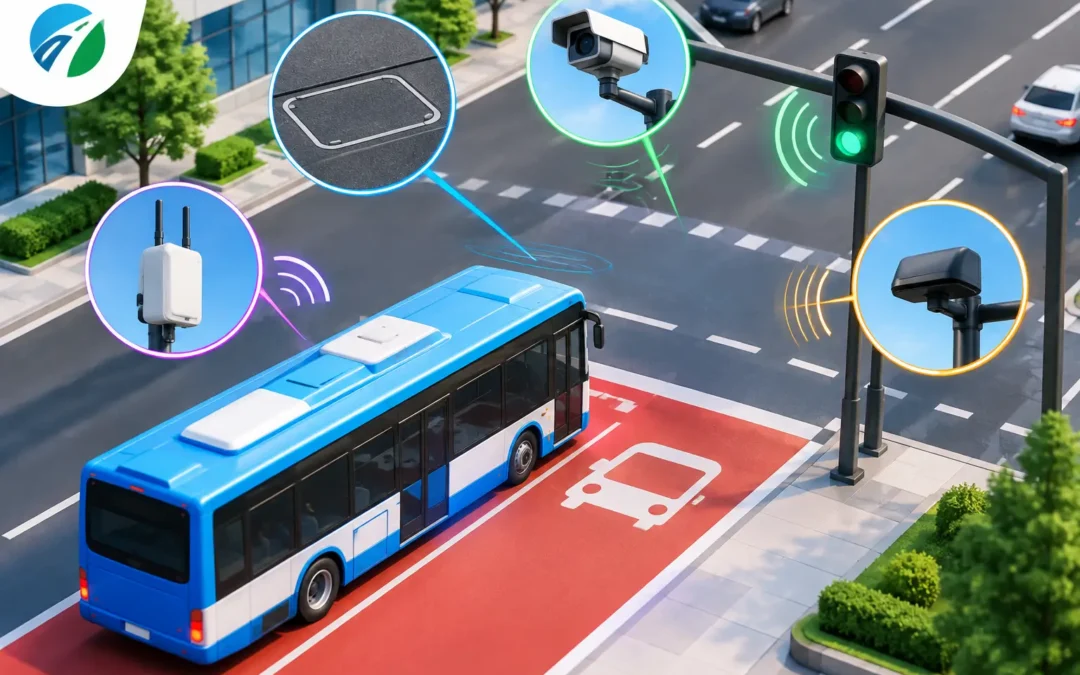
A bus can lose its timetable advantage in a single poorly detected approach. If the signal controller receives a late, false or missed call, the vehicle either stops unnecessarily or receives priority too late to be useful. The question, which detector suits bus priority, therefore cannot be answered by selecting a sensor type in isolation. The right choice depends on what the controller needs to know, where the request must be made and how complex the junction environment is.
For most priority schemes, an above-ground detector provides a faster and less disruptive route than cutting the carriageway for inductive loops. But radar, AI video and wireless sensors each solve different parts of the problem. A sound specification starts with the operational outcome: maintain bus journey time and reliability while protecting pedestrian stages, general traffic capacity and road safety.
What bus priority detection must achieve
Bus priority is not simply vehicle presence detection. A useful installation must identify an approaching eligible vehicle, make the request early enough for the controller to act, and cancel or confirm that request once the bus has passed. It should do so reliably across changing traffic conditions, darkness, rain, queueing and, where relevant, mixed traffic lanes.
The detection arrangement also needs to match the priority logic. A green extension may need confirmation that the bus is still approaching. An early start may need a request well upstream. At a junction with several bus routes, the system may need to distinguish a bus in the kerbside lane from general traffic in an adjacent lane. Where a bus lane terminates before the stop line, the detector must account for merging behaviour rather than assume a fixed approach path.
This is why detector performance should be assessed alongside the signal strategy, controller interface and physical layout. The sensor is only one part of a working priority system.
Which detector suits bus priority on a typical approach?
For a straightforward signalised approach where reliable advance detection is the main requirement, radar is often the strongest starting point. Modern traffic radar can monitor approaching vehicles by range and speed without an intrusive carriageway installation. Mounted above ground, it avoids lane closures associated with loop cutting and is well suited to retrofit projects where keeping disruption to a minimum matters.
Radar is particularly effective where the scheme needs a detection zone upstream of the stop line. It can provide a consistent call as a bus enters the defined approach area and can support speed-based logic, helping the controller judge whether a request remains relevant. Its performance is generally less affected by darkness than camera-based detection, and it is a practical option for exposed sites where changing light conditions would complicate video configuration.
That said, radar is not automatically the best choice at every junction. In dense, slow-moving queues, closely spaced vehicles can make it harder to isolate the intended target if the geometry and lane separation are not carefully configured. A site survey should establish mounting position, viewing angle, approach width, street furniture and possible reflections from large vehicles or roadside structures. The required output also matters: detecting a vehicle is different from proving that it is an eligible bus.
When AI video is the better fit
AI-powered video detection is often the preferred option where the priority decision depends on classification and detailed lane context. A video detector can be configured to identify buses, cars, cyclists and pedestrians within defined zones, making it valuable at complex urban junctions with bus lanes, shared approaches or multiple turning movements.
The principal advantage is situational intelligence. Rather than receiving a simple presence input, the controller can receive a bus-specific demand from a zone that reflects the actual traffic arrangement. This can reduce unnecessary priority calls from other large vehicles, depending on the classification capability and configuration used. Video can also monitor whether the bus is held in a queue, has changed lane or has cleared the junction, supporting better call cancellation.
AI video is especially useful when the project has wider operational objectives. The same installation can support cyclist detection, pedestrian monitoring, queue measurement and traffic analytics, subject to the selected system and local requirements. For highways authorities seeking evidence on junction performance as well as detection, this wider data value can be decisive.
The trade-off is that camera positioning, line of sight and scene management require close attention. High-sided vehicles, foliage, street clutter, glare and persistent occlusion can affect a camera’s view. Low light performance has improved substantially, but it should be validated against the actual site conditions rather than assumed. Video deployments should also be designed with appropriate data governance and privacy controls.
Where wireless sensors have a role
Wireless traffic sensors can be a useful alternative where a compact, targeted vehicle-presence input is needed and conventional cabling or loop installation is impractical. They can be deployed with less civil engineering than wired in-road systems and can provide a discreet detection point at a chosen location.
For bus priority, their limitation is usually specificity. A sensor that detects vehicle presence at a point cannot necessarily determine whether that vehicle is a bus, unless eligibility is established through another source. They are consequently better suited to supporting functions such as stop-line presence, queue detection or supplementary confirmation than as the sole means of delivering bus-specific priority on a busy mixed-traffic approach.
Their suitability also depends on maintenance planning, communications design and the required detection coverage. A point sensor cannot provide the same approach tracking or lane context as a well-positioned radar or video detector.
Identification matters as much as detection
A detector may identify a vehicle class, but some bus priority strategies require stronger assurance that the approaching vehicle is a scheduled service entitled to priority. In these cases, the detection layer may be combined with fleet location data, vehicle-to-infrastructure communications or an on-vehicle identification method.
This distinction is important. If the policy is to give priority to every bus, classified detection may be sufficient. If priority is conditional on lateness, route, occupancy, emissions status or service regulation, the system needs a reliable source of operational vehicle data as well as roadside detection.
Conditional priority is often the more efficient approach. It avoids granting calls that disrupt other stages when a bus is running to time, while helping recover reliability when a service is delayed. The detector must still provide timely, accurate information, but the final decision should be made against the operating rules rather than a blanket request.
Design the detection zones around the signal decision
The most common weakness in bus priority schemes is not the sensor itself. It is placing detection too close to the stop line, then expecting the controller to create a useful response. A green extension needs a different detection position from an early green request, and both depend on the stage sequence, intergreens, pedestrian demands and opposing traffic movements.
An effective design normally considers three functions: advance request, stop-line or near-stop-line confirmation, and clearance or cancellation. The advance zone gives the controller time to act. The confirmation zone prevents a request being maintained after a bus has stopped, diverted or become delayed in a queue. The clearance point removes priority demand once the vehicle has passed.
These functions do not always require three separate devices. A properly configured radar or AI video detector may cover more than one zone. However, combining functions should never compromise the clarity of the controller inputs. The priority logic should be tested against realistic scenarios, including late-running buses, platoons of buses, congestion, lane changes and pedestrian-heavy periods.
Choose by site condition, not product category
A practical selection process should begin with the junction problem. Where the requirement is dependable approach detection with minimal installation disruption, radar is usually compelling. Where bus classification, lane-specific operation and multimodal detection are central, AI video is often more suitable. Where a defined point presence input is needed in a difficult-to-cable location, wireless sensing can provide useful support.
The best answer may also be a combined arrangement. For example, radar can deliver resilient advance detection while AI video provides detailed confirmation in a complex stop-line area. This can improve confidence in the request without relying on road-embedded loops or extending roadworks unnecessarily.
C & T Technology assesses detection as part of the traffic operation, rather than as a standalone hardware decision. That means considering controller compatibility, mounting infrastructure, communications, signal timings and future data requirements before a device is specified.
Test performance against real bus movements
Before commissioning, agree measurable acceptance criteria. These should cover bus detection rate, false-call rate, the time available for priority action, cancellation performance and behaviour during queueing. Test across peak and off-peak periods, in darkness where relevant, and with the traffic conditions that create the greatest challenge at the site.
A detector that performs well in an empty-lane demonstration may still struggle when buses are obscured by lorries, stop in a queue or approach beside high volumes of general traffic. Equally, a technically accurate detector can deliver poor results if signal logic is too constrained to respond in time. Commissioning should therefore involve both detector configuration and controller validation.
The most effective bus priority schemes are designed around a simple principle: give the controller accurate information early enough to make a worthwhile decision. Start with the bus movement, the junction constraints and the intended priority outcome. The right detector will then become clear.