
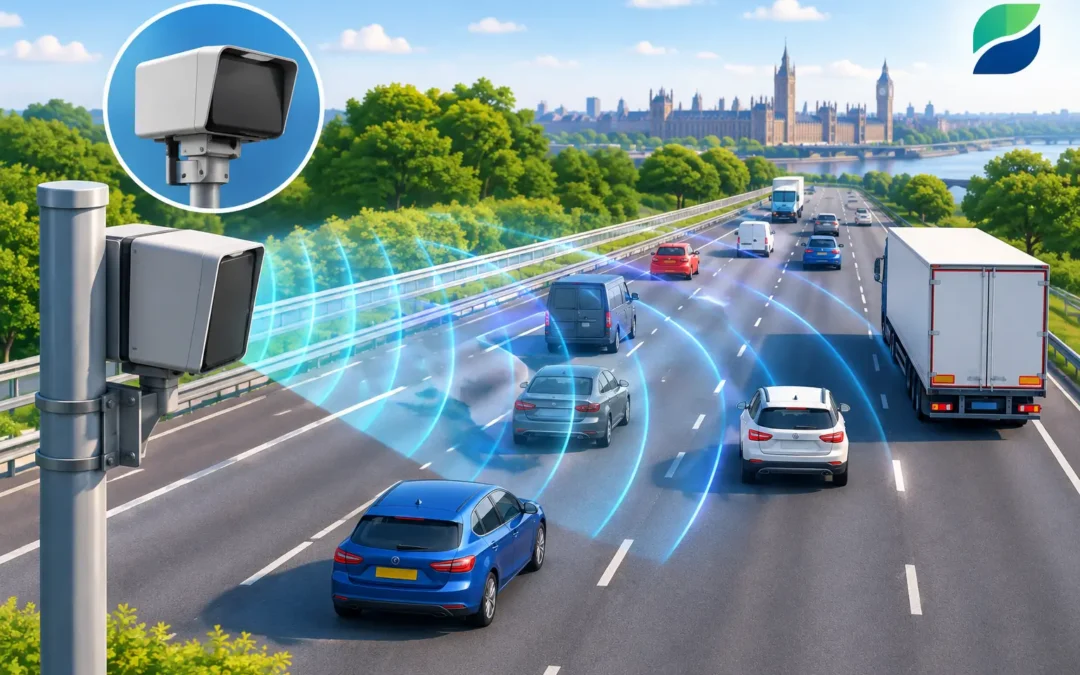
A missed call at a side-road junction is not a minor inconvenience. It can leave a driver waiting through an empty signal cycle, encourage risky gap acceptance, and erode public confidence in the network. A well-specified radar traffic sensor can address that problem without cutting the carriageway, closing lanes or relying on ageing inductive loops. This radar traffic sensor review considers where above-ground radar delivers the strongest operational value, what it cannot do alone, and how to specify it with confidence.
For highways authorities, consultants and signal engineers, the central question is rarely whether radar can detect moving vehicles. It is whether the detector will provide dependable, useful data in the precise location, geometry and controller environment that matter to the scheme.
What a radar traffic sensor should achieve
Radar detection works by transmitting radio waves and analysing the reflected signal from moving or stationary road users, depending on the sensor and configuration. Modern traffic radar can measure presence, speed, direction and lane-related movement within defined detection zones. That makes it suitable for far more than a simple vehicle-actuated call.
At a signalised junction, radar can extend detection upstream to identify approaching vehicles early enough to optimise stage demand. At a pedestrian crossing, it can support approach speed monitoring or provide advance warning logic. On rural roads, it can detect excessive approach speeds and activate a speed information display. For cycle routes and shared corridors, correctly selected radar can provide non-intrusive detection where loops are impractical or unsuitable.
The practical attraction is clear. The sensor is pole-mounted or otherwise installed above ground, so the carriageway remains intact. There is no saw-cutting, loop slot sealing or return visit to repair failed buried cable. This reduces disruption, shortens installation programmes and avoids introducing a new weakness into the road surface.
That benefit is especially relevant on high-traffic routes, newly resurfaced roads, bridges, sites with difficult utility records and locations where traffic management is costly. It also supports a more sustainable maintenance strategy: fewer road closures, fewer site visits and less material disturbance over the asset life.
Radar traffic sensor review: performance factors that matter
A meaningful review starts with the application, not a data-sheet maximum range. Detection range is useful only when the sensor can distinguish the required movements consistently within the real roadside environment.
Detection objective and zone design
Define what constitutes a valid detection event. Is the controller looking for an approaching vehicle, a stopped vehicle at a stop line, a vehicle turning right, a cyclist travelling in a defined lane, or an excessively fast approach? Each requirement calls for different zone placement, timing and filtering.
An upstream approach zone may be wide enough to capture all traffic in a lane, while a stop-line zone needs much tighter definition to prevent vehicles in adjacent lanes creating false calls. At complex junctions, several virtual zones may be needed to separate through traffic, turning traffic and vehicles queuing back from downstream restrictions.
This is where radar has a significant advantage over a single buried loop. Its detection areas can normally be adjusted in software rather than by reopening the road. However, virtual zones still need disciplined design. A poorly positioned sensor or excessively broad zone will not become accurate simply because it is configurable.
Accuracy in real traffic conditions
Radar is generally well suited to adverse weather because it is not dependent on visible light in the way video detection can be. Rain, darkness and glare are therefore less likely to compromise the underlying detection principle. This is valuable for safety-critical approaches and sites with low winter sun.
The trade-off is that radar interprets movement and reflected energy rather than visual context. Large vehicles, close vehicle platoons, metal street furniture, safety barriers and unusual junction geometry can affect how targets are resolved. A lorry masking a car in an adjacent lane is a different challenge from detecting a single, free-flowing vehicle on a straight approach.
Stationary presence capability also varies between products and configurations. Some radar units are particularly effective at moving-object detection and speed measurement, while other applications require reliable stationary vehicle detection at the stop line. Specifiers should verify this against the operating scenario rather than assuming every radar detector behaves in the same way.
Road users beyond private cars
A detection strategy that performs well for cars but misses cycles is not a complete strategy for an urban network. Cyclists present a smaller radar target and can travel close to kerbs, islands or parked vehicles. Detection zones, mounting height and sensor sensitivity must account for this.
Similarly, pedestrian detection is often better addressed by AI video where the scheme requires classification, waiting-area occupancy or precise tracking of people. Radar may contribute to a wider solution, but it should not be presented as the automatic answer to every vulnerable road user requirement.
A combined approach is often the most effective. Radar can provide dependable approach detection and speed data in difficult light, while video analytics can distinguish road user classes and interpret more complex behaviours. The correct choice depends on the movement to be controlled, the level of classification required and the tolerance for false calls or missed calls.
Installation and integration are part of the system
Non-intrusive installation is a major operational benefit, but it does not remove the need for survey, commissioning and validation. Sensor mounting position determines what the radar can see. Height, lateral offset, viewing angle, roadside clutter and the presence of gantries or signal heads all influence zone quality.
A site survey should establish clear lines of sight across the intended detection area and identify potential interference from adjacent carriageways, slip roads and opposing traffic. In a constrained urban setting, a small change in mounting location can make the difference between clean lane separation and persistent unwanted activations.
Integration needs equal attention. The detector must communicate useful outputs to the traffic signal controller, warning sign, data logger or traffic management platform. Depending on the scheme, this may involve relay outputs, digital interfaces, serial communications or IP connectivity. The selected method should be compatible with the controller architecture, fault-monitoring requirements and any future data needs.
For signal control, confirm the required detector states, extension timing, inhibit logic and fail-safe behaviour before installation. For speed management, establish whether the sensor will trigger a sign at a defined threshold, record individual vehicle speeds, calculate aggregate statistics, or do all three. A detector that captures data without a clear operational action can add complexity without improving the road network.
Maintenance and whole-life considerations
Traditional loops are familiar, but familiarity is not the same as low risk. They are vulnerable to resurfacing works, utility excavations, deteriorating road surfaces and cable faults that can be difficult to locate. Repair commonly requires traffic management and carriageway intervention.
Above-ground radar moves much of that maintenance exposure away from the road surface. Firmware updates, sensitivity adjustments and zone refinement can often be completed without intrusive civil works. The sensor itself remains an exposed roadside asset, however, so installation quality, cable protection, power provision and protection from accidental impact still matter.
Remote access and diagnostic capability can materially improve support arrangements, particularly across dispersed authority networks. The ability to check detector status, interrogate fault conditions and amend a configuration before sending an engineer can reduce unnecessary visits. It must be implemented within the authority’s communications and cyber-security requirements.
A sensible specification also considers replacement and expansion. Can a failed detector be replaced without reworking the entire mounting arrangement? Can additional detection zones be configured as traffic patterns change? Can data be made available to a wider analytics platform? These questions protect the long-term value of the installation.
Where radar is the strongest fit
Radar is particularly compelling where installation disruption must be minimised and the primary task is vehicle approach, presence, speed or direction detection. Typical examples include signalised junctions, rural approaches, speed management schemes, queue detection, temporary traffic management, bridge decks and recently resurfaced carriageways.
It is also a strong option where weather resilience and 24-hour operation are priorities. Unlike road-embedded systems, it avoids cutting into a finished surface. Unlike camera-only detection, it is not dependent on a clean visual scene for its core measurement.
There are cases where another technology should lead. If the scheme depends on detailed classification, pedestrian behaviour analysis, automated incident interpretation or evidence-grade imagery, AI video may be more appropriate. If the purpose is long-duration network monitoring across many locations, wireless sensors or a combination of technologies may offer a better deployment model.
C & T Technology approaches this as a detection design issue rather than a product swap: identify the operational outcome, assess the site constraints, then select and configure the technology that gives the controller or road safety team the information it genuinely needs.
The most useful next step is to test the detection requirement against the road layout before finalising a specification. A short, well-informed survey can prevent years of unreliable calls, unnecessary maintenance and avoidable congestion.