
A signalised junction can look healthy from the control room while failing badly on the street. A missed cyclist call, a queue that spills back into the next arm, or a detector fault that sits unnoticed for weeks can all distort network performance. That is why traffic monitoring and control systems matter – not as a back-office layer, but as the operational foundation for safer roads, better flow and more reliable decisions.
For highways authorities, consultants and contractors, the challenge is no longer simply whether detection is present. The real question is whether the data is accurate enough, timely enough and flexible enough to support modern traffic operation. Legacy methods still have a place in some schemes, but they often come with installation disruption, maintenance burden and limited adaptability. As networks become more multimodal and performance expectations rise, above-ground detection and data-led control are becoming the more practical fit.
What traffic monitoring and control systems actually do
At their best, traffic monitoring and control systems combine three functions. They detect what is happening on the road, interpret that information in a useful way, and feed it into operational responses. Those responses may be signal actuation, congestion management, speed awareness, traffic counting, journey time assessment or network performance review.
This sounds straightforward, but the quality of the outcome depends on each layer. Weak detection leads to poor control decisions. Good raw data with limited analytics leads to underused assets. A well-configured control strategy with poor site visibility still leaves engineers reacting late. Effective systems bring these elements together so that operators and planners can move from assumption to evidence.
That matters particularly where conditions change quickly. Urban corridors with buses, cycles, pedestrians and turning traffic need different detection logic from a rural speed management site or a temporary works diversion. A one-size-fits-all approach usually creates blind spots.
Why legacy detection creates operational friction
Inductive loops have served the sector for decades, but they also create familiar problems. Installation requires cutting into the carriageway, which means traffic management, disruption and reinstatement risk. When loops fail, fault finding is rarely simple, and replacement can mean more road occupation. In sites with ageing surfaces or repeated utility works, reliability can deteriorate over time.
There is also a practical limitation around flexibility. Once embedded infrastructure is in place, adapting detection zones or adding new data outputs is not always easy. If the site changes, if a cycle lane is introduced, or if a junction staging strategy is revised, the original detection arrangement may no longer suit the real demand profile.
This is where non-intrusive technologies have changed the conversation. Radar, AI-powered video and wireless sensing can often be installed faster, adjusted more easily and maintained with less impact on the network. That does not mean every above-ground option is automatically better. Site geometry, lighting, weather exposure, mounting position and control integration all affect suitability. But for many authorities, the balance has shifted decisively towards above-ground detection because the operational penalties of road-embedded systems are harder to justify.
The shift to above-ground traffic monitoring and control systems
Modern above-ground traffic monitoring and control systems are not just replacements for loops. They offer broader visibility of the network and support more detailed classification of road users. That distinction is important.
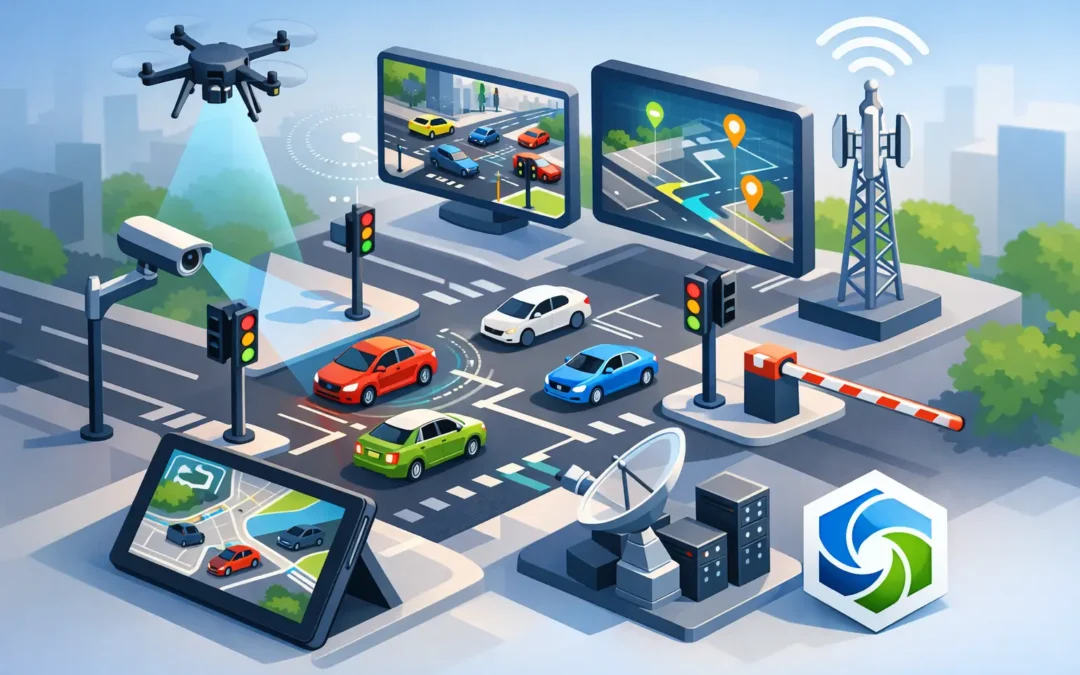
A radar detector, for example, may provide dependable presence and movement detection in challenging conditions, making it well suited to junction control and stop line detection. AI video detection can add richer scene understanding, including vehicle tracking, cycle detection and pedestrian insight, particularly where site complexity demands more nuanced logic. Wireless traffic sensors can help collect data where civil works are undesirable or impractical. Speed information displays and traffic counters add another layer by influencing behaviour and quantifying outcomes.
The benefit is not only technical. It is operational. Engineers can alter zones, refine settings and respond to changing road layouts without repeatedly returning to invasive installation methods. Maintenance teams can work above ground. Project teams can reduce the amount of roadspace occupation required during deployment. For authorities under pressure to minimise disruption while still improving performance, that is a significant advantage.
Better detection leads to better control
Control systems are only as intelligent as the inputs they receive. If a detector misses cyclists, overcalls stationary vehicles, or fails to recognise queue extension, the controller still acts – just on the wrong evidence. The result can be wasted green time, unnecessary delay or avoidable safety conflict.
Better detection improves control in several ways. Accurate presence detection supports cleaner signal actuation. Reliable approach monitoring helps identify demand earlier. Classification data allows separate treatment of vehicles and cycles where the site strategy requires it. Persistent monitoring also helps engineers identify whether poor operation is caused by timing, geometry, saturation or detector performance.
That last point is often underestimated. When a junction performs badly, teams may first look at timings or capacity. Sometimes the real issue is a detection layer that no longer reflects actual use of the site. Upgrading the controller without upgrading the inputs can leave the root cause untouched.
Multimodal roads need smarter logic
Many UK and Irish networks now have to manage a more mixed set of movements than they did even ten years ago. Protected cycle routes, bus priority measures, pedestrian stages and lower-speed urban design all place greater demands on detection.
This creates a practical requirement for systems that can differentiate road users and support tailored responses. A cyclist should not be treated as a general vehicle if that compromises call reliability or stage efficiency. A pedestrian crossing near a school may need different monitoring priorities from a rural crossing with lower footfall. The value of modern sensing is that it can support this level of specificity without relying on repeated carriageway intervention.
Data is not useful unless it changes a decision
One of the weaknesses in some deployments is that monitoring is treated as a reporting function rather than an operational tool. Large volumes of traffic data are collected, but not structured in a way that helps engineers change anything. Useful systems do more than count passing vehicles. They create evidence for intervention.
That may mean identifying peak period saturation at a junction, validating the effect of a signal timing adjustment, understanding cycle demand by hour and direction, or spotting where speeding remains persistent despite previous measures. It may also mean giving authorities a clearer view of how schemes perform after installation, which is essential for future specification and business case development.
Platforms that manage vehicle and detector data well can improve this process considerably. They help turn isolated site information into network intelligence. Still, more data is not automatically better. The aim should be decision-grade insight. If the platform cannot support operational review, maintenance planning or measurable scheme assessment, then the value remains limited.
Choosing the right system depends on the site
There is no single ideal specification for all traffic monitoring and control systems. A compact urban junction, a high-speed approach, a temporary installation and a permanent network upgrade all come with different technical constraints.
Engineers should consider detection purpose first. Is the requirement signal actuation, classification, speed awareness, count data, queue monitoring or a combination? From there, the physical environment becomes critical. Mounting opportunities, lane configuration, lighting conditions, weather exposure, street clutter and communications architecture all influence system choice.
Integration is equally important. A strong detector that does not interface cleanly with the controller or wider data environment will add friction rather than remove it. That is why product capability on paper is only part of the assessment. Technical support, commissioning knowledge and real understanding of traffic management systems often determine whether a deployment performs well six months later.
This is also where specialist advisory input has real value. Matching radar, video, wireless or display technologies to the site objective avoids the common mistake of specifying by product category rather than operational outcome.
What good deployment looks like
Successful deployment usually has a few common features. The scheme objective is clear from the start. Detection is chosen to suit that objective and the site conditions. Installation minimises disruption. Configuration is checked against actual road behaviour rather than assumed behaviour. Performance is then reviewed using measured outputs, not guesswork.
In practice, that means treating detection as part of network operation, not just an item on a procurement list. It also means accepting that some sites need refinement after installation. That is not a failure. It is often the difference between simply fitting equipment and achieving a meaningful transport outcome.
For authorities and delivery partners looking to reduce congestion, improve safety and gather better evidence, the direction of travel is clear. Non-intrusive detection and analytics-led control offer a more adaptable way to manage modern roads, especially where maintenance access, sustainability and network uptime are under pressure.
C & T Technology works in this space because the sector needs practical alternatives to disruptive legacy methods, backed by technical understanding rather than product-only claims. The strongest systems are the ones that detect accurately, adapt readily and give engineers confidence in the decisions that follow.
When a road network is under strain, better visibility is not a luxury. It is what allows the next intervention to be the right one.