
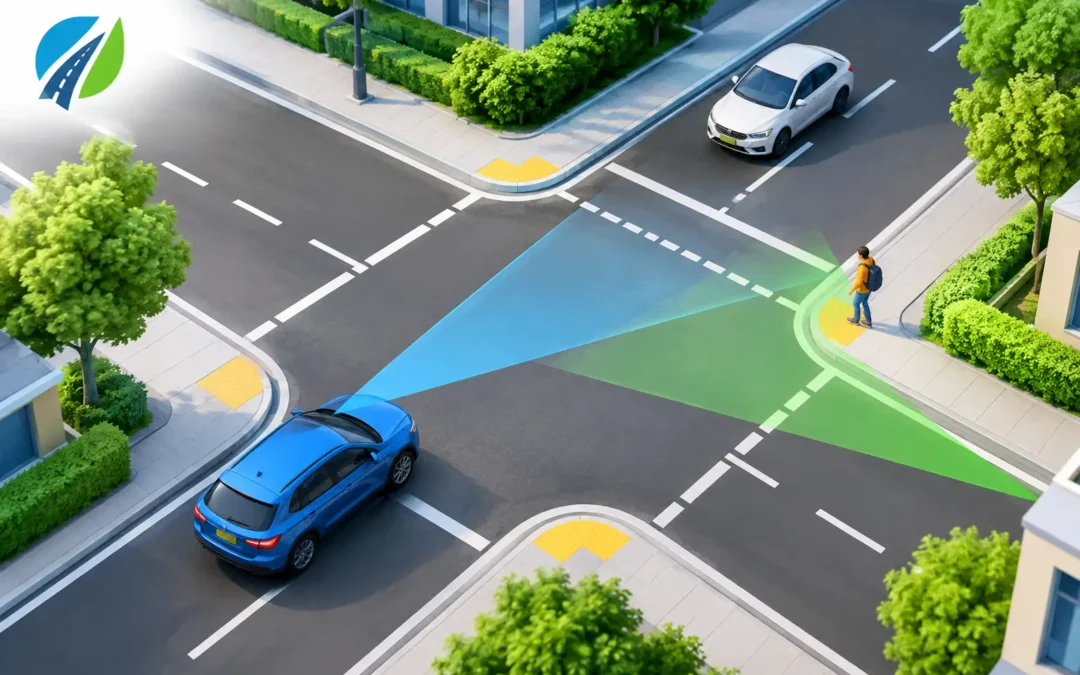
A driver edging out from a minor road should be able to assess approaching traffic before their vehicle enters the conflict area. When they cannot, the junction is relying on judgement, hesitation and last-second braking rather than sound road design. Knowing how to improve junction visibility means looking beyond a single sightline: approach speeds, road geometry, vegetation, lighting, signing, parking behaviour and detection all affect whether people can make safe, timely decisions.
For highways authorities and network operators, the right intervention depends on the type of junction and the reason visibility is compromised. A rural priority junction with fast-moving traffic needs a different response from an urban signalised crossroads used by pedestrians, cyclists, buses and delivery vehicles. The common objective is clear: give every road user sufficient time and information to identify hazards and respond safely.
Start with the real visibility problem
Junction visibility is often treated as a straightforward landscaping issue. Cutting back a hedge may help, but it will not resolve a hidden conflict caused by poor stop-line position, an unsuitable parking arrangement or signal operation that does not reliably recognise a cyclist.
A site review should establish where the decision point sits for each user. At a priority junction, this is typically the give-way line and the available visibility splays from it. At a signalised junction, it includes the ability to see signal heads, crossing users, lane allocations and vehicles in adjacent streams. For a pedestrian or cyclist, visibility also concerns whether drivers can see them early enough when turning.
Measurements should be paired with observed behaviour. Video surveys and radar data can reveal whether drivers routinely nose forward, brake sharply on approach, accept small gaps or queue across pedestrian crossings. These behaviours help distinguish between an isolated obstruction and a wider operational problem.
Account for speed, not just distance
A long sightline is not automatically a safe one. The available visibility needs to reflect the actual speed of approaching traffic, including the upper end of observed speeds rather than only the posted limit. A vehicle travelling faster than expected reduces the time available to judge a gap and can make a nominally compliant layout unsafe in practice.
This is particularly relevant on rural approaches, downhill sections and wide urban corridors that encourage higher speeds. Where speed is the underlying issue, options may include gateway treatments, carriageway narrowing, improved speed limit signing, speed information displays or targeted enforcement support. Removing obstructions without addressing excessive approach speed can leave the core risk unchanged.
Improve the physical sightlines first
Clear, maintainable sightlines remain the foundation of a safe junction. The aim is not to create an unnecessarily open roadside, but to remove objects that obscure critical views at the point users need to make a decision.
Vegetation requires planned maintenance rather than one-off clearance. Hedges, trees and verge growth can quickly block splays during the growing season, while fallen branches and leaf cover can obscure signs, road markings and signal heads. Maintenance specifications should define the required clearance envelope and inspection frequency, particularly where vegetation sits on third-party land.
Street furniture also deserves scrutiny. Advertising boards, utility cabinets, direction signs, bins, bus shelters and temporary works can all interrupt a driver’s view. Their effect is often greatest at low mounting heights, where they hide children, cyclists or the front of an approaching vehicle. Before installing additional roadside equipment, designers should test views from realistic driver, cyclist and pedestrian positions.
Parking and loading controls are equally important in built-up areas. A legally parked van close to a side-road mouth can conceal an approaching cycle or pedestrian and force emerging drivers into the main carriageway. Clear corner protection, appropriately placed waiting restrictions and well-marked loading locations can protect visibility without imposing broad restrictions across an entire street.
Make the junction legible on approach
Drivers need to understand a junction before reaching it. Clear advance signing, road markings and lane discipline reduce late manoeuvres, abrupt braking and indecision, all of which can amplify the consequences of constrained visibility.
At larger junctions, confirm that direction signs are readable at the relevant approach speed and are not screened by foliage, parked vehicles or other signs. Refresh worn give-way lines, lane arrows, stop lines and cycle markings. On wet or dark roads, degraded markings may be difficult to identify even where geometric visibility is otherwise adequate.
Lighting should be reviewed in relation to the actual conflict points, not simply the general carriageway. A well-lit approach can still leave a pedestrian waiting area, crossing point or cycle entry poorly defined. The desired outcome is controlled contrast that helps drivers recognise people, vehicles and the road layout, without glare from poorly aimed luminaires or illuminated advertising.
Treat temporary traffic management as a visibility risk
Roadworks can alter sightlines overnight. Barriers, cones, plant, material storage and temporary signs may block views at precisely the point where traffic has been diverted into unfamiliar lanes. Temporary arrangements should be checked in daylight and darkness from each approach, including the viewpoint of a person walking or cycling.
This is not merely a compliance exercise. A junction operating close to capacity has little tolerance for uncertainty. If drivers cannot see a queue, a signal head or a crossing user until late in the approach, delay and risk increase together.
Use detection to reveal and manage conflict
Physical improvements alone cannot address every visibility limitation. At complex, signalised or constrained sites, above-ground detection can support safer operation by providing earlier and more reliable awareness of approaching traffic and vulnerable road users.
AI-powered video detection can identify and track vehicles, cyclists and pedestrians within defined zones. It can be configured to support demand-responsive signal stages, extend crossing time where users are still present, monitor queue formation or identify blocked exits. Radar detection provides reliable vehicle and bicycle detection across challenging conditions and can measure approach speed without road-embedded loops.
The value is operational as well as safety-led. If a signal controller receives accurate, timely detection, it can allocate green time to genuine demand rather than relying on fixed assumptions. This can reduce unnecessary delay while helping prevent vehicles from entering a junction without a safe downstream exit.
Non-intrusive technologies are especially useful where cutting the carriageway would create disruption, increase installation time or introduce future maintenance liabilities. Above-ground sensors can be installed and adjusted with far less intervention than inductive loops, making them well suited to live networks, resurfaced roads and sites where lane closures are difficult to secure.
Design for cyclists and pedestrians, not only vehicles
Visibility assessments historically focused on a driver emerging from a minor road. That remains necessary, but it is not sufficient at junctions carrying active travel movements. Cyclists approach more quietly and can be masked by vehicles, street furniture or turning traffic. Pedestrians may step into a crossing from behind a bus shelter or parked vehicle.
Review the turning paths and waiting positions that create the highest risk. Left-turning lorries, for example, require particular attention where cycle routes run alongside the carriageway. Set-back crossings, dedicated cycle signal stages, early release arrangements and clear separation can improve the time and space available for users to see one another. The appropriate measure depends on traffic volume, available highway width, cycle demand and the junction’s overall role in the network.
Detection should also reflect the users the junction is intended to serve. If a cyclist has to position themselves in an awkward location to trigger a phase, or a pedestrian call demand is poorly located, the system is creating avoidable uncertainty. Detection zones, mounting positions and controller logic should be commissioned and tested in real operating conditions.
Validate performance after installation
A completed scheme should not be assumed to perform as designed. Revisit the site after changes to check sightlines in different weather, lighting and traffic conditions. Observe whether drivers still creep beyond give-way lines, whether queues obscure crossings and whether cyclists are reliably detected.
Before-and-after data provides a stronger basis for refinement. Traffic counts, classified movement data, approach speeds, queue lengths, signal demand records and near-miss observations can show whether the intervention has improved safety and traffic flow. Where video analytics are used, privacy requirements and data handling policies must be built into the deployment from the outset.
The best junction visibility improvements are often modest but precisely targeted: a relocated sign, a maintained splay, a clearer stop line, a protected corner or detection that gives the controller a more accurate picture of demand. Treat visibility as an ongoing operational condition rather than a box to tick at design stage, and the junction will be better equipped to protect people while keeping the network moving.