
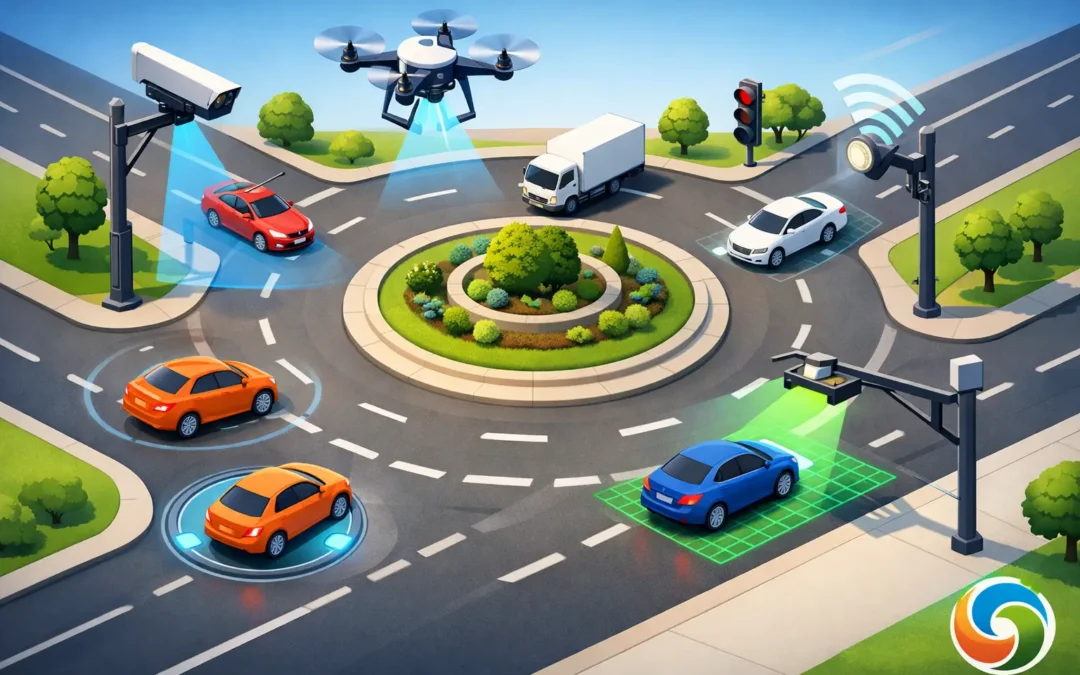
A roundabout can appear to operate acceptably until a missed approach vehicle, an undetected cyclist or an unreliable gap call exposes the weakness in its control strategy. The best traffic detection for roundabouts is not a single device selected from a catalogue. It is a detection design matched to the roundabout’s geometry, control objectives, traffic mix and practical installation constraints.
For highways authorities and signal engineers, the priority is clear: obtain dependable, actionable data without repeatedly cutting into the carriageway. Above-ground radar, AI-powered video and wireless sensing can replace or complement legacy inductive loops while reducing disruption, improving maintainability and supporting safer decisions at complex junctions.
What roundabout detection must achieve
Detection at a roundabout has a wider role than simply registering a vehicle at a stop line. At signal-controlled roundabouts, it may need to extend or terminate stages, manage queue discharge, identify circulating traffic, protect pedestrian crossings and provide demand-responsive operation. At priority roundabouts, data may support capacity studies, before-and-after assessments, speed management and decisions on future intervention.
The operating environment makes this demanding. Detection zones can be affected by curved approaches, splitter islands, multiple entry lanes, close-following vehicles, tall-sided lorries, road markings and moving shadows. Cyclists may use a carriageway lane, an adjacent shared-use facility or a separate crossing. Pedestrians require different detection logic again. A detector that performs well on a straight, single-lane approach can be poorly suited to a constrained multi-arm roundabout.
The specification should therefore start with the decision that detection must support. Is the objective signal actuation, queue measurement, classification, speed monitoring, vulnerable road user detection or network analytics? The answer determines what should be detected, where the zone should sit and how the output is used by the controller or data platform.
Best traffic detection for roundabouts: radar or AI video?
In most schemes, radar and AI video provide the strongest above-ground options. They solve different parts of the problem and can be deployed independently or together.
Radar for consistent vehicle detection
Radar is particularly effective where dependable vehicle presence, speed and range information are required in difficult weather or poor light. It can monitor an approach over a defined detection area without excavation, making it well suited to replacement of failed loops, temporary works, rural roundabouts and locations where carriageway closures are difficult to secure.
For signal control, radar can provide advance detection to assess approaching demand and support efficient stage timing. It can also help distinguish moving traffic from queues, depending on the detector and configuration. The ability to position equipment above ground means zones can be refined during commissioning without reinstating the road surface.
There are trade-offs. Radar is generally strongest for vehicle movement and presence, but a complex scene with several lanes, tight curves and a need to understand individual road user behaviour may call for the richer scene interpretation offered by video analytics. Careful siting is still essential. Street furniture, signs, bridge parapets and unsuitable mounting height can reduce the quality of a radar installation.
AI video for multi-modal understanding
AI video detection is valuable when a roundabout needs to respond to more than vehicles. Properly configured systems can detect and classify cars, vans, lorries, buses, motorcycles, cycles and pedestrians, while establishing tailored virtual zones for each movement or crossing point.
That makes AI video particularly relevant at urban signal-controlled roundabouts, active travel schemes and junctions where pedestrian and cycle safety is central to the design. Engineers can define zones on entry lanes, circulating carriageways, exit lanes, zebra or signalised crossings, and cycle facilities. The output can support demand actuation, safety monitoring and traffic studies without deploying multiple road-embedded sensors.
Video does require an unobstructed, stable field of view. Trees in leaf, glare from a low sun, headlamp flare, rain on the lens and parked maintenance vehicles should all be considered at survey stage. Modern analytics can handle challenging conditions well, but performance depends on camera position, cleaning access, network connectivity and rigorous commissioning. AI video should be specified as a detection system, not treated as a conventional CCTV camera with an analytics feature added later.
Why hybrid detection is often the practical answer
A hybrid design can give a roundabout both resilient vehicle detection and detailed multi-modal intelligence. Radar can provide the primary approach detection required for signal operation, while AI video monitors crossing demand, cycle movements, lane-specific queues or unusual conflicts. This approach avoids forcing one technology to do every job.
It is especially useful where signal reliability is non-negotiable but the authority also needs better evidence on how people and vehicles use the junction. The exact arrangement depends on the controller interface, available poles, sightlines and maintenance strategy. More equipment is not automatically better. The best design is the one that provides verified outputs for each operational decision with the fewest unnecessary points of failure.
Design detection around movements, not just arms
Roundabouts are movement-based environments. An entry-arm detector alone may show demand, but it will not necessarily explain whether a queue is caused by circulating traffic, an over-capacity downstream exit, a pedestrian stage or lane imbalance.
A useful design process maps the critical movements first. Consider entry demand, circulating flow, exit blocking, lane utilisation, queue tail location and vulnerable road user crossings. Then identify where detection provides a control benefit rather than merely producing more data.
For example, an approach detector positioned too close to the give-way line may offer little time for a signal controller to react. Conversely, a detector positioned too far upstream can create calls from traffic that diverts before reaching the roundabout. Queue zones require similar care: the zone should capture a meaningful queue tail without confusing adjacent movements or traffic on a nearby access.
This movement-led approach also improves scheme evaluation. Classified counts and speed data can reveal whether changes have shifted traffic between lanes, reduced delay for buses, improved crossing opportunities or introduced new pinch points. Detection becomes a source of operational evidence rather than a hidden component that is only noticed when it fails.
Installation and maintenance are part of performance
Inductive loops remain familiar, but their limitations at roundabouts are substantial. Installation requires carriageway cutting and traffic management, while future resurfacing, utility works and pavement movement can damage the loop or its feeder cable. Diagnosing a fault can mean further disruption at a location where closures affect several approaches at once.
Above-ground detection changes that maintenance profile. Radar and video units can often be installed on existing poles or purpose-designed mounting infrastructure, with less intervention in the running surface. Detection areas can be adjusted through configuration, and replacement work is generally more contained than reinstating embedded loops.
That does not remove the need for a proper site survey. Engineers should assess mounting height, cable routes, power availability, communications, pole loading, visibility, vegetation growth, drainage and safe maintenance access. Wireless sensors can be useful where civil works or cabling are constrained, but their battery life, communications coverage and data requirements must be assessed against the intended use.
Commissioning is equally important. A detector should be tested against real traffic conditions, including peak queues, darkness, wet weather where feasible, buses and lorries, cycles and pedestrians. Detection logs and controller outputs should be checked together. A technically accurate detector can still produce poor outcomes if zones, delays and extensions are not aligned with the signal strategy.
Specify outcomes, then verify them
The strongest procurement specifications state the outcome required rather than naming a technology by habit. Define the road users to be detected, the movements and zones, required outputs, controller compatibility, environmental conditions, data retention needs and acceptance tests. Include requirements for configuration support, fault diagnosis and ongoing technical assistance.
Acceptance testing should reflect the operational purpose. If the detector is intended to call a pedestrian stage, test the call under realistic approach conditions. If it supports queue management, verify that the queue zone identifies the intended tail across relevant lanes. If classified data will inform a scheme appraisal, confirm the classification categories and data quality before relying on the results.
For UK and Irish authorities balancing safety, congestion, carbon reduction and maintenance pressures, non-intrusive detection offers a practical route away from repeated road cutting. C & T Technology can help translate the junction problem into a detection design that is measurable, maintainable and fit for the way the roundabout actually operates.
The right question is not which detector is best in isolation. It is which combination of detection, placement and control logic will make the next decision at the roundabout safer and more informed.