
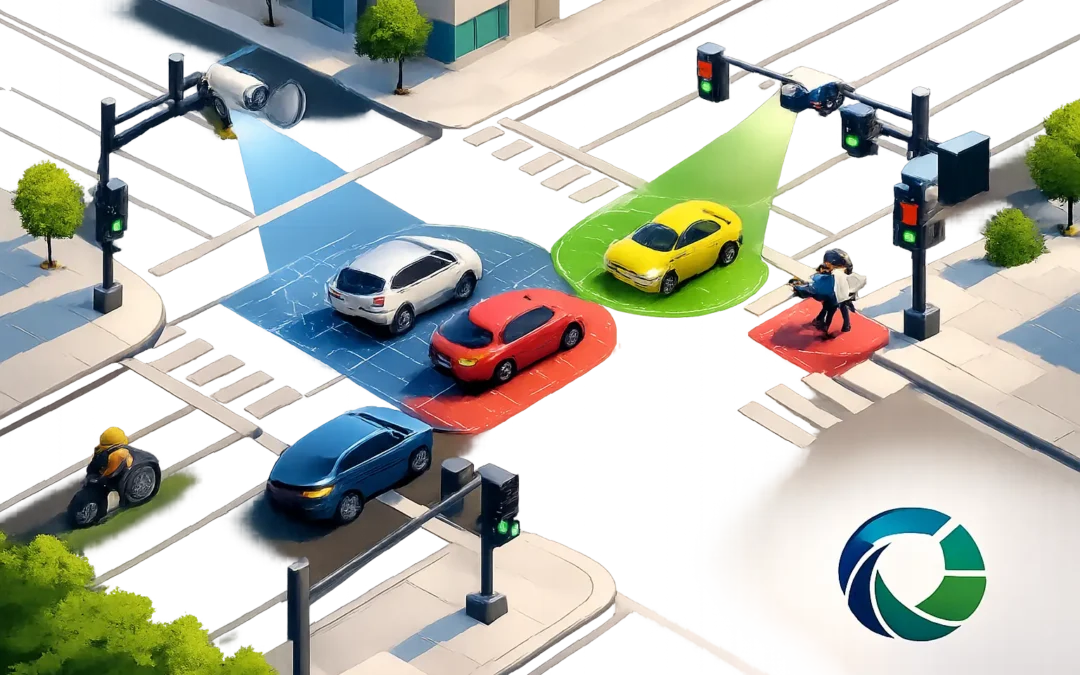
A signalised junction only performs as well as its detection. When detection is late, missed or unreliable, the result is familiar – wasted green time, poor cyclist calls, unnecessary stopping, and avoidable congestion that spreads beyond the stop line. That is why the best traffic detection for signalised junctions is not simply the most established option. It is the option that matches the junction layout, user mix, control strategy and maintenance reality.
For many authorities and contractors, that has shifted the conversation away from road-embedded loops and towards above-ground detection. The reason is practical rather than fashionable. Junction teams need dependable presence and movement data, but they also need faster installation, less carriageway disruption, safer maintenance access and better visibility of what is happening at the kerbside and in the approaches.
What defines the best traffic detection for signalised junctions?
At a technical level, good junction detection has to do three things well. It must detect the right road users in the right place, at the right time. That sounds obvious, but it is where many schemes either succeed or underperform.
Accuracy on its own is not enough. A detector may perform well in a controlled demonstration but still create operational issues if its detection zone is difficult to tune, if it struggles with turning traffic, or if maintenance requires repeated road closures. For signal engineers, the best solution is usually the one that improves junction performance without adding complexity elsewhere in the asset lifecycle.
That means assessment should cover more than raw detection capability. Detection range, stop line presence, queue monitoring, cyclist sensitivity, pedestrian interface, false call rate, weather resilience, commissioning effort and maintenance access all matter. So does compatibility with existing signal control architecture.
In practice, the best-performing systems are those that support a wider traffic management objective. That may be reducing delay on a linked corridor, improving cycle safety at an urban junction, providing cleaner demand data for MOVA or SCOOT operation, or replacing failing loops where resurfacing and repeated cut-ins are creating a long-term maintenance burden.
Why legacy loop detection is no longer the default
Inductive loops still have a place, and on some sites they remain serviceable. But at modern signalised junctions, their limitations are increasingly hard to ignore. Installation is disruptive, requiring carriageway cuts, lane closures and reinstatement. Maintenance is equally awkward, particularly where failure occurs after resurfacing or utility works.
Loops are also inherently limited in what they can see. They are effective for vehicle presence in a fixed location, but they do not provide the same flexibility as above-ground systems when a junction needs multiple detection zones, turning movement insight, cyclist priority, or changes to geometry over time. If the layout changes, the detection often has to be physically rebuilt.
That is the key issue. Junction control is no longer static. Authorities need assets that can be adapted, retuned and expanded without repeated intrusive works. Above-ground technologies are better aligned with that requirement.
Radar, AI video or wireless – which performs best?
There is no single answer for every junction, because the operational task is not always the same. Still, three technology families now dominate serious consideration for signalised junction upgrades.
Radar detection
Radar is strong where reliable vehicle and cycle detection is needed across approaches, stop lines and advance zones, especially in variable light conditions. It is well suited to detecting moving and stationary objects, and modern units can be configured for lane-level and approach-specific operation.
For signal control, radar is often valued because it is stable, above-ground and relatively straightforward to deploy. It avoids saw-cutting the carriageway, which immediately reduces installation disruption and future maintenance exposure. It also performs well in poor visibility compared with camera-based systems that depend more heavily on image quality.
The trade-off is that radar does not always offer the same interpretive richness as advanced video analytics. If a site needs fine-grained classification, conflict analysis or visual verification of unusual behaviours, radar may need to sit alongside other tools rather than replace them entirely.
AI-powered video detection
AI video detection is particularly effective where a junction has mixed users, unusual geometry or a need for more sophisticated scene understanding. It can distinguish between vehicles, cyclists and pedestrians, monitor multiple zones from a single mounting position, and support detailed tuning in response to site conditions.
This makes video highly attractive for urban junctions where active travel provision matters and where authorities want more than simple vehicle calls. It can support cycle detection at advanced stop lines, side-road monitoring, queue observation and selective priority strategies. Because the detection is software-defined, changes can often be made without physical intervention in the carriageway.
The obvious consideration is environmental resilience. Camera placement, lighting, occlusion and scene clutter all need proper assessment. Good AI video systems are far better than older image processing approaches, but specification and commissioning still matter. A poor field of view will not be fixed by clever software alone.
Wireless and non-intrusive sensor options
Wireless traffic sensors can be useful where rapid deployment, temporary monitoring, or lower-disruption installation is a priority. They are often chosen to support data collection, approach monitoring or targeted detection without major civil works.
At permanent signalised junctions, their suitability depends on the control objective and the level of precision required. On some sites they can complement radar or video rather than act as the sole source of detection. Their strength is flexibility. Their limitation is that not every wireless solution is designed for every stop line or high-complexity junction application.
Matching detection to junction type
A compact four-arm urban junction with significant pedestrian and cycle demand will often benefit most from AI video, particularly where separate treatment of different users is needed. The ability to refine detection zones and classify road users is operationally valuable, especially where safety and active travel performance are being scrutinised.
A higher-speed peri-urban signalised junction may favour radar, especially if the priority is stable vehicle approach detection, queue protection and dependable all-weather operation. Radar can also be attractive where access for maintenance is constrained and authorities want to minimise the risk of future intrusive repairs.
At larger junctions, hybrid arrangements are often the strongest option. Radar may handle approach and stop line detection, while AI video addresses cyclist and pedestrian movement, complex turning flows or supplementary analytics. The best scheme is not always the simplest in hardware terms. It is the one that gives control engineers the detection quality they need without creating unnecessary operational overhead.
The procurement question is really a whole-life performance question
When specifiers evaluate the best traffic detection for signalised junctions, it is easy to focus on detector type in isolation. A better approach is to look at whole-life network value.
Non-intrusive systems reduce installation risk because they avoid carriageway cutting. They reduce disruption to road users and site crews. They are typically easier to maintain because access is from the roadside or signal pole rather than within the running lane. They also support future adaptability, which matters when junction staging, lane use or priority rules change.
That whole-life view also improves resilience planning. A detector that can be retuned remotely, re-aimed without traffic management escalation, or expanded to cover new use cases is usually a stronger long-term asset than one that works well only in its original configuration.
For UK and Irish authorities managing ageing infrastructure, this point is becoming more significant. Replacement decisions are no longer just about restoring failed detection. They are increasingly about improving the capability of the junction while reducing intervention in the carriageway.
Getting specification right
The best results usually come from early technical review rather than late-stage product substitution. Detection should be specified against the junction function, not just copied from a standard detail. That means understanding whether the site needs presence, count, speed, classification, queue length, turning movement logic, cycle priority or a combination.
It also means checking mounting opportunities, sight lines, likely occlusion, controller integration and future adaptability. Commissioning should not be treated as a box-ticking exercise either. Fine-tuning detection zones is often the difference between a system that merely operates and one that genuinely improves capacity, safety and responsiveness.
This is where specialist support matters. Suppliers with practical traffic systems knowledge can help authorities and contractors avoid common specification errors, particularly on mixed-mode junctions or sites replacing unreliable loops. C & T Technology has built its approach around that combination of detection hardware, network insight and implementation support, because the detector alone is only part of the answer.
The best traffic detection for signalised junctions is the technology that gives engineers more control with less disruption. In many cases that now means above-ground radar, AI video, or a considered combination of both. The right choice is not the one with the longest history on the network. It is the one that helps the junction respond better to the traffic actually using it, today and after the next change in demand.