
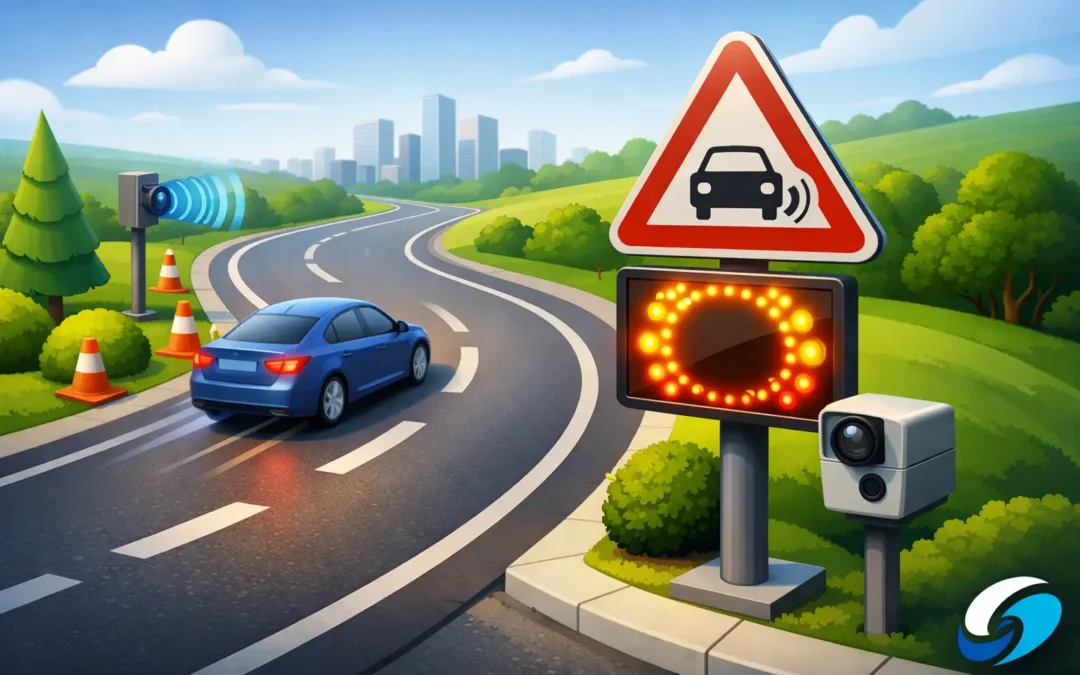
A roadside speed warning sign only has a few seconds to change driver behaviour. If it is poorly sited, based on weak data or installed as a standalone fix where a broader intervention is needed, it quickly becomes background noise. When specified properly, though, speed warning signs for roads can play a measurable role in reducing approach speeds, improving compliance and supporting safer operation at known risk locations.
For highways authorities, road safety teams and traffic engineers, the real question is not whether these signs are useful. It is where they are most effective, what technology gives the most operational value, and how to avoid treating them as a one-size-fits-all solution.
What speed warning signs for roads are designed to do
Speed warning signs for roads are intended to influence driver behaviour in real time. Unlike static regulatory signing, they respond to approaching traffic conditions, most commonly by detecting a vehicle speed and displaying a visual warning when a threshold is exceeded. That threshold may align with the posted speed limit, or it may be set to target a particular approach speed at a bend, crossing, village gateway or junction.
Their value lies in immediacy. A driver who has missed earlier cues may still react to a conspicuous sign face, illuminated roundel or vehicle-activated message. On networks where enforcement resource is limited and physical traffic calming is either unsuitable or unpopular, that can make them a practical intervention.
That said, they are not a substitute for engineering judgement. Some sites need geometric change, carriageway narrowing, revised signing strategy or stronger enforcement support. A speed warning sign can help, but only if it is part of a credible evidence-led response to the site conditions.
Where speed warning signs are most effective
The strongest results usually come at locations with a clear speed management problem and a definable trigger point. Rural approaches into lower speed settlements are a common example. Drivers transition from higher-speed open road conditions into a village environment, and compliance can be inconsistent if the visual character of the road changes too late.
The same principle applies on approaches to sharp bends, priority junctions, schools, pedestrian crossing points and collision clusters where excessive speed is a contributory factor. In these cases, the sign is not simply repeating the legal limit. It is reinforcing a specific need to slow down at a specific point.
Effectiveness depends heavily on context. If the route already contains excessive sign clutter, another display may have limited impact. If visibility is compromised by vegetation, horizontal alignment or competing roadside lighting, the sign’s influence may be reduced. If the threshold is set too low, drivers may see frequent activations and begin to ignore them. If it is set too high, too many non-compliant vehicles pass without intervention.
This is why site selection should always start with traffic speed data, vehicle profile, collision history and a realistic assessment of driver workload on approach.
Choosing the right technology for the site
Not all speed warning signs for roads deliver the same operational benefit. For many authorities and contractors, the choice has moved beyond a simple flashing sign towards integrated detection and data-led systems.
At a basic level, a sign may use internal radar to detect an approaching vehicle and trigger a warning. That can be appropriate for straightforward locations where the aim is localised behavioural influence with minimal complexity. However, more demanding sites often benefit from higher-specification above-ground detection that offers better targeting, more consistent performance and stronger reporting capability.
Radar-based systems can be particularly effective where reliability in varying weather and lighting conditions matters. AI-enabled video detection may add value where a site needs richer classification, multi-modal monitoring or a wider operational picture beyond a single speeding trigger. The important point is that the sign should not be considered in isolation from detection quality. Poor detection creates poor intervention.
For network operators moving away from inductive loops and other intrusive methods, above-ground detection offers obvious practical advantages. Installation is faster, disruption is lower, and future maintenance can often be carried out without repeated carriageway intervention. On busy roads, that has direct operational and safety benefits.
Visibility, conspicuity and driver response
A speed warning sign succeeds when drivers notice it early enough to act, understand it instantly and respond without confusion. That sounds straightforward, but it depends on careful design decisions.
Display format matters. Some sites respond well to a simple roundel with speed indication. Others need a vehicle-activated warning legend because the risk is linked to geometry or a hazard ahead rather than the speed limit itself. Brightness must be sufficient for daytime conspicuity without creating glare or distraction after dark. Sign size, mounting height and lateral position all affect legibility and compliance.
There is also a trade-off between impact and overuse. Highly conspicuous signs can be very effective at isolated high-risk sites, but widespread deployment without strong justification may reduce driver sensitivity over time. Engineers should be selective. The objective is not to illuminate every approach. It is to intervene where behaviour can be changed and where change matters.
Data should lead the decision, not follow it
One of the most common weaknesses in roadside speed interventions is the lack of baseline evidence. A sign is installed because speeding is perceived to be a problem, but no robust pre-installation data exists to define the scale of the issue, the time periods involved or the dominant vehicle types.
That creates two problems. First, the wrong solution may be selected. Second, even if the intervention works, the authority has limited evidence to demonstrate value.
A stronger approach is to begin with measured speed and volume data, ideally supported by classification and directional analysis. Is the issue linked to peak periods, overnight traffic, motorcycles, light vehicles or HGVs? Is speeding concentrated at the gateway, or does it continue through the full corridor? Are there vulnerable road user movements that alter the risk profile?
Once a sign is deployed, the same data discipline should continue. Post-installation monitoring allows the team to assess whether mean speeds, 85th percentile speeds and compliance rates have changed in a meaningful way. If not, thresholds, sign positioning or complementary measures may need adjustment.
For authorities under pressure to justify safety investment, this evidence base is not optional. It supports internal decision-making, funding cases and longer-term programme planning.
Integration with wider traffic management objectives
The best results tend to come when speed warning signs are treated as part of a broader intelligent traffic strategy rather than a standalone product purchase. A sign that detects speed exceedance can also contribute to network insight if paired with traffic counters, classifiers or a wider data management platform.
That matters because speeding rarely exists in isolation. It may interact with congestion patterns, signal coordination issues, active travel routes, school travel demand or known near-miss locations. A site that appears to need only a warning sign may in fact benefit from improved detection upstream, revised priority control or a more complete understanding of vehicle behaviour.
This is where non-intrusive technology offers a clear advantage. Above-ground radar and video systems can support multiple objectives from one installation approach, reducing civil works while improving the quality of available traffic intelligence. For transport teams trying to improve safety and network efficiency at the same time, that flexibility is increasingly valuable.
Common specification mistakes to avoid
The first mistake is specifying the sign before understanding the problem. If the speed issue is intermittent, direction-specific or linked to a particular road user mix, the detection and display logic should reflect that.
The second is underestimating the site environment. Power availability, mounting options, visibility constraints and maintenance access all affect long-term performance. A sign that looks suitable on a drawing may prove awkward in operation if these details are missed.
The third is focusing on the sign face and neglecting the supporting technology. Detection accuracy, data capture and remote monitoring can make the difference between a reactive asset and a useful managed intervention.
Finally, there is the temptation to judge success too quickly. Driver response can vary over time, and some sites need threshold adjustment or complementary measures before the full benefit is seen. A pragmatic review period is usually more informative than a simple before-and-after snapshot taken too soon.
A practical standard for better outcomes
For road authorities and specifiers, the practical standard is clear. Start with evidence. Match the sign type and detection method to the exact risk at the site. Favour non-intrusive technologies where they reduce disruption and improve maintainability. Then monitor performance properly.
That approach is far more useful than asking whether one sign type is universally best, because it never is. Roads differ, driver behaviour differs, and operational priorities differ. What remains constant is the need for interventions that are visible, credible and backed by reliable traffic data.
When speed warning signs are selected with that level of care, they do more than flash at passing vehicles. They become part of a safer, more intelligent road network.