
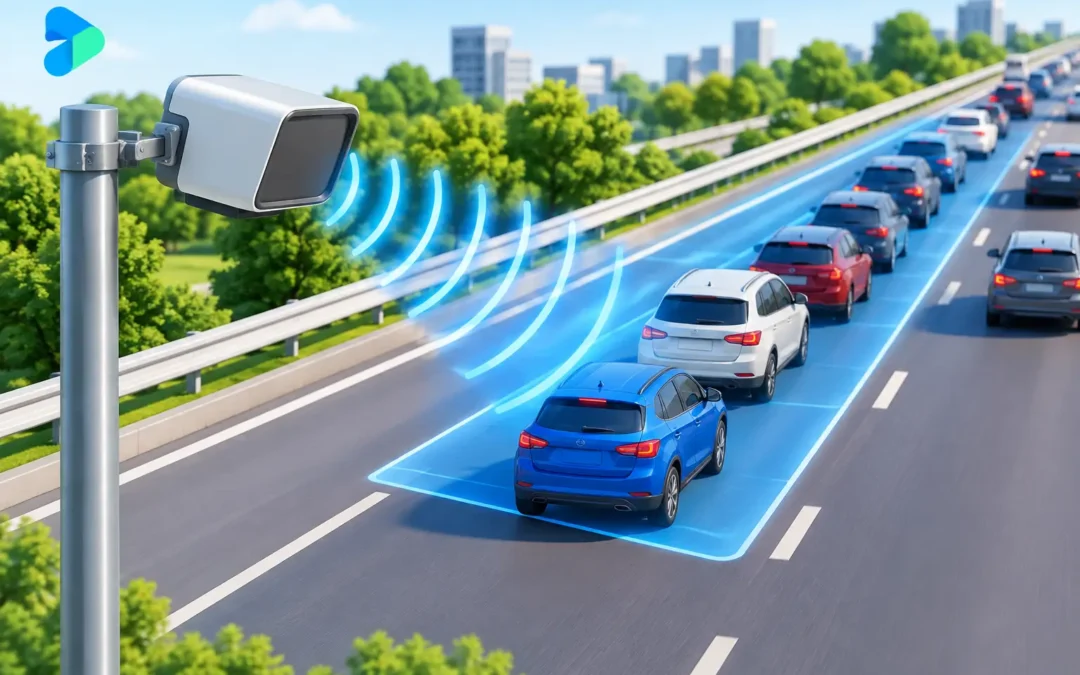
A detector can report every approaching vehicle correctly and still fail the junction if it cannot identify the back of a queue. That distinction matters at congested urban approaches, signalised roundabouts and temporary traffic-management sites, where delayed queue recognition can block side roads, pedestrian crossings or upstream junctions. So, can traffic radar measure queues? Yes, provided the radar, mounting position and control strategy are specified for queue detection rather than simple presence or speed measurement.
Radar is already widely valued as an above-ground alternative to inductive loops. It can be installed without cutting the carriageway, avoids lane closures associated with loop installation and is less exposed to deterioration from road surfacing works. Queue measurement is a more demanding application, however. It requires the system to interpret vehicle position, movement and occupancy across a defined detection area with sufficient consistency for operational decisions.
What queue measurement means in practice
A queue is not simply a group of slow-moving vehicles. For traffic operations, the relevant measure may be the distance from the stop line to the rearmost stationary or slow-moving vehicle, the number of vehicles within a lane, the time that a queue has persisted, or whether it has reached a critical point. The required output depends on the use case.
At a signalised junction, the controller may only need a call that the queue has extended beyond a set point. This can support an extension, a stage demand or a congestion-management response. On a strategic corridor, an engineer may instead need queue length and discharge information for performance monitoring. In a work zone, the priority may be early warning that standing traffic is approaching a high-speed transition.
This is why a specification that asks for “queue detection” without defining the decision to be made is incomplete. A practical scheme should state the lane or lanes being monitored, the queue zone, the speed threshold used to distinguish queued traffic, the update rate, the required accuracy and how the output will interface with the controller or data platform.
How traffic radar measures queues
Traffic radar transmits radio waves and analyses the reflected signal from road users. Depending on the sensor design, it can determine range, speed and direction, then track multiple objects within its field of view. For queue applications, the detection logic uses these measurements to identify vehicles occupying successive positions in a configured zone.
A radar can be configured with virtual detection areas that correspond to an approach lane or a section of carriageway upstream of a stop line. When vehicles slow below a defined threshold, stop, or remain present within that area for a defined period, the system can report occupancy, queue presence or an estimated queue extent. More advanced radar units can maintain object tracks, helping to distinguish arriving traffic from vehicles already waiting.
The key benefit is that these zones are software-defined. If the approach layout changes, if a stop line is relocated, or if the operating need evolves, the detection geometry can often be adjusted without disturbing the road surface. This is particularly valuable where access windows are limited or repeated carriageway interventions would be disruptive.
Queue length is usually an estimate, not a physical measurement
It is useful to be precise about terminology. Radar does not normally measure a queue in the same way that a surveyor measures a line on the ground. It estimates the rear of the occupied or low-speed traffic stream using detected objects and configured rules. The quality of that estimate depends on how well the radar sees each lane, how vehicles are spaced, and whether the chosen settings reflect real driving behaviour at that location.
For many control applications, a reliable threshold is more valuable than a highly granular length estimate. Knowing that a queue has crossed a 60-metre detection point can be enough to protect an upstream junction or trigger a suitable signal response. Where network analytics require metres or vehicle counts, validation against site observations should form part of commissioning.
What affects radar queue-detection accuracy
Installation geometry has a direct effect on performance. The radar needs a clear view of the approach, appropriate mounting height and angle, and enough range to cover the required detection area. A poorly positioned unit may have limited visibility of the queue tail, particularly where the road curves, rises or falls sharply.
Lane discipline also matters. On approaches where drivers regularly straddle lanes, filter late, use a bus lane inconsistently or form two informal lanes, assigning every vehicle to the correct queue becomes more difficult. Radar can still provide valuable occupancy and congestion information, but the design should not assume perfect lane-by-lane precision where the road layout does not support it.
Large vehicles can create temporary screening effects, especially on compact approaches with constrained mounting options. A lorry or bus may obscure smaller vehicles behind it from a particular angle. Sensor placement, field-of-view design and, where appropriate, a complementary detection technology can reduce this risk.
Environmental conditions are another consideration. Radar performs well in darkness and is generally less affected by rain, fog and glare than camera-only detection. That does not remove the need for a sound survey. Street furniture, signs, bridge structures, parked vehicles and vegetation can all affect the available sightline or introduce unwanted reflections.
Finally, the operational definition of a queue should be tested. If the speed threshold is too high, normal slowing traffic may be classified as queued. If it is too low, a creeping queue may not be recognised early enough. The right setting varies between an urban signal approach, a high-speed rural junction and a site with frequent stop-start conditions.
Radar versus loops and video for queue monitoring
Inductive loops can provide reliable presence detection at fixed points, but they offer limited information between loop locations unless multiple loops are installed. Extending queue coverage can therefore mean additional road cutting, cabling and future maintenance exposure. Radar can cover longer approach sections from a single above-ground installation, making it attractive where disruption, programme risk and whole-life maintenance are key concerns.
AI-powered video detection can provide rich scene understanding, including lane occupancy, road-user type and visual verification of unusual conditions. It is often highly effective where the camera has an unobstructed view and the scheme benefits from detailed classification. Its performance can be influenced by image quality, lighting, glare, obscuration and camera alignment.
Radar is particularly strong where all-weather operation, speed measurement and non-intrusive deployment are priorities. It can detect vehicles effectively in poor light and does not depend on a clear visual image in the same way as video. The most suitable technology is therefore site-dependent. Some complex junctions benefit from combining radar with AI video, using each technology where it is strongest rather than asking one sensor to resolve every operational challenge.
Specifying a radar queue-detection scheme
A successful installation begins with the traffic question, not the sensor. Define whether the aim is queue-tail warning, adaptive signal control, junction blocking prevention, travel-time analysis or operational reporting. Then identify the exact points at which an intervention should occur.
The site survey should consider detector location, mounting infrastructure, lane geometry, approach gradients, roadside clutter, turning movements and likely obstructions. It should also confirm power, communications and controller integration requirements. A technically capable detector cannot compensate for a mounting position with no clear view of the critical zone.
Commissioning should include observed traffic conditions, not just a static alignment check. Test free flow, arriving platoons, standing queues, creeping traffic, buses and lorries, as well as the conditions that cause the problem the scheme is intended to solve. Compare detector outputs with field observations, then refine detection zones and logic where needed.
For highways authorities and contractors, non-intrusive radar offers a practical route to better queue intelligence without opening the carriageway. The value comes from defining the operational need clearly, matching the detection design to the site and validating performance against real traffic behaviour. A queue alert is only useful when it arrives early enough, accurately enough and in a form the network can act on.