
A detector that misses a waiting cyclist, holds a green phase for an empty approach, or requires a lane closure to repair can have a direct effect on network performance. That is why the question, how do radar detectors work, matters well beyond simple speed measurement. Modern roadside radar provides continuous, above-ground detection that can support safer junction operation, more responsive traffic signals and better-quality traffic data without cutting into the carriageway.
For highways authorities and traffic engineers, radar is not a single-purpose device. Correctly selected and commissioned, it can detect approaching, departing and stationary road users; measure speed and direction; and provide inputs for control strategies, monitoring and enforcement-supporting applications.
How do radar detectors work in traffic management?
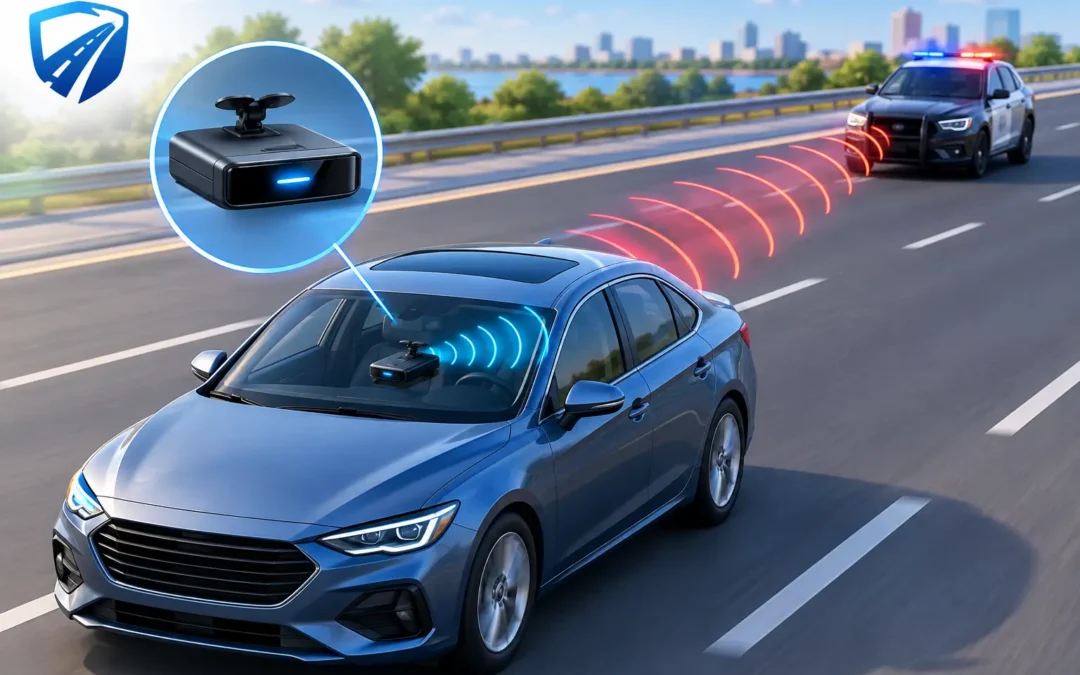
Roadside radar works by transmitting radio waves towards a defined detection area and analysing the energy reflected back by objects within it. Vehicles, cyclists and other road users reflect a portion of that signal. The radar’s processor uses changes in the returned signal to establish whether an object is present, moving, approaching or receding.
The underlying principle is well established, but the practical value comes from the quality of the antenna, signal processing, detection logic and installation design. A traffic radar is configured to distinguish relevant road users from background movement and to create detection zones that correspond with a lane, stop line, advance detector position or shared-use route.
Unlike an inductive loop, which detects a change in electromagnetic field caused by a vehicle over a cut in the road surface, radar is normally mounted on a pole, signal head, gantry or roadside structure. It observes the carriageway from above or beside it. This non-intrusive approach avoids saw-cutting, reinstatement and the repeated disruption associated with failed loops.
The Doppler effect measures movement
Many radar detectors measure speed using the Doppler effect. When the transmitted wave reflects from a moving vehicle, the frequency of the returned signal changes slightly. A vehicle moving towards the detector produces a different frequency shift from one moving away from it. The size and sign of that shift enable the radar to calculate speed and direction.
This makes Doppler radar particularly useful for approaches where speed is a key operating condition, including speed-activated signs, warning systems, queue monitoring and traffic data collection. The detector can be configured to ignore traffic travelling in an irrelevant direction, reducing unwanted calls from adjacent movements where the site geometry allows.
Range and position add operational context
Speed alone is not enough for responsive control. More advanced traffic radar can determine the range to an object as well as its movement. Frequency-modulated continuous-wave radar, commonly referred to as FMCW radar, varies its transmitted signal in a controlled way. By comparing the transmitted and reflected signals, the device can estimate how far away a target is.
Range information allows the detector to divide its field of view into virtual zones. Rather than relying on a physical loop at one fixed point, engineers can establish zones for approaching traffic, dilemma-zone protection, queue presence or stop-line detection. A single suitably positioned sensor may cover several zones, subject to the road layout, mounting height and required detection performance.
The radar then converts its observations into usable outputs. These may be relay-style calls, digital messages, detector states or data sent to a traffic controller, sign, monitoring platform or local communications network. The controller does not need to know the physics behind the signal. It needs a dependable, correctly timed indication that a relevant road user is present or approaching.
From reflections to reliable detector calls
A roadside environment is rarely simple. Multiple lanes, turning movements, buses at stops, parked vehicles, street furniture and nearby traffic can all affect the field of view. Reliable radar detection therefore depends on more than mounting a sensor and switching it on.
The first task is to define the operational need. At a signal-controlled junction, this may be a vehicle extension call or a confirmation that traffic remains at the stop line. On a rural approach, it may be advance detection that responds to speed. At a crossing, the requirement may be to avoid prematurely ending a stage while a cyclist is still within the conflict area.
The detector is then positioned and aligned to view the intended approach. Height, lateral offset, angle and orientation affect what the radar can see and how accurately it separates road users. Configuration software is used to draw detection zones and apply rules for direction, speed thresholds, target persistence and filtering. Commissioning should test realistic movements, not only a single car travelling through an empty site.
Good configuration reduces false detections, but it should not be confused with making a difficult site disappear. Closely spaced lanes, steep gradients, severe curves or substantial occlusion may require a different mounting position, multiple sensors or a complementary technology. The right answer depends on the detection objective and the consequences of a missed or false call.
What radar can detect well – and where care is needed
Radar is especially effective in poor visibility. It does not depend on daylight or image contrast in the way that video detection can, and it can continue operating through darkness, glare, rain, fog and light snow. This is a significant advantage for sites where dependable vehicle detection is needed through changing weather and lighting conditions.
It also has no road-surface component. Installation can often be completed with far less disruption than loop cutting, making radar a practical option for resurfaced roads, high-traffic routes, bridge decks and locations where lane closures are difficult to secure. Above-ground access can simplify maintenance and future changes to detector zones.
However, radar is not automatically the best technology for every requirement. Its ability to identify object type depends on the sensor, processing capability, target size, traffic mix and site geometry. Detecting a lorry is generally less demanding than consistently detecting a slow-moving cyclist in a cluttered urban scene. Pedestrian detection, detailed classifications, queue length estimation and complex multimodal conflict areas may benefit from AI video, radar-video fusion or another complementary sensor.
Radar performance also depends on line of sight. Large vehicles can mask smaller road users behind them, and poorly selected zones can capture movements from adjacent lanes or side roads. These are engineering considerations, not reasons to default to legacy in-road detection. They underline the need to specify the detection task clearly and validate performance at the actual site.
Radar versus inductive loops and video detection
Inductive loops remain common because they are familiar and can provide dependable presence detection when installed and maintained correctly. Their limitations are operational: installation requires carriageway intervention, road defects can damage loop wires, and changing a detection point usually means revisiting the road surface. Those costs and disruptions can be disproportionate at busy or safety-critical locations.
Radar replaces the fixed, road-embedded sensing point with configurable coverage from the roadside. Detection zones can often be adjusted in software as layouts, signal strategies or traffic patterns change. The benefit is not simply quicker installation. It is a more adaptable detection asset with less exposure to roadworks-related failure.
Video detection offers a different strength. It can provide visual coverage, rich classifications and situational information across complex scenes. Yet camera performance can be influenced by lighting, shadows, obscuration, lens contamination and privacy requirements. Radar and AI video are often best considered as complementary tools rather than competing products. Radar brings all-weather motion and range data; video can add visual context and classification intelligence.
Specifying radar for measurable network outcomes
The most effective specification starts with the decision the detector must support. Is the objective to reduce unnecessary green time, provide advance warning of speeding vehicles, extend a phase for approaching traffic, count and classify movements, or improve cyclist detection? Each use case creates different requirements for range, field of view, latency, outputs and integration.
It is also worth defining acceptance criteria before installation. These may include detection coverage by lane, minimum target speeds, response time, direction discrimination, false-call tolerance and controller interface requirements. A device specification alone does not guarantee an operational result. Site survey, mounting design, configuration and commissioning are part of the detection system.
For authorities seeking to reduce disruption from legacy in-road infrastructure, radar offers a proven route to more flexible above-ground detection. The strongest deployments are those where the sensor is selected around the control problem, not simply used as a like-for-like replacement for a loop. That is where better detection begins to translate into safer roads, reduced congestion and more sustainable network operation.