
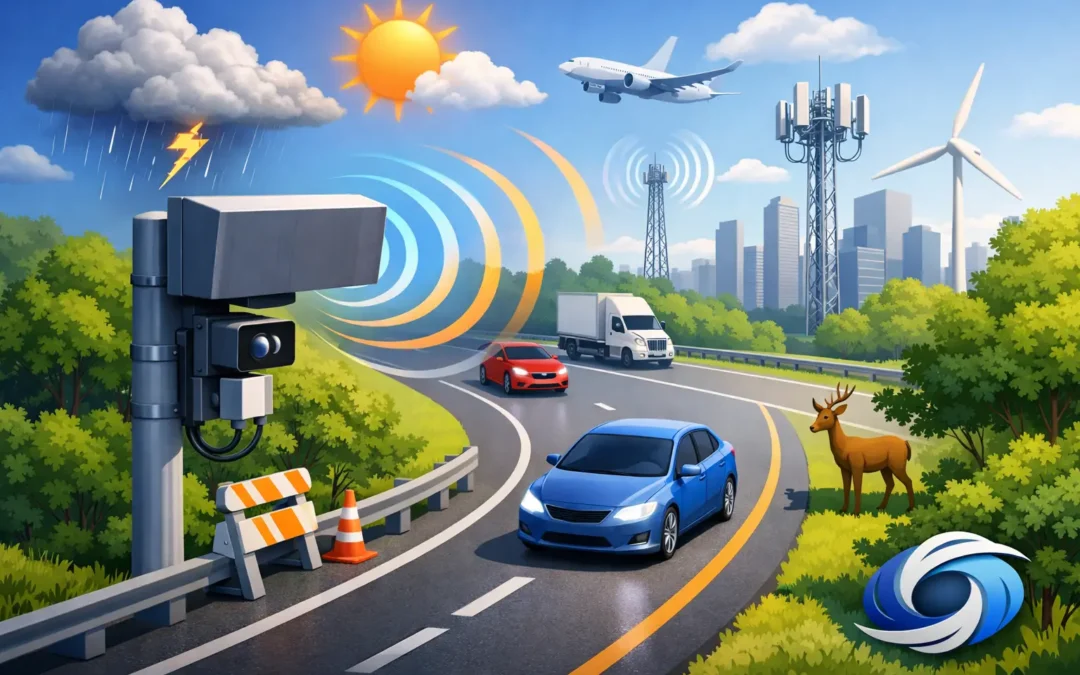
A radar detector can be installed without closing a lane or cutting the carriageway, but roadside radar performance is not simply a matter of mounting a sensor and applying power. Its useful output depends on whether the detector is correctly matched to the approach geometry, lane layout, traffic mix and control objective. A system that detects a moving vehicle reliably may still be unsuitable if it cannot hold a queue, distinguish a cyclist from a car, or provide the lane-level data required by the controller.
For highways engineers and signal professionals, the relevant question is not whether radar works in principle. It is whether the installed system will provide dependable, actionable detection under the conditions that matter at that location: peak queues, low-speed approaches, adverse weather, turning movements and changing road layouts.
What roadside radar performance should mean
Performance should be measured against the application, rather than a single detection range figure. On a signal-controlled junction, the priorities may be accurate call generation, queue detection and reliable gap-out operation. On a rural high-speed approach, early detection and speed measurement may be more significant. At a crossing or cycle route, the requirement may be to identify vulnerable road users while excluding adjacent carriageway traffic.
This distinction matters because radar is capable of reporting several different data types. Depending on the technology and configuration, it can provide presence, range, speed, direction, lane position, vehicle count and classification. The value of each output depends on how it is used. A highly accurate speed reading does not compensate for a poorly defined detection zone at a stop line.
A practical specification should therefore state the operational outcome first. For example: maintain a call for stationary or slow-moving traffic in lane two; extend green for an approaching cyclist; count vehicles by direction; or provide advance warning of a queue. The detector, mounting arrangement and configuration can then be assessed against that task.
Installation geometry has the greatest influence
Above-ground detection avoids the disruption and future failure points associated with road-embedded inductive loops. It does not remove the need for careful design. The position, height, orientation and line of sight of a roadside radar sensor have a direct effect on coverage and target separation.
Mounting height and angle
A detector mounted too low may have limited visibility through traffic, particularly where larger vehicles obscure smaller cars, motorcycles or cyclists. A unit mounted too high can reduce useful resolution close to the detector or produce an unnecessarily shallow viewing angle. The optimum height depends on the road width, desired detection area and the sensor’s field of view.
Mounting angle is equally important. Radar measures target movement relative to the sensor, so its viewing direction must support the intended speed and direction calculation. An oblique angle may be necessary to view multiple lanes from a single roadside pole, but it can make lane separation and target tracking more demanding. The configuration must account for the actual geometry, not an idealised drawing.
Detection-zone design
Detection zones should reflect vehicle behaviour and signal strategy. A large zone covering the entire approach can appear attractive, yet it may create unwanted calls from turning vehicles, traffic in adjacent lanes or vehicles travelling on a parallel service road. Tighter zones can improve selectivity, but may leave gaps if the mounting location or road alignment changes.
At complex junctions, it is often better to define several purposeful zones rather than rely on one broad area. Advance zones can support efficient approach detection, while stop-line or queue zones maintain demand where traffic is moving slowly. Each zone should be checked against the controller logic so that radar data supports, rather than complicates, the operation of the junction.
Traffic conditions test the detector, not the brochure
A clear approach with freely flowing cars is rarely the difficult case. The real test of roadside radar performance comes when traffic is dense, slow, mixed and irregular.
Queueing conditions can create masking, where a larger vehicle reduces the sensor’s view of another road user. This is particularly relevant where HGVs and buses use the same approach as cyclists or small vehicles. The selected radar technology, mounting position and zone design should be evaluated for the likelihood of occlusion at that site.
Low-speed and stationary detection also deserve specific attention. Traditional Doppler radar is strongly associated with moving-target detection because it measures frequency shift caused by motion. More advanced radar systems can support presence detection and tracking at very low speeds, but capability varies by product and configuration. A scheme requiring dependable queue presence should not assume that every speed radar provides equivalent stationary-object performance.
Traffic classification introduces another layer of complexity. Vehicle size, shape, movement and radar cross-section all influence how a target is interpreted. Classification can be highly useful for counting, enforcement support, freight monitoring and adaptive control, but it should be validated against local traffic. A regular bus route, frequent articulated lorries, cyclists travelling close to kerbs and pedestrians near the detection area can all affect the rules needed to achieve useful results.
Weather and the roadside environment
Radar has a major operational advantage over optical-only detection: it is generally less affected by darkness and changing light. That makes it well suited to 24-hour traffic applications. However, it should not be treated as immune to its environment.
Heavy rain, snow, spray and airborne debris can affect the signal environment, particularly at longer ranges or where detection thresholds are set too aggressively. In most UK roadside installations, the bigger practical risks are often physical rather than meteorological: a pole that vibrates in wind, vegetation entering the field of view, a new sign installed close to the detector, or a change in carriageway layout following works.
Reflective surfaces and roadside infrastructure can also produce unwanted returns. Metal safety barriers, street furniture and parked vehicles may be within the radar field of view. A good survey identifies these features before installation, while commissioning confirms that the detector is tracking genuine road users rather than fixed objects or irrelevant movement beyond the target approach.
Commissioning turns capability into usable data
Commissioning is where the difference between a functioning installation and a trusted detection system becomes visible. It should include physical alignment, zone configuration, controller integration and live observation of representative traffic movements.
The technician should observe more than a small sample of free-flowing vehicles. Testing should include vehicles in each lane, turning movements, slow approaches, queues and, where relevant, cyclists and buses. The aim is to identify both missed detections and false activations. A false call may seem less serious than a missed vehicle, but repeated unnecessary extensions can reduce junction efficiency and undermine the intended signal strategy.
Where radar data is passed to a traffic controller, the input mapping and fail-safe behaviour must be understood. Detection outputs need clear definitions: which zone creates a demand, which holds it, which provides an extension, and what happens if communications are interrupted. These are engineering decisions, not merely software settings.
For counting and analytics applications, validation should compare radar output with a measured reference sample. The appropriate tolerance depends on the use case. Strategic trend analysis may accept a different level of variance from a safety-led scheme or a signal optimisation project. Establishing this baseline at handover makes later performance checks far more meaningful.
Maintaining performance after handover
Non-intrusive roadside radar reduces the maintenance burden associated with loops damaged by resurfacing, utility works and road deterioration. It still benefits from planned inspection. Road networks change: lane markings move, new cycle facilities are introduced, vegetation grows and traffic patterns alter following development or diversion routes.
Periodic checks should review physical mounting security, field-of-view obstructions, detector health status and the continuing relevance of configured zones. If data is available through a vehicle data management platform, trend changes can flag a potential issue. An unexpected fall in counts, a shift in lane distribution or an unusual level of occupancy may indicate a detector problem, but could equally reveal a genuine change in network conditions. The investigation should consider both.
C & T Technology supports this outcome-focused approach by combining above-ground radar detection with the technical advice needed to align equipment, installation and operational requirements. The objective is not simply to replace a loop. It is to provide dependable traffic intelligence that improves safety, reduces disruption and helps the network operate as intended.
The strongest roadside radar schemes begin with a clear definition of the decision the detector must support. When mounting geometry, target behaviour, controller logic and commissioning are considered together, radar becomes more than a convenient alternative to road-embedded detection: it becomes a practical source of evidence for better traffic management.