
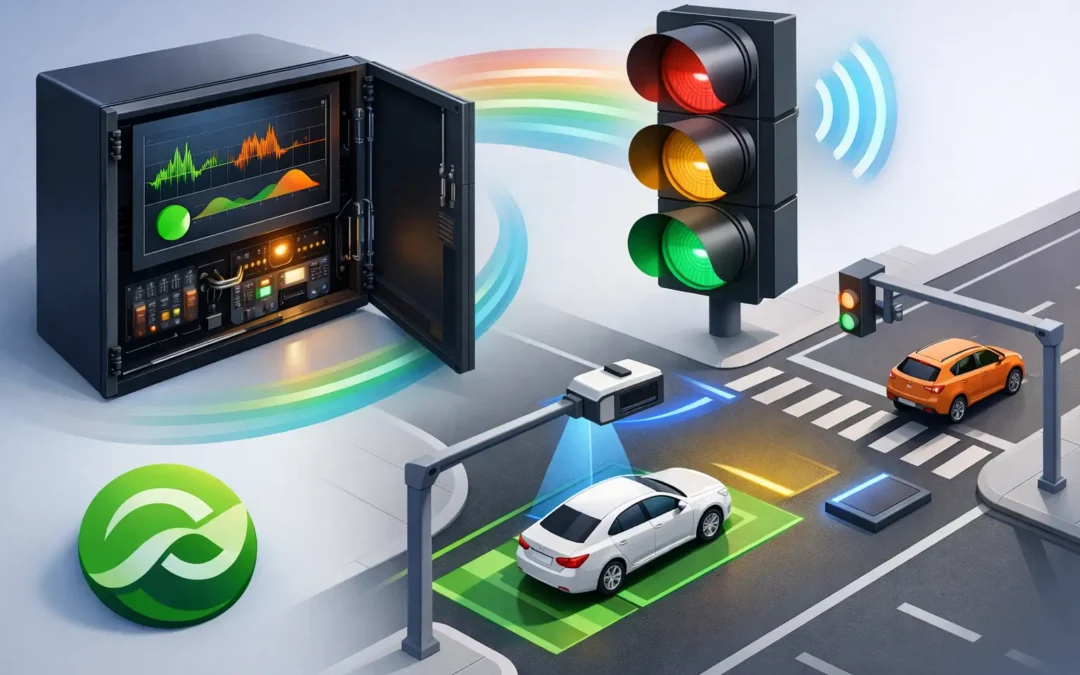
A detector can identify a waiting cyclist, an approaching vehicle or a growing queue with impressive accuracy. That capability only improves the network when the controller receives the right demand, at the right time, in the right form. To integrate detector outputs with signal controllers effectively, engineers must treat detection, interface design and signal operation as one coordinated system – not as separate installation tasks.
For authorities replacing inductive loops, this is particularly relevant. Above-ground radar, AI video and wireless sensors can be installed without cutting the carriageway, but their operational value depends on how their outputs are configured, mapped and proven at the junction.
Start with the signal operation, not the detector
The first question is not which output the detector can provide. It is what the controller needs to make a better decision. A vehicle detector may be required to place a phase demand, extend green time, hold a phase while traffic remains present, cancel a demand, support queue management or provide data to an adaptive control strategy.
Each purpose has different timing and reliability requirements. A simple side-road demand may only need a momentary input when a vehicle enters a defined detection zone. A high-speed approach may need an advance call, carefully positioned to give the controller enough time to respond within its programmed stage sequence. A detector used for maximum green extension needs dependable presence information throughout the relevant approach.
This operational definition should be agreed before installation. It avoids a common problem: a detector zone is positioned for a clear camera view or convenient radar mounting location, rather than for the decision the controller must make.
Define the input function precisely
At design stage, document every detector-to-controller relationship. Identify the detector location and zone, the road user class to be detected, the controller input reference, the output type, the intended action and the timing behaviour. Include whether the output is normally open or normally closed, latching or pulsed, and the required pulse duration where applicable.
The distinction between a call and a presence input matters. A call confirms that an event has occurred. Presence indicates that an object remains in a zone. If a presence function is wired and configured as a brief pulse, the controller may remove demand while a vehicle is still waiting. If a call is held continuously when the controller expects a pulse, the phase may be repeatedly demanded or held unnecessarily.
Choose an interface that suits the controller estate
Most signal controllers can accept conventional digital inputs, typically via a suitable input card or interface module. Detectors may provide volt-free relay contacts, opto-isolated outputs, open-collector outputs or network-based messages. Compatibility must be confirmed for the specific controller, cabinet arrangement and maintenance standard rather than assumed from a product datasheet.
Volt-free relay outputs remain a practical choice where a straightforward, auditable connection is needed between an above-ground detector and a local controller input. They are familiar to maintenance teams and can simplify like-for-like replacement of loop functions. However, relay logic, contact ratings, cable runs and fault states still need to be checked.
Network integration can be appropriate where multiple data streams, remote configuration or richer classification information are required. It can reduce the need for numerous individual hardwired outputs, but it introduces requirements around communications resilience, cyber security, addressing, protocol compatibility and failure behaviour. For a single call point, a simple hardwired interface may be the most proportionate solution. For a corridor scheme with centralised analytics, the balance may favour IP connectivity.
Design for safe and predictable fault behaviour
Detection should improve responsiveness, but it must not compromise the controller’s safety functions. Intergreens, conflict monitoring and the controller’s core safety logic remain the controller’s responsibility. Detector interfaces should be configured so that a lost feed, damaged cable, obscured camera or communications fault results in a defined operational state.
The preferred response depends on the application. A failed extension detector may need to fall back to fixed-time operation. A missed pedestrian or cyclist demand may require a different mitigation strategy than a failed vehicle call on a lightly used arm. The key is to make the fallback explicit, record it in the design, and test it during commissioning.
Position detection zones around real traffic behaviour
Above-ground detection provides flexibility that road-embedded loops cannot easily match. Zones can be adjusted without carriageway reinstatement, allowing engineers to refine detection after observing actual driver, cyclist and pedestrian behaviour. This is valuable, but it should not become an excuse for vague design.
For approach demand, consider approach speed, queue formation, lane discipline and the controller’s likely response time. A radar zone positioned too close to the stop line may provide insufficient notice at a busy junction. One positioned too far upstream may create calls from traffic that turns off or joins a queue that never reaches the junction.
At the stop line, the challenge is often presence detection. AI video can distinguish vehicle types and track queue conditions, while radar can offer reliable detection in poor visibility and challenging weather. The most suitable technology depends on the geometry, detection objective, mounting height, available power and communications, and the level of classification required.
Cycle detection deserves its own assessment. A zone designed around general traffic may not reliably identify a cyclist waiting to make a separate demand, particularly where cyclists wait outside a conventional lane position. Detector configuration should reflect the movement, expected waiting location and approach path, rather than simply applying a vehicle-oriented zone.
Configure timings as carefully as zones
The controller sees an electrical or digital input, not the road scene. That means detector timing settings translate directly into junction behaviour.
A pulse output needs enough duration to be reliably recognised by the controller, allowing for input scan rates and any configured filtering. A presence output may need dropout delay to avoid losing a vehicle when it pauses, creeps forward or is briefly masked by another road user. Equally, excessive delay can keep an inactive phase demanded after traffic has departed.
Filtering should address real false calls without masking genuine demand. Wind-blown vegetation, reflections, headlight glare, parked vehicles, large vehicles in adjacent lanes and detector occlusion can all influence performance depending on the technology and site. A good configuration is not the one with the most aggressive filtering. It is the one that maintains reliable detection under expected site conditions while avoiding needless stage changes.
Commission on street, not only at the cabinet
Bench testing proves the electrical interface. Site testing proves the traffic operation. Both are needed.
Before live operation, verify that each physical detector output appears at the correct controller input and initiates only the intended function. Then observe the complete sequence in representative traffic conditions. Test vehicle demand, green extension, queue presence, cyclists where applicable, and loss of detection or communications.
A practical commissioning record should capture the configured zones, output logic, input references, controller parameters, photographs of the installed equipment and test results. This gives maintenance teams a usable baseline when a junction is modified, retimed or investigated after a reported issue.
For schemes with variable demand through the day, testing should extend beyond a quiet off-peak visit. Peak queues, darkness, wet weather and low sun can expose issues that are not visible during an initial installation check. Remote health monitoring and detector diagnostics can help identify faults early, but they do not replace periodic operational review.
Use detector data to improve control over time
A well-integrated detector does more than create a call. It can provide evidence for refining signal operation. Traffic counts, speed profiles, occupancy, queue length and classification data can reveal whether a phase is being demanded appropriately, whether green is being extended productively, or whether a junction is creating avoidable delay.
This is where non-intrusive technologies offer a wider operational benefit. The same above-ground installation that supplies a controller input can also support network monitoring without further carriageway works. Authorities can use that evidence to review timing plans, identify cycle movements, assess lorry activity or target interventions at locations where congestion and safety concerns overlap.
The integration should, however, remain proportionate. Not every junction needs detailed analytics or complex logic. At some sites, a dependable vehicle call and a clear fault strategy will deliver the greatest benefit. At others, classified detection and adaptive control can justify a more sophisticated design.
A better detector connection is a better junction decision
Signal control performs best when detection reflects what is actually happening on the approach, and when the controller has a clear, reliable instruction on how to respond. C & T Technology supports this outcome with above-ground radar, AI video and wireless detection technologies that can replace disruptive loop installations while giving engineers greater flexibility over detection design.
The useful final check is simple: when a road user arrives, waits, moves or leaves, does the detector output cause the controller to make the intended decision? If the answer is proven under real site conditions, the integration is doing its job – supporting safer roads, reduced congestion and more sustainable traffic operation.