
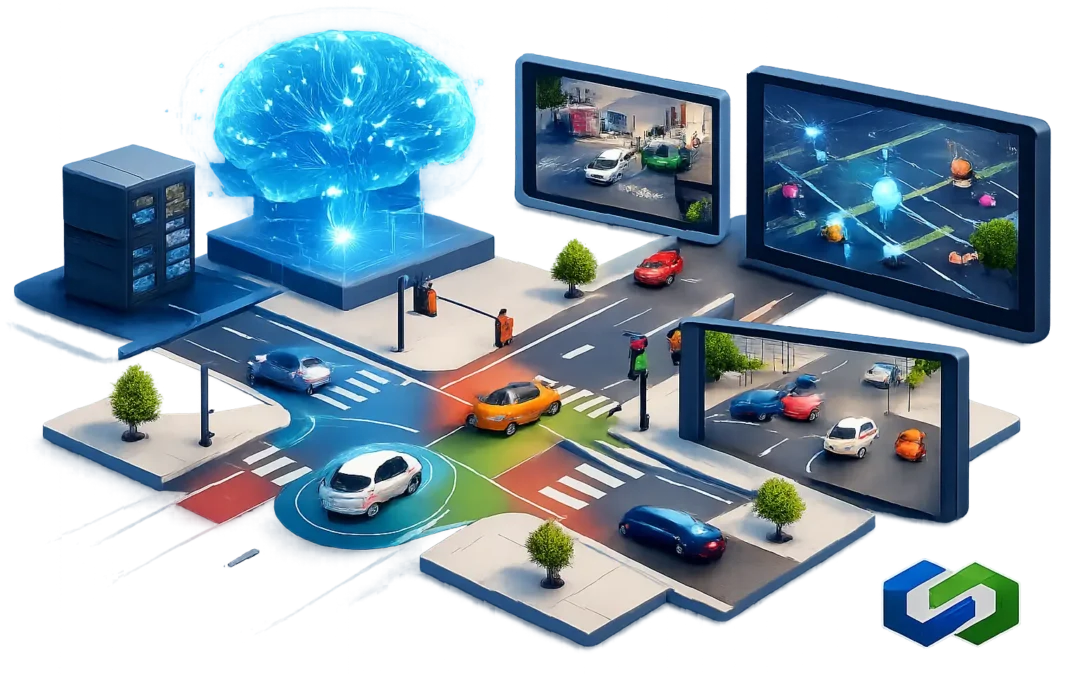
A guide to AI junction monitoring starts with a simple operational question: what must the junction know, and how quickly must it act? At a busy urban crossroads, a missed cyclist, an unnecessarily long green phase or a queue extending beyond the detector zone can affect safety and network performance within minutes. AI-enabled video monitoring gives traffic teams a more detailed, above-ground view of those conditions without cutting into the carriageway.
Unlike legacy inductive loops, an AI camera can distinguish between road users, track movement through defined areas and produce data that supports both real-time control and longer-term engineering decisions. The technology is not a substitute for sound signal design or traffic engineering judgement. It is a way to provide those decisions with better, more timely evidence.
What AI junction monitoring should achieve
AI junction monitoring uses video analytics to identify and classify objects within a camera scene. Depending on the system configuration, it can detect cars, vans, lorries, buses, motorcycles, cycles and pedestrians, then report their presence, direction of travel, speed, queue status or occupancy within virtual detection zones.
For a signal-controlled junction, the immediate value is dependable demand detection. A detector can call a stage when a vehicle approaches, extend a green phase while traffic remains present, or confirm that a cycle lane and pedestrian crossing area are clear. This avoids relying on a fixed timing plan that may be inefficient outside peak periods.
The wider value lies in understanding how a junction actually operates. Video analytics can reveal recurring queue formation, late lane changes, turning conflicts, blocked exits, cycle movements and the effect of bus stops or loading activity near the stop line. These are the details that can be missed when teams only have loop activations or periodic manual surveys.
The objective should be specific. One site may need improved cyclist detection at a protected approach. Another may need queue length data to prevent traffic blocking an upstream junction. A third may require classified turning counts before a capacity improvement scheme. Defining the outcome before selecting equipment prevents a sophisticated camera from becoming an expensive replacement for a basic presence detector.
A practical guide to AI junction monitoring design
The strongest deployments begin with a site survey and a detection plan, not a camera specification. Engineers should identify every decision that the monitored junction needs to make, from calling a vehicle stage to measuring a queue or recording a near-miss pattern.
Map movements, not just lanes
Lane-based detection remains useful, but junction operation is defined by movements. Map the approaches, stop lines, turn pockets, pedestrian crossings, cycle facilities, bus lanes and exit links. Then identify where each road user should be detected and what action that detection should trigger.
For example, a right-turn lane may need an approach call zone and a separate stop-line presence zone. The approach zone gives the controller time to serve demand; the stop-line zone prevents a waiting vehicle being lost from detection. On a cycle approach, the zone should be positioned and sized for realistic rider behaviour, including filtering and staggered arrival at the signal.
Exit monitoring is equally valuable where downstream congestion can block a junction. A virtual zone beyond the crossing can support queue management strategies, while carefully defined areas can identify vehicles stopped in a yellow box or on a pedestrian crossing. These applications require particular care: a poorly positioned zone can misinterpret normal waiting behaviour as an obstruction.
Choose camera positions for detection quality
Mounting height, viewing angle, distance and line of sight determine whether analytics can perform consistently. A camera needs a sufficiently clear view of the intended detection zones, with limited obstruction from signal heads, street furniture, mature trees, parked vehicles and large vehicles in adjacent lanes.
A high, oblique view can cover several lanes and movements, but may reduce the visible size of smaller objects such as cycles. A lower view may improve detail at a stop line while being more vulnerable to occlusion. There is no universal mounting arrangement. The best position depends on the geometry, the road users that matter most and whether the priority is control, safety analysis or counts.
Lighting conditions deserve equal attention. Headlight glare, low winter sun, reflections on wet surfacing and shadows cast by buildings can all change the scene. Modern AI video analytics are designed to handle varied conditions, but performance must be assessed on the actual site, not assumed from a daylight demonstration.
Specify the outputs and interfaces early
AI detection only improves operations when its outputs reach the right system in the right form. For signal control, this may mean detector calls, extensions, occupancy states or fault indications delivered through the controller interface. For planning and safety work, it may mean classified counts, turning movements, speed profiles, queue data and time-stamped event records supplied to a traffic data platform.
Set out the required outputs before installation. Clarify whether detection is intended to be safety-critical, advisory or analytical, and agree the expected response if communications fail, a camera view is obstructed or confidence falls below an agreed threshold. Fail-safe behaviour and local controller logic are central to a reliable design.
Where AI video adds operational value
At isolated junctions, AI monitoring can make stage demand more responsive to actual traffic. This can reduce unnecessary delay on side roads, particularly during off-peak periods, while maintaining detection for vulnerable road users.
In coordinated urban networks, the benefit is often better visibility rather than a single detector call. Queue length and occupancy data can show where congestion is propagating between junctions. Signal engineers can use that evidence to refine timing plans, assess gating strategies and investigate why a coordinated route is not performing as expected.
For road safety teams, classified movement data can support more targeted intervention. If analysis shows that cyclists are regularly delayed, queuing in an unsuitable position or encountering turning traffic at a particular time, the authority has evidence to review detection, staging, signing, markings or layout. Video-based systems should support safety assessment, not replace formal collision analysis or site observation where these are required.
Temporary traffic management and works sites can also benefit from non-intrusive monitoring. Above-ground equipment avoids carriageway cutting and can be deployed where access windows are short or road closures are difficult to secure. That reduces disruption, though temporary installations still need secure mounting, power, communications and a clear maintenance plan.
Commissioning matters as much as installation
An AI junction monitoring system should be commissioned against real traffic, not simply checked for a live video feed. Each zone needs to be tested with the types of road user it is meant to detect, across every relevant lane and movement. This includes bicycles, motorcycles and buses where they form part of the requirement, not only standard passenger cars.
Testing should verify detection at low and high speeds, vehicles stopping at the line, queues, turning movements and likely occlusion scenarios. Record the detector behaviour and confirm that the controller responds as intended. If a zone is too wide, it may call demand from an adjacent movement. If it is too narrow, it may miss road users who position themselves differently from the assumed lane path.
Commissioning is also the time to set practical performance measures. These may include detection rate by class, false-call rate, queue measurement accuracy, time from object detection to controller response, and data availability. The appropriate threshold depends on the application. A strategic count survey and a signal extension function do not carry the same operational risk or need the same tolerances.
Manage data, maintenance and change
AI video monitoring brings data governance into junction design. Authorities and contractors should establish who can access live images, how long footage or event data is retained, what data is exported and how the deployment meets applicable data protection obligations. In many cases, the useful output is anonymised traffic data rather than identifiable imagery, but that outcome needs to be designed into the system and operating process.
Maintenance should focus on the factors that affect the camera scene: lens cleanliness, alignment, enclosure condition, communications, power supply and changes in the streetscape. New signs, vegetation growth, resurfacing, altered lane markings or a relocated bus stop can all affect detection zones. A periodic review is more effective than waiting for a control fault or a public complaint to reveal degraded performance.
It is also sensible to retain a baseline. Before changing signal logic or detector settings, capture the existing delay, queue, stage demand and journey-time conditions where possible. This allows teams to distinguish a genuine improvement from normal day-to-day traffic variation.
Making the technology work for the junction
AI junction monitoring is most effective when it is treated as part of the traffic control system rather than a standalone camera project. The hardware, virtual zones, controller logic, communications and operating procedures all need to match the junction’s actual problems.
For UK and Irish authorities working with constrained road space and limited possession opportunities, above-ground AI detection offers a practical route away from disruptive embedded sensors. The lasting benefit comes from disciplined design and ongoing review: detect the right movement, deliver the right response and use the resulting data to make the next intervention more certain.