
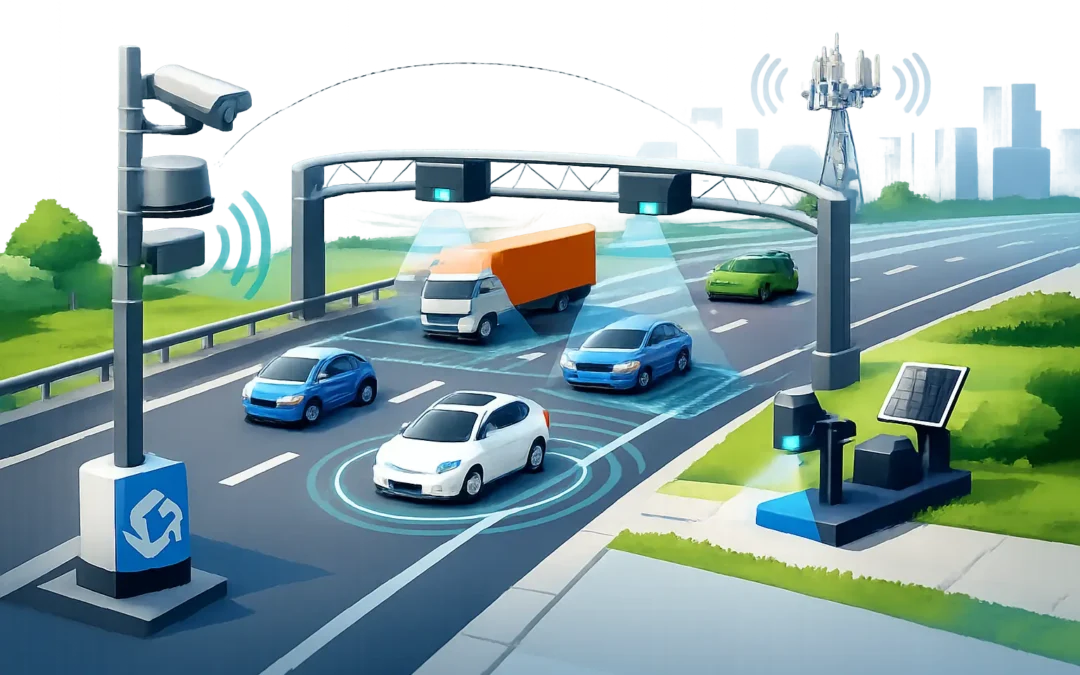
A missed vehicle call at a busy junction is rarely just a detector issue. It can extend queue lengths, frustrate bus operators, encourage risky manoeuvres and weaken confidence in the whole signal operation. Roadside traffic sensors give highways teams a practical way to detect, measure and understand road users without cutting into the carriageway.
For authorities managing ageing assets, constrained maintenance windows and increasing demands for active travel provision, above-ground detection changes the delivery model. Radar, AI video and wireless sensors can be installed at the roadside or on existing street furniture, avoiding the disruption, reinstatement risk and future failures associated with road-embedded inductive loops. The result is not simply faster installation. It is better-quality information for safer, more responsive network management.
Why roadside traffic sensors matter at the kerbside
Traditional loops remain familiar technology, but their limitations are operational as much as technical. Installation normally requires carriageway cutting, traffic management and reinstatement. When a loop fails, the same disruption is often required again, sometimes at a location where access is difficult or where resurfacing has recently taken place.
Roadside detection moves the sensing point above ground. A radar unit may monitor approaching traffic from a signal pole, while an AI-powered camera can establish virtual detection zones across several lanes, cycle approaches or pedestrian movements. Wireless sensor deployments can collect traffic data where power and communications infrastructure are limited. Each approach removes dependence on a physical cable and loop beneath the road surface.
That distinction matters when schemes must be delivered around live traffic. A junction renewal, temporary traffic management layout or safety intervention can often be commissioned with fewer lane closures and less programme risk. It also supports more sustainable delivery by reducing excavation, materials use and repeat visits to repair failed embedded equipment.
The operational case is equally strong. Modern detectors can provide presence, approach, speed, direction, vehicle class, queue information and gap data. Rather than telling a controller only that a vehicle is present, the right sensor can help engineers understand how traffic is arriving and where capacity or safety concerns are developing.
Detection technology should follow the application
No single sensing technology is correct for every location. The best specification starts with the control or monitoring decision the data must support, then considers the geometry, road-user mix, communications and environmental conditions.
Radar for dependable vehicle and cycle detection
Roadside radar is well suited to vehicle detection, speed measurement, direction of travel and classification applications. It can operate day and night and is generally less affected by changes in ambient light than video-based systems. At signal-controlled junctions, radar can provide advance detection, stop-line presence and queue monitoring without installing loops in the carriageway.
Radar is particularly useful where detection must remain reliable in darkness, low sun or adverse weather. It also suits locations where privacy considerations make image-based detection less appropriate. However, site geometry still matters. Engineers need to account for mounting position, detection angle, lane coverage, nearby moving objects and potential occlusion by larger vehicles.
For cyclists, a detector must be selected and configured with greater care than a conventional vehicle-only system. The expected approach line, speeds, waiting position and interaction with adjacent motor traffic all influence the required detection area. A well-placed radar solution can improve cycle call reliability, but validation with real users is essential.
AI video for complex junction behaviour
AI-powered video detection is valuable where the road environment is more complex than a single approach lane. A single camera can monitor multiple virtual zones and distinguish between cars, lorries, buses, cyclists and pedestrians. This makes it effective for adaptive signal control, junction monitoring, conflict analysis and locations with changing layouts.
Its advantage is flexibility. Detection zones can usually be adjusted in software when a lane is repurposed, a cycle facility is introduced or the signal strategy changes. This reduces the need for physical changes at the detection point.
Video does have its own design considerations. Camera placement, lens selection, lighting, shadows, tree growth, rain on the viewing window and privacy governance all require attention. AI classification can considerably improve performance, but it does not remove the need for a proper survey and commissioning process. The system should be assessed against the actual movements that matter, not just a clear demonstration during quiet conditions.
Wireless sensors for rapid data collection
Wireless traffic sensors can be highly effective for temporary surveys, network studies, roadworks monitoring and locations where conventional civil works are disproportionate. Their value lies in speed of deployment and the ability to gather data from sites that may not justify permanent infrastructure.
For a local authority planning a scheme, this can provide evidence before committing to a design. Data on volumes, speeds, classifications and directional flows helps test whether a perceived issue is persistent, time-specific or concentrated in one movement. The trade-off is that battery life, communications availability, mounting arrangements and the duration of the study must be planned from the outset.
Turning detection into better control decisions
A sensor is only as useful as the operational action it informs. At a signal-controlled junction, that could mean extending green time when a queue is building, calling a stage only when a cyclist is waiting, or avoiding unnecessary green time for an empty approach. On a rural route, it may mean identifying excessive speeds before selecting an appropriate intervention. On an urban corridor, it may reveal whether recurring delay is caused by downstream blocking, poor lane discipline or a particular time-of-day demand pattern.
This is where traffic data platforms and analytics become important. Data should be available in a form that engineers can interrogate, compare and report on. Raw counts alone do not explain network performance. Teams need to see patterns over time, assess changes following a scheme and distinguish a genuine trend from a one-off event.
The most useful deployments define performance measures before installation. For example, a junction scheme may track maximum queue length, average delay, cycle demand, bus journey time or the proportion of pedestrians receiving a prompt call. A road safety team may focus on approach speeds, vehicle classes and the periods when non-compliance is highest. Clear measures turn sensor data into evidence for operational changes and future investment.
Selecting roadside traffic sensors for real sites
Specification should not begin with a product type. It should begin with a site survey and a concise statement of need. Is the priority signal actuation, traffic counting, speed monitoring, classification, cycle detection, safety analysis or several of these together? The answer affects the detection range, accuracy requirement, field of view, output protocol and mounting arrangement.
Engineers should also consider how the detector will integrate with the wider estate. Compatibility with signal controllers, communications networks and data management systems is fundamental. So is access for installation, alignment, cleaning and future replacement. A detector placed where it cannot be safely maintained may solve one problem while creating another.
There are practical trade-offs. Video may offer richer classification and flexible virtual zones, while radar can provide dependable detection in conditions where image quality is variable. A combined approach may be justified at complex junctions, with radar supporting core vehicle actuation and video providing wider situational data. At simpler sites, a focused sensor configuration can be more economical to operate and easier to validate.
Accuracy should be assessed in context. A traffic counter used for strategic planning has different tolerances from a detector used to hold a signal stage for a vulnerable road user. The acceptance criteria should reflect the consequence of a missed, false or delayed detection event.
Installation and commissioning are part of performance
Above-ground technology reduces civil engineering work, but it is not a fit-and-forget replacement for loops. Correct mounting height, orientation, detection-zone configuration and controller interface settings all affect results. The commissioning visit should include live observation across the expected range of movements, including peak traffic, large vehicles, cyclists and pedestrians where relevant.
A documented baseline is useful. It records the original zone settings, alignment, firmware version, communications status and tested outputs. This makes later fault diagnosis more efficient and gives maintenance teams confidence when changes are made to the road layout.
Seasonal changes deserve attention too. Foliage can obstruct a camera view, parked vehicles can alter sightlines, and a new sign or street furniture installation can affect a radar field. Regular performance checks help maintain detection quality, particularly at sites where signal timing or safety performance is sensitive to accurate calls.
A stronger basis for safer, more sustainable roads
The case for non-intrusive detection is strongest when it is treated as an operational tool rather than a hardware swap. Roadside traffic sensors can reduce the disruption of installation and maintenance while supplying the information needed to manage demand, protect vulnerable road users and target interventions with greater confidence.
For transport authorities and contractors, the next useful step is to identify the locations where poor detection, incomplete data or repeated loop maintenance is constraining performance. A site-led assessment, supported by specialist technical advice from providers such as C & T Technology, can turn those constraints into a practical programme of safer, lower-disruption improvements.