
Replacing legacy SCOOT loops and VA detection loops with the TMB-133 above ground radar detector in Glasgow
- Background & Context
With a metropolitan population approaching 1.8 million people, the city of Glasgow requires a highly efficient, resilient transport network to manage high-volume urban traffic flow. To maintain optimum signal timings, reduce idling emissions, and mitigate gridlock, the city’s traffic control infrastructure relies heavily on accurate, real-time vehicle detection data.
- The Challenge: The Vulnerability of Legacy Detection
The primary obstacle to maintaining smooth traffic flow was the council’s reliance on traditional inductive loops. In a harsh climate with heavy traffic wear and tear, these sub-surface sensors suffered from frequent structural and electrical failures.
This legacy system created a compounding problem for the city:
- Disruptive Maintenance: Every loop failure required intrusive civils works, necessitating complex street works permits, lane closures, and road surface excavation.
- Induced Congestion: Ironically, the very process of repairing the traffic-monitoring infrastructure actively caused severe traffic delays, worsening the congestion the system was designed to prevent.
- Asset Lifecycle Costs: Frequent maintenance interventions created an unsustainable drain on engineering resources and municipal budgets.
- The Solution: Non-Intrusive Radar Detection
To eliminate the vulnerabilities of sub-surface infrastructure, a trial was initiated utilising the Icoms TMB-134 above ground radar detector. This transition from legacy inductive VA and SCOOT loops to an advanced, above-ground micro-radar solution fundamentally altered how traffic is detected at traffic signals.
Key Technical & Operational Features:
- Non-Intrusive Infrastructure: The TMB (X)-134 is mounted completely above ground on existing traffic signal poles. This eliminates the need for any costly, disruptive road excavation or civil works during installation and future maintenance.
- Multi-Lane & Multi-Modal Capabilities: The single radar unit has the capacity to monitor multiple lanes simultaneously, including dedicated turning pockets. It provides comprehensive coverage by accurately detecting both moving and stationary vehicles, as well as bicycles, ensuring active travel modes are integrated into the signal control strategy.
- Extended Range & 24/7 Reliability: With a detection range of up to 100 meters, and a stop line offset of just 4m the unit provides the user the ability to detect advanced queue detection. The radar technology operates seamlessly under all lighting and environmental conditions, ensuring consistent day-and-night performance through harsh weather.
- Rapid Deployment: While traditional inductive SCOOT loops can require weeks of planning and active lane closures to install, the TMB-134 can be fully deployed and commissioned in just a matter of hours.
- Implementation
Site Selection
The TMB detector was deployed above ground at the critical, high-volume intersection of Baillieston Road / Glasgow Road in Glasgow to test the radar’s performance under real-world traffic stress.
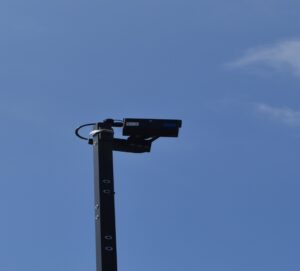
TMB-133 Radar detector
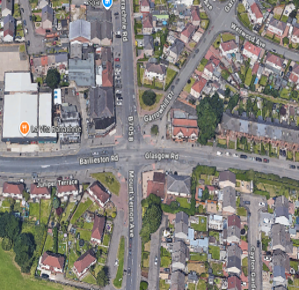
Technical Configuration: Virtual Detection Zones
Rather than relying on physical, sub-surface hardware infrastructure, engineers utilised the radar’s advanced configuration software to map the intersection digitally:
- Configuring ‘Virtual Loops’: Each above ground radar was configured with a VA zone 40m long, and then a SCOOT loop was placed at 50m back from the stop line. (NB: SCOOT loops have been placed up to 80m back)
- Seamless Retrofitting: The system was integrated smoothly by utilising the intersection’s existing cabling infrastructure, minimizing the need for new back-end wiring or controller overhauls.
- Dynamic Demand Responsiveness: The virtual zones operate with high precision—activating instantly upon the presence of a vehicle or cyclist and deactivating immediately as they clear the zone. This ensures that the traffic lights always respond accurately to actual on-site demand.
| Operational Milestone: The entire deployment, configuration, and commissioning process was completed successfully without a single road excavation, avoiding any disruption to the traveling public. Since 2024: 140 above ground radar detectors have been purchased by Glasgow City Council for installation on SCOOT sites with VA / CLF fallback.
|
- Proven Business Benefits & Outcomes
Glasgow City Council quickly realized the multifaceted advantages of transitioning to the above-ground radar system. The outcomes of the trial delivered clear value across four key performance pillars:
- Significant Time Savings: Traditional loop installations routinely disrupted traffic networks for days or weeks during cutting and sealing. In contrast, the complete installation and configuration of the Icoms above ground radar TMB-134 was finalised in just a few hours, drastically reducing project delivery timelines.
- Direct Cost Reductions: By moving away from sub-surface SCCOT llops, the council achieved substantial financial savings. The non-intrusive installation required significantly less manpower, eliminated the raw material costs of recutting loops, and avoided the steep financial penalties associated with street works disruption and traffic management. The entire intersection has just 4 detectors installed.
- Environmental Sustainability: Eliminating legacy loops means no further physical waste from abandoned, broken cables embedded in the tarmac. Furthermore, by optimising signal responses to actual queue demands, the system reduced gridlock, keeping vehicles moving and preventing unnecessary emissions from idling traffic.
- Unmatched Operational Flexibility: Perhaps the most significant long-term benefit is future-proofing the network. Because the detection zones are defined entirely within the radar’s software, they can be reprogrammed at any time. As the city’s traffic patterns evolve or lane configurations change, the system can adapt instantly via software adjustments—completely eliminating the need to ever dig up the road again.
ITS Intelligent Traffic Management Systems – Icoms Detections
Contact C & T Technology for Traffic Management Technologies
Comparison Matrix: Legacy Loops vs. Icoms TMB-134 Radar
| Feature | Legacy Inductive Loops | Icoms TMB-134 Radar |
| Installation Position | In-road (sub-surface) | Above-ground (pole-mounted) |
| Installation Time | Days to weeks | Hours |
| Coverage Efficiency | 1 loop per lane/pocket | 1 unit replaces up to 9 loops |
| Civil Works Required | Extensive (digging/resurfacing) | None (uses existing poles) |
| Target Detection | Does not always detect HGV and bicycles | Vehicles, stationary queues, & bicycles |
| Future Adaptability | Permanent (requires re-cutting) | Flexible (software reprogrammable) |