
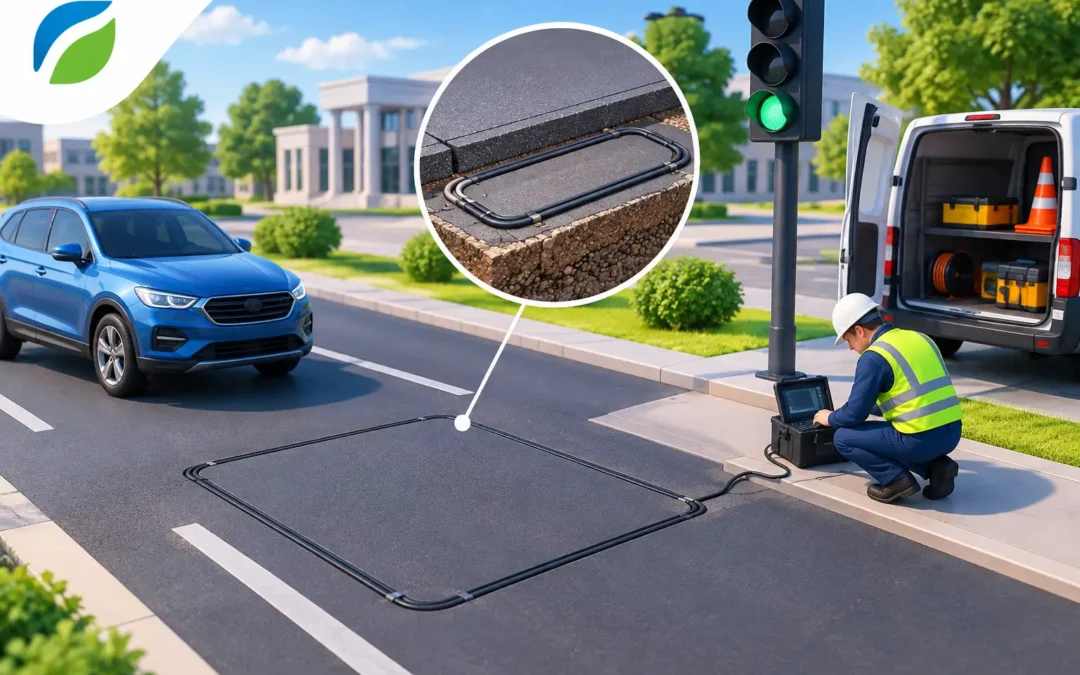
A loop failure rarely arrives at a convenient time. It may first appear as a missed cyclist call, an approach that holds green unnecessarily, or a junction controller reporting intermittent occupancy. The practical question of when should councils replace loops is therefore not simply about the age of the cable beneath the carriageway. It is about whether the existing detection still supports safe, efficient and maintainable operation of the junction.
Inductive loops remain familiar technology across the UK road network, and a sound installation can continue to serve a straightforward vehicle-actuated application. However, every repair that requires a carriageway cut, traffic management and reinstatement should prompt a wider assessment. In many cases, replacing failed or limited loops with above-ground radar or AI video detection is the more resilient route.
Replace loops when maintenance becomes disruptive
The strongest trigger is repeated intervention. A loop that has failed once after resurfacing, utility activity or deterioration around the saw cut may be repairable. A loop that fails repeatedly, or sits in a location where access requires difficult lane closures, has become an operational liability.
The direct repair task is only part of the issue. Councils must also consider traffic management, disruption to road users, programme risk, reinstatement quality and the effect of works on local residents and businesses. At busy urban junctions, strategic corridors and constrained town centres, gaining safe access to the carriageway can be more challenging than the detector repair itself.
Above-ground detection removes the need to cut into the road surface. Radar units and AI-powered video detectors can generally be installed on existing signal poles, lighting columns or purpose-designed street furniture, subject to a proper site survey. This reduces the need for excavation and allows works to be planned with far less impact on traffic flow.
That does not mean every isolated loop fault demands immediate wholesale replacement. Where a junction has a simple layout, low traffic volumes and accessible ducting, a targeted repair may still be proportionate. The decision changes when the same asset creates repeated call-outs, closures or uncertainty for the maintenance team.
When loop detection no longer reflects real road use
Loops detect the presence of conductive vehicles within a fixed area of carriageway. That can be effective for basic stop-line presence detection, but it has limitations where councils need a clearer understanding of what is approaching, waiting or moving through a junction.
A common issue is inconsistent detection of vulnerable road users. Standard loops may not reliably support all cyclists, particularly where bicycle position, loop geometry or bicycle construction affects the inductive signature. They also cannot directly detect pedestrians. If a scheme requires better active-travel provision, more responsive crossing operation or improved cycle stage demand, the detector strategy must be reconsidered rather than merely reinstated.
Modern radar and video solutions can provide wider detection zones and richer information. Depending on the technology and configuration, this can include approaching and stationary vehicles, direction of travel, speed, queue presence, bicycles and classified road users. AI video detection can be particularly useful where the operational requirement calls for multiple virtual detection zones, vehicle classification or visual analytics without repeated carriageway works.
The benefit is not technology for its own sake. Better detection supports better signal decisions. A junction can respond to actual demand, avoid unnecessary stages, manage gaps more accurately and identify conditions that contribute to delay or risk.
Look beyond the stop line
A loop installation often answers one narrow question: is a vehicle over this point? Many junctions need more context. On high-speed approaches, for example, earlier detection can support safer and more efficient extension logic. On congested urban approaches, queue detection further upstream can help prevent inefficient staging or support network management decisions.
Because detection zones in above-ground systems are software-defined, they can be adjusted as traffic patterns, lane use or signal strategies change. This is valuable at junctions affected by development, new cycle infrastructure, bus priority measures or revised road markings. The physical detector does not need to be buried in a location that may soon be obsolete.
Planned renewal is the best time to replace loops
Councils should not wait for a complete detector failure if a scheme already involves signal refurbishment, resurfacing, junction remodelling or communications upgrades. Planned works offer the best opportunity to review detection as part of the full asset lifecycle.
Resurfacing is a particularly relevant moment. Re-cutting loops after new surfacing can add programme complexity and leaves new carriageway material vulnerable to future water ingress and movement at the cut. Replacing loops with non-intrusive detection can protect the finished road surface while reducing the likelihood of return visits.
Similarly, a signal controller renewal should not automatically inherit the previous detection layout. The original loops may have been designed around older traffic patterns, legacy staging or limited capability in the controller. A modernisation project is an opportunity to assess what the junction needs now: vehicle actuation, cycle detection, queue monitoring, speed data, bus priority inputs or network analytics.
This review should involve signal engineers, highways maintenance teams and road safety colleagues. Each sees a different consequence of poor detection. Signals teams see inefficient operation, maintenance teams see difficult access, and safety teams see the potential effects of delayed calls, unexpected behaviour or inadequate provision for cyclists.
Choose the replacement technology by application
There is no single above-ground replacement for every loop. A well-specified solution starts with the traffic objective, the geometry of the site and the detection performance required.
Radar is often a strong option for vehicle and bicycle detection where reliability in changing light conditions is essential. It can provide accurate presence, approach and speed-related information, and is well suited to demanding environments where glare, shadows or low light can challenge conventional camera systems.
AI video detection is valuable where the authority needs flexibility and a broader view of the junction. Virtual zones can be configured for multiple lanes and movements, while classification and analytics can support more informed operational decisions. Camera positioning, privacy requirements, visibility and local environmental conditions must all be considered during design.
Wireless traffic sensors can also suit selected applications, particularly where installation speed matters and the authority needs data without extensive civil works. However, the selection should always be based on the operational need, not a preference for a particular device type.
A site survey is essential. Engineers should assess mounting locations, detection coverage, occlusion, power and communications, lane geometry, weather exposure, existing assets and controller interface requirements. The best technology on paper will underperform if its detection zones are poorly designed or its mounting position is compromised.
Build a business case around whole-life performance
The decision to replace loops should account for more than the immediate repair requirement. The relevant comparison is the whole-life operational burden of embedded detection against the expected performance of an above-ground alternative.
For an authority managing a large signal estate, this means examining fault history, planned maintenance visits, frequency of traffic management, carriageway condition, detector obsolescence and the consequences of poor actuation. A single loop repair may appear minor. Across dozens of sites, repeated excavation and reactive attendance consume budget, staff time and network capacity.
There is also a sustainability consideration. Fewer carriageway interventions mean less disruption, reduced material use and fewer works-related vehicle movements. More responsive signals can contribute to smoother traffic flow, although results depend on the overall signal design and prevailing demand. Detection is one part of a control strategy, not a cure for every congestion issue.
C & T Technology supports this transition with above-ground detection and traffic data solutions designed around real highway operations. The priority is not simply to remove loops, but to give councils the detection capability needed for safer roads, reduced congestion and more sustainable maintenance.
Set clear replacement triggers
A council can make decisions more consistent by defining replacement triggers within its asset management approach. These may include repeated loop faults at the same site, defects following resurfacing, high traffic-management requirements, poor cycle detection, a junction refurbishment programme, or a need for data that loops cannot provide.
The trigger should also account for risk. At locations serving schools, busy cycle routes, emergency service routes or complex pedestrian movements, unreliable detection has a greater operational consequence. These sites may justify proactive replacement even before a complete failure occurs.
The most effective approach is to treat every significant loop intervention as a design decision, not just a maintenance task. If the existing detector no longer matches the junction’s safety, control or data requirements, reinstating it may only preserve a limitation beneath the carriageway. A properly specified above-ground system can turn that necessary intervention into a lasting improvement for the network.