
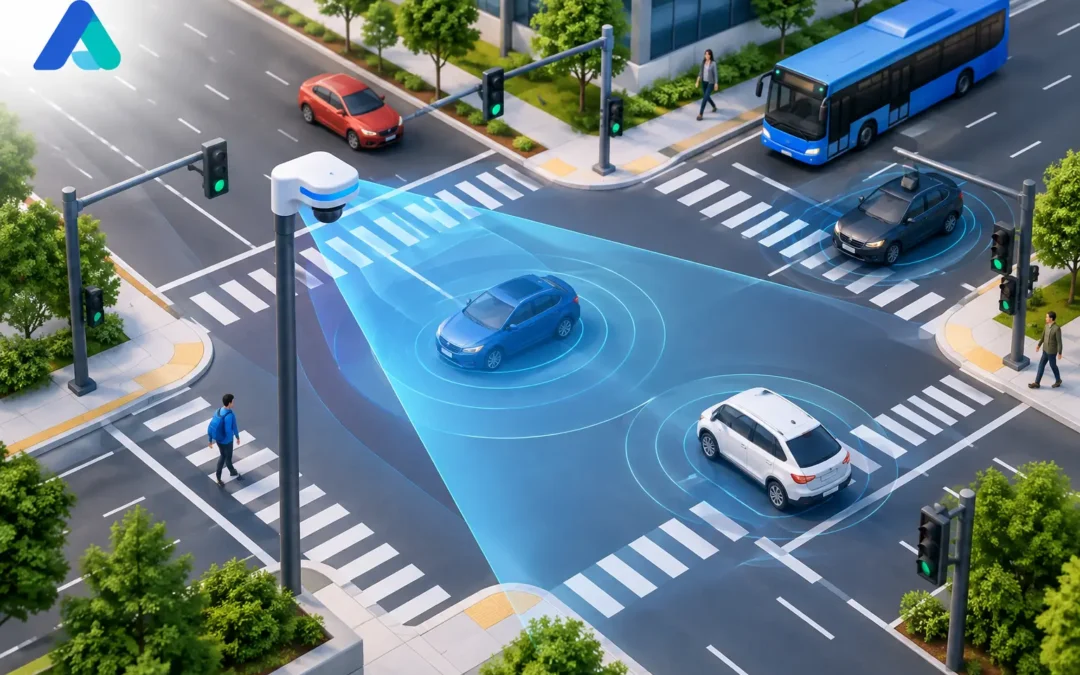
A signal stage can only perform as well as its knowledge of the traffic waiting for it. When a vehicle is missed at the stop line, held in a turn lane or waiting at a side-road approach, the result may be wasted green time, unnecessary delay or a safety-critical movement receiving less protection than intended. Intersection presence sensors give traffic signal controllers the continuous, dependable detection needed to make stage decisions from the real conditions on the carriageway.
For highways authorities and signal engineers, the issue is not simply whether a detector can register a vehicle. The detector must identify the right road user, in the right zone, for the required duration, while remaining practical to install and maintain. Above-ground radar and AI video technologies are changing what can be achieved without cutting into the road surface.
What intersection presence sensors are designed to do
Presence detection confirms that a road user remains within a defined detection area. Unlike an advance detector, which may only indicate that a vehicle has passed a point upstream, a presence sensor supports decisions at the point where demand matters most: the stop line, a right-turn pocket, a bus gate or a cycle waiting area.
At a signalised junction, a correctly configured presence zone can hold a demand until it is served, extend a green stage where traffic is still discharging, or help terminate a stage when the approach is clear. The output may feed an existing signal controller through standard interfaces, allowing the controller logic to respond to live occupancy rather than fixed assumptions about traffic.
This matters most where demand is variable. Low-flow side roads, late-night operation, protected turns and junctions with intermittent cycling activity can all suffer when detection is unreliable or zones are poorly placed. A detector that accurately distinguishes occupancy from a brief pass-through event gives engineers more useful control over stage timing.
Why road-embedded loops create an operational constraint
Inductive loops remain familiar across the network, but familiarity does not remove their limitations. Installation requires saw-cutting the carriageway, placing cable, sealing the slot and reconnecting to roadside equipment. On a busy junction, that can mean traffic management, possession planning and disruption at precisely the location where capacity is already under pressure.
Loops are also exposed to the condition of the road surface. Resurfacing, utility works, cracking, water ingress and repeated heavy vehicle loading can affect loop integrity. Locating and repairing a fault may require further intrusive work, with a corresponding impact on labour, traffic management and public confidence in the junction.
Above-ground detection does not eliminate the need for sound design or commissioning, but it changes the maintenance equation. Radar and video sensors can typically be mounted on existing signal poles, lighting columns or purpose-designed masts. Detection areas can then be configured in software rather than determined solely by a cable placed in the carriageway. This is particularly valuable when layouts change, road markings are renewed or a junction is upgraded in stages.
Choosing the right sensing technology for the junction
The best technology depends on the site, the detection task and the surrounding environment. There is no universal sensor specification that suits every approach.
Radar for reliable all-weather vehicle presence
Radar detection measures movement and position using radio waves. For vehicle presence applications, it can provide stable coverage across several lanes and operate effectively in darkness, rain, fog and glare conditions that can challenge optical systems. It is well suited to stop-line presence, approach detection and turn-lane monitoring where the principal requirement is dependable vehicle detection.
Radar also avoids dependence on road markings, headlamp illumination or vehicle colour. Its performance should still be assessed against the geometry of the junction, mounting height, lane widths, nearby street furniture and the mix of cars, buses, motorcycles and lorries using the approach. A good survey confirms that the sensor has an unobstructed view of the zones that matter.
AI video where classification adds value
AI-powered video detection brings a different capability. It can identify and classify road users, enabling engineers to separate cars, heavy goods vehicles, buses, cyclists and pedestrians where the application requires it. This can support more targeted signal strategies, such as prioritising buses at a constrained approach, identifying cycle demand or measuring queues by vehicle class.
Video systems require careful consideration of camera position, lighting variation, occlusion and the scene beyond the junction. A tall vehicle in a queue can obscure a smaller road user, while low sun, reflections and complex backgrounds need to be accounted for during configuration. Modern AI video systems are highly capable, but performance depends on selecting suitable viewpoints and defining detection zones with operational intent.
In many schemes, radar and video are complementary rather than competing options. Radar may provide highly reliable core vehicle presence, while video supplies classification, queue information or vulnerable road user analytics. The appropriate choice should follow the control objective, not a preference for a particular sensor type.
Intersection presence sensors need more than a detection zone
A drawing that labels a stop-line zone is only the beginning. Detection should be designed around the controller’s decisions and the behaviour expected from road users.
At a simple side-road junction, the detector may only need to hold a side-road call until the stage is served. At a multi-stage urban junction, separate zones might be required for near-side and off-side lanes, a right-turn reservoir, a bus lane and a cycle approach. If all movements are grouped into one broad zone, the controller cannot distinguish between traffic that needs service and traffic that has already cleared.
Zone length also requires judgement. A zone that is too short may fail to hold a vehicle positioned slightly back from the stop line. One that extends too far upstream can create demand from vehicles that are not genuinely waiting, particularly in slow-moving queues. Engineers should define the zone to reflect lane discipline, queue behaviour, stop-line position and the signal logic used at the site.
Detection persistence is equally important. The system must continue to report a stationary vehicle for as long as it remains in the zone, without generating false calls from adjacent movements, swinging vegetation or background activity. This is where commissioning and validation make the difference between a technically installed detector and an operationally effective one.
Commissioning should test real traffic, not just communications
A sensor may be correctly powered and communicating with the controller while still failing the real-world test. Commissioning should include observations through representative traffic conditions: free flow, queue formation, heavy vehicles, poor weather where feasible, darkness for video installations and movements in neighbouring lanes.
The engineer should verify that each configured zone activates for the intended road user and remains active while that road user is stationary. They should also test non-target movements. For example, traffic in an adjacent lane should not hold a right-turn demand, and pedestrians near the kerb should not be interpreted as vehicles unless that is a stated requirement.
Controller outputs deserve the same scrutiny as the sensor itself. A clear detection indication must result in the expected demand, extension or cancellation behaviour within the signal strategy. Recording baseline observations before installation and reviewing performance after commissioning provides evidence that the change has reduced missed demand, excessive green time or avoidable delay.
The wider value: safer roads and lower disruption
Accurate presence detection improves efficiency, but its benefits extend beyond junction capacity. When a driver can be confident that a side-road call will be registered, there is less temptation to edge forward or take an unsuitable gap. When a right-turn lane is detected correctly, the controller can serve it according to the intended safety strategy rather than leaving drivers stranded through repeated cycles.
Non-intrusive installation also supports more sustainable network operation. Avoiding carriageway cuts reduces the materials, plant movements and traffic disruption associated with loop installation and repair. For local authorities working around resurfacing programmes, utility coordination and restricted working windows, the ability to deploy or adjust detection from above ground is a significant practical advantage.
The data generated by intelligent sensors can also inform decisions beyond immediate control. Occupancy trends, queue build-up and classified movements help teams identify where signal timing, lane allocation or active travel provision needs review. Detection becomes both an input to control and a source of evidence for future investment.
Specifying for dependable operation
A successful specification should define the operational outcome first: which users must be detected, in which lanes, at what point in the approach and for what controller function. It should then address mounting constraints, communications, controller compatibility, environmental conditions and the requirement for configuration and site acceptance testing.
It is sensible to ask how detection zones can be amended after installation, what diagnostics are available to maintenance teams and how the system behaves if communications are interrupted. These details affect whole-life performance far more than a headline detection range. They also help contractors, consultants and authority teams avoid designing in a future road closure for a task that could be completed from the roadside.
C & T Technology supports schemes where practical deployment matters as much as detection capability, combining above-ground radar and AI video options with traffic management expertise. The objective is straightforward: give the controller dependable information, without adding unnecessary disruption to the network.
The most useful next step is to review a junction in terms of the decisions its controller needs to make, rather than the legacy detection already in the ground. That shift often reveals where better presence detection can remove delay, protect vulnerable road users and make the next intervention easier to deliver.