
A detector that performs well at midday can become a source of delay, missed calls and safety concern after dark. Radar versus thermal detection is therefore not simply a specification comparison. For traffic engineers, it is a site-led decision about what must be detected, how reliably it must be detected, and how the resulting information will support control, enforcement or analysis.
Both technologies offer a major advantage over inductive loops: they can be deployed above ground, avoiding carriageway cuts, traffic management for installation and the maintenance burden associated with buried equipment. Their operating principles, strengths and constraints are different, however. Selecting the right technology starts with understanding the operational outcome required.
Radar versus thermal detection: the core difference
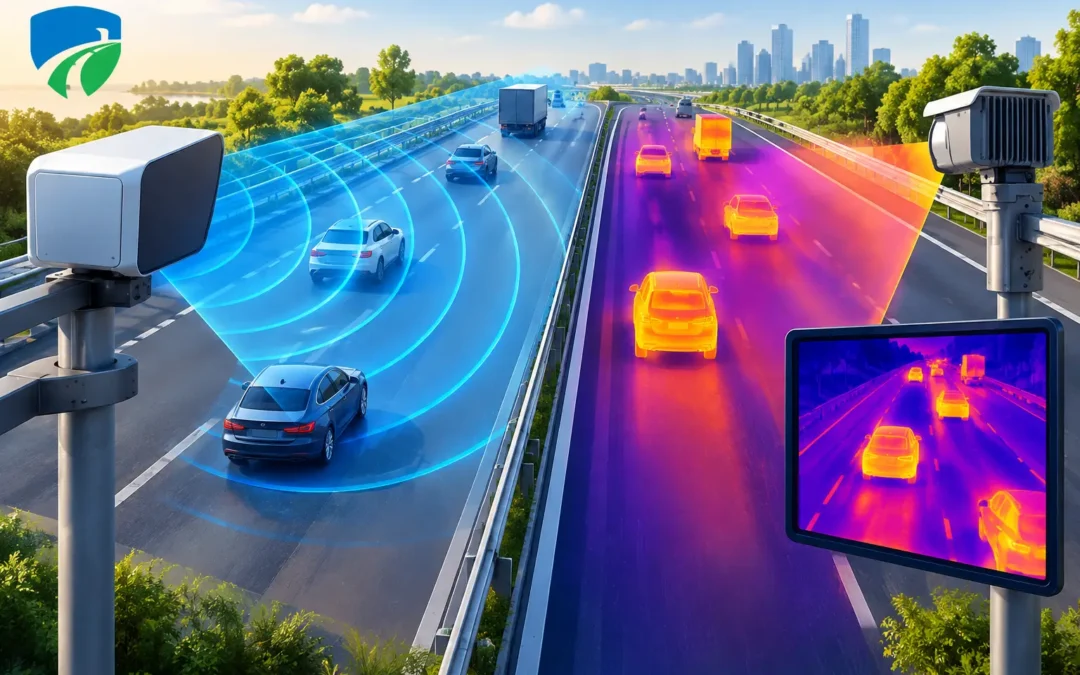
Radar transmits radio waves and measures the reflected signal from objects within its detection area. Depending on the device and configuration, it can identify presence, range, speed, direction and movement. This makes radar particularly effective where moving vehicles need to be detected consistently, including in poor light and adverse weather.
Thermal detection uses the heat emitted by people, vehicles and other objects to create an image based on temperature contrast rather than visible light. It does not need street lighting or vehicle headlights to see a target. At a junction, crossing or poorly lit approach, this can give thermal systems a clear advantage over conventional visible-light cameras.
The distinction matters. Radar is measuring movement and position through reflected radio energy. Thermal is interpreting a heat-based scene. Neither is automatically the better choice in every location. The decision depends on whether the priority is reliable vehicle approach detection, vulnerable road user awareness, occupancy measurement, classification, or a combination of these requirements.
Where radar delivers the strongest operational value
For vehicle actuation and approach monitoring, radar is often the most direct solution. A correctly positioned radar detector can monitor one or more lanes, establish vehicle speed and direction, and provide detection zones that support signal control logic. Because it is not dependent on visible illumination, performance is not compromised by darkness, low sun or headlight glare in the same way as optical video detection.
This is particularly useful on higher-speed approaches, rural junctions and sites where vehicles must be detected at distance. Advance detection can give traffic controllers more time to respond to approaching traffic, helping to reduce unnecessary delay while maintaining safe signal operation. Radar can also support speed monitoring and warning applications, where speed data is as valuable as presence data.
Radar is generally well suited to harsh operating conditions. Rain, fog and snow can affect any sensing technology to some degree, but radar commonly retains useful detection capability when a visible or thermal image becomes less distinct. Its performance can nevertheless be influenced by installation height, angle, lane geometry, large stationary objects and nearby metalwork. Accurate commissioning remains essential.
There is also an important limitation: radar is strongest when the target is moving. Detecting stationary vehicles, bicycles waiting at a stop line or pedestrians in a defined crossing area can require careful product selection and configuration. A detector specified only around moving traffic may not provide the dependable presence information needed for every signalised junction.
Where thermal detection changes the picture
Thermal detection is valuable when the challenge is seeing road users in darkness or low-light conditions. It can make pedestrians and cyclists stand out from their surroundings without relying on street lighting, headlights or the visible contrast required by conventional cameras. For safety-led schemes, that is a meaningful capability.
At pedestrian crossings, shared-use paths and junctions with significant active travel movements, thermal imaging can contribute to better awareness of vulnerable road users. It can also be useful where concerns around privacy make a heat-based image preferable to conventional colour video, subject to the system design and data handling requirements of the scheme.
Thermal cameras do not, however, interpret every scene without difficulty. Their effectiveness relies on a usable temperature difference between a target and its background. In certain weather conditions, particularly when road surfaces, vehicles and the surrounding environment approach similar temperatures, contrast can reduce. Heavy rain, mist, lens contamination and poorly chosen viewing angles can also affect the image available to the analytics engine.
Thermal detection is not a replacement for all traffic sensing. It does not inherently provide the direct speed and range measurement associated with radar. Where a controller needs precise approach speed, direction or distance, radar may be the more straightforward technology. Thermal systems are most effective when their image-based strengths are aligned with a specific safety or monitoring requirement.
Detection accuracy depends on the site, not the brochure
The most capable detector can underperform if it is mounted in the wrong position or asked to solve a problem outside its intended use. Before specifying radar or thermal technology, engineers should define the detection task in operational terms.
Is the system required to extend a green phase for an approaching vehicle? Confirm a cyclist waiting in a feeder lane? Monitor pedestrian occupancy on a crossing? Count and classify traffic for planning evidence? Detect queues? Each requirement has different implications for detection range, field of view, target behaviour and controller integration.
Site geometry is equally influential. Curved approaches, multiple lanes, bus stops, parked vehicles, tall vehicles, street furniture and adjacent movements can all introduce complexity. Radar zones need to be designed around the road layout and likely trajectories. Thermal cameras need an unobstructed view and an image suitable for reliable analytics across the relevant area.
A useful specification also considers false calls as well as missed detections. A system that repeatedly responds to traffic outside the intended lane, roadside activity or heat sources may reduce junction efficiency. Conversely, a detector that misses a cyclist or stationary vehicle can create avoidable delay and compromise user confidence. Detection performance should be assessed against real traffic behaviour, not idealised test conditions.
Choosing technology by application
For high-speed vehicle approaches and signal actuation, radar is frequently the preferred technology because it provides fast, weather-tolerant information about moving vehicles. It can support efficient control decisions without intrusive carriageway works.
For poorly lit crossings, active travel routes and locations where vulnerable road user visibility is the primary issue, thermal detection offers a different and valuable layer of information. Its ability to operate independently of visible light can strengthen night-time monitoring where conventional imaging is constrained.
At complex junctions, a single technology may not address every requirement. Radar can provide dependable approach detection and speed data, while thermal or AI-enabled video can add occupancy and road user context. The objective is not to install more equipment than necessary. It is to use complementary sensing where the operating case justifies it.
This approach is especially relevant when replacing inductive loops. Above-ground detection can reduce the disruption associated with lane closures and reinstatement, while making future adjustment easier as layouts, traffic patterns and active travel provision change. The practical benefit comes from designing the detection strategy around the junction’s control needs from the outset.
Commissioning and maintenance are part of detection performance
Above-ground technology reduces many of the civil engineering issues associated with buried loops, but it does not remove the need for disciplined implementation. Mounting position, alignment, detection zone configuration, cable routes, power provision and controller interface must all be considered before installation.
Commissioning should include checks across representative conditions: free-flow traffic, queueing, larger vehicles, cyclists, darkness where relevant, and movements in neighbouring lanes. Detection zones and analytics rules should then be refined against observed behaviour. This is where specialist technical support can turn capable hardware into dependable junction operation.
Maintenance planning should address lens cleanliness for thermal systems, physical alignment, vegetation growth, new street furniture and changes to road markings or lane use. A detector is not a fit-and-forget asset if the surrounding scene has changed materially. Periodic review protects the quality of the data used to manage the network.
A practical decision for safer, more efficient networks
Radar and thermal technologies solve different problems well. Radar is a strong choice where moving vehicle detection, speed, range and all-weather approach monitoring are central. Thermal detection is compelling where darkness, low-light visibility and vulnerable road user awareness are the overriding concerns.
For highways authorities and contractors, the most productive question is not which technology is universally best. It is which sensing method provides the most reliable input for this location, this control strategy and these road users. A clearly defined requirement, informed site survey and properly commissioned above-ground solution will do more for safer roads and reduced congestion than a detector selected on headline capability alone.