
A seven-day traffic count can look straightforward on a programme, until the survey team needs a lane closure to install tubes, a cyclist catches a tube line, or a road resurfacing scheme removes the evidence before it can inform a decision. When assessing traffic counters vs tube surveys, the useful question is not which technology is universally better. It is which method will produce dependable data for the site, mode mix and operational decision without creating unnecessary disruption.
For highways authorities, consultants and contractors, that distinction affects more than the survey budget. It shapes site safety, programme certainty, data completeness and the confidence that can be placed in a scheme design, speed intervention or traffic management plan.
Traffic counters vs tube surveys: the key difference
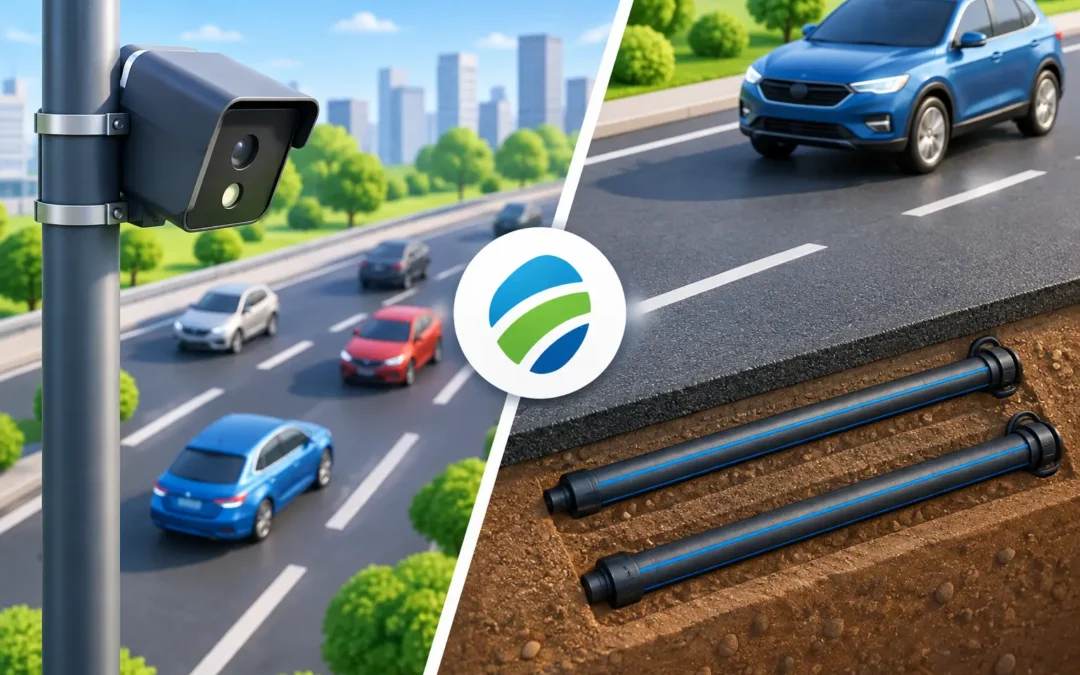
A tube survey uses pneumatic rubber tubes laid across the carriageway. As vehicle tyres pass over the tube, air pulses are recorded by a roadside counter. Depending on the configuration, the system can provide traffic volumes, vehicle speed, direction and axle-based vehicle classification.
Traffic counters are a broader category. They may include pneumatic tube equipment, but increasingly refer to above-ground detection systems such as radar, AI-powered video and wireless sensors. These devices detect road users from the verge, a pole, street furniture or another roadside mounting point, rather than requiring equipment to be fixed across the running lane.
That difference in installation method is central. Tube surveys collect useful traffic data quickly on many conventional roads, particularly where a short-duration vehicle count is all that is required. Above-ground counters are better suited where roadworks, repeated surveys, vulnerable road users, more detailed classification or continuous monitoring create a stronger operational case.
Where tube surveys still have a place
Pneumatic tubes remain familiar to survey teams because they are portable, well understood and capable of capturing basic vehicle data over a defined period. On a low-speed, low-risk road with modest traffic flows, two tubes can support directional counts and speed measurement without a complex installation.
For some short-term studies, this is entirely appropriate. A rural road count to establish broad traffic volumes, or a preliminary speed assessment on a straightforward link, may not demand sophisticated detection. Where the carriageway can be accessed safely, the tube can be secured effectively and the likelihood of interference is low, the method can provide a practical baseline.
The limitations become more significant when the site is less forgiving. Tubes are exposed to traffic, weather, deliberate tampering and damage from turning movements. They can be displaced or severed by heavy vehicles, especially near junctions, accesses, bus stops and tight bends. On multi-lane roads, installation and retrieval are more involved and may require traffic management that is disproportionate to the duration of the count.
Tube data also requires careful interpretation. Classification is inferred from axle signatures, so unusual vehicle configurations can be misclassified. Motorcycles, cyclists and pedestrians are not reliably represented in a standard pneumatic tube survey. A tube can register a passing vehicle, but it cannot explain whether congestion is caused by a queue, a turning movement, a bus stop or conflicting demand at a junction.
Why non-intrusive traffic counters change the survey approach
Above-ground traffic counters use different detection principles, but share an important advantage: they can collect data without placing equipment in the carriageway. Radar-based systems detect moving vehicles and can measure speed, direction and presence across one or more lanes. AI video detection can identify and classify multiple road users, including vehicles, cyclists and pedestrians, while providing a visual audit trail where appropriate. Wireless sensors can support discreet, flexible deployments where cabling or civil works would be impractical.
This approach reduces exposure for installation teams and avoids the recurring risk of equipment being struck or displaced in the road. It also prevents a temporary survey from becoming a traffic management exercise. On busy urban routes, strategic corridors or roads with high cycle activity, that can be the deciding factor.
Data quality benefits depend on selecting and configuring the right technology. A well-sited radar unit can provide highly consistent speed and volume data in poor light and adverse weather. Video analytics can offer richer classification and mode data, but requires a clear field of view and careful consideration of lighting, occlusion and privacy requirements. Neither is simply a replacement for the other. The detection objective should determine the sensor.
For C & T Technology, the practical advantage of above-ground detection is not only avoiding invasive installation. It is enabling authorities to turn a temporary count into a more useful evidence source for traffic operations, active travel planning and road safety decisions.
Compare the methods against the decision you need to make
The strongest specification starts with the required output, not the equipment type. If the brief asks only for a representative daily vehicle volume on a quiet road, a tube survey may be sufficient. If the result will support a speed limit review, junction improvement, signal design, school safety scheme or cycle route intervention, the need for reliable and richer data increases.
Vehicle volumes, speed and direction
Both methods can produce vehicle counts, directional flows and speed information. Tube surveys are often effective for simple point measurements where traffic behaviour is predictable. Radar counters are particularly valuable when speed data must remain dependable over longer deployments or on roads where tubes are likely to be damaged.
Consider the location as closely as the metric. A tube installed downstream of a junction may record traffic satisfactorily, but it cannot distinguish turning movements unless the layout and tube configuration are designed for that purpose. A radar or video system can be positioned to cover defined approaches and lanes, offering more useful insight into approach-specific demand.
Classification and vulnerable road users
This is where the gap between technologies often widens. Axle-based classification can provide useful categories for cars, vans and larger goods vehicles, but it is not designed to give a complete picture of all users. Cyclists may not actuate the tube consistently, and pedestrians are outside the method’s capability.
Where a scheme must understand cycle flows, pedestrian activity, micromobility or interactions between modes, AI video detection is usually the more appropriate option. It can classify road users by type and direction, subject to site conditions and correct configuration. This matters on urban corridors where vehicle volumes alone can lead to the wrong conclusion about how the network is being used.
Installation risk and network disruption
Tube surveys require personnel to work at or near the live carriageway. Even on lower-speed roads, that exposure must be planned and controlled. On higher-speed routes or roads with limited safe access, the installation can require lane restrictions, traffic management or an out-of-hours possession.
Above-ground counters can often be installed from the verge or footway, using existing street furniture where suitable. This can shorten deployment time and reduce disruption to road users. It does not eliminate the need for a site survey – line of sight, mounting height, power, communications and asset permissions still matter – but it moves the work away from the most exposed part of the road.
Survey duration and repeatability
A short survey is vulnerable to abnormal conditions. School holidays, roadworks, severe weather, local events and diversions can all distort a seven-day sample. Extending a tube survey may be possible, but the chance of damage or disturbance rises with time.
Non-intrusive counters are well suited to longer-term and repeat deployments. That supports before-and-after studies, seasonal comparison and ongoing monitoring of a road safety intervention. The ability to leave detection in place without repeated carriageway access can improve both the evidence base and the programme.
Avoid treating any count as self-explanatory
The technology is only one part of a credible traffic survey. Detection zones, classification rules, timestamp accuracy and communications all influence the final dataset. So does the physical environment. A parked vehicle can obscure a video view; foliage can affect coverage; a radar unit may need adjustment to avoid detecting an adjacent lane or footway.
Validation should therefore be built into the deployment. Check early data against observed traffic, confirm the direction and lane assignments, and investigate unusual peaks or missing periods before the equipment is removed. For decisions with significant safety or capital implications, a data platform that makes exceptions visible is as valuable as the counter itself.
Choose the method that reduces uncertainty
Tube surveys remain a sensible tool for defined, lower-complexity vehicle studies. They are not obsolete, and specifying a more advanced counter where it adds no value is not good engineering.
However, where access is difficult, traffic is fast or heavy, active travel matters, or the survey needs to inform a lasting operational decision, above-ground traffic counters offer a more resilient route to the evidence required. The best survey method is the one that keeps people out of the carriageway, captures the road users that matter and gives the project team data they can act on with confidence.