
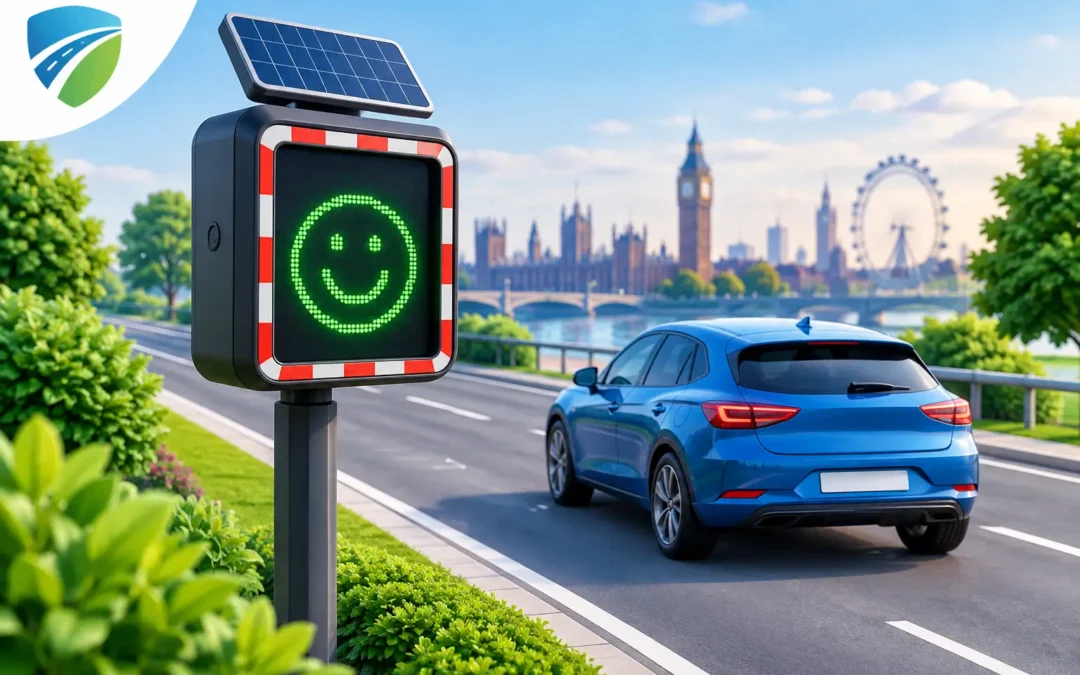
A speed display can be one of the most visible interventions on a local road, yet its value is determined long before a driver sees a roundel or illuminated speed. For authorities specifying the best UK speed display features, the question is not simply whether a sign can show a vehicle’s speed. It is whether the installation will influence driver behaviour at the right location, remain legible in changing light, produce useful evidence and operate reliably with minimal disruption.
Speed information displays are often deployed where residents report excessive speed, where collision history indicates a concern, at village gateways, near schools, or on approaches to lower speed limits. These are different operating environments. A display suitable for a constrained rural gateway may not be the right choice for a busy urban corridor with frequent bus movements, side-road activity and competing visual clutter.
What the best UK speed display features achieve
An effective speed display combines accurate detection with a clear, immediate message. The driver should understand their current speed and the applicable limit without having to interpret an overloaded screen. For road safety teams, the system should also provide defensible data on approach speeds, volumes and behavioural change before and after installation.
The strongest specifications therefore balance three outcomes: safer driver behaviour, dependable operational performance and evidence for future traffic management decisions. A bright display alone is not enough if the detector captures vehicles in the wrong lane. Equally, highly detailed data has limited value if the sign is difficult to read in direct sunlight or is poorly positioned.
Clear, compliant visual communication
Display legibility is the first practical requirement. High-intensity LEDs, automatic brightness control and a well-designed character layout help keep the message visible during bright daylight, low winter sun and night-time operation. Automatic dimming matters as much as peak brightness. A display that is excessively bright after dark can create glare, distract road users and attract complaints from nearby residents.
The message should reinforce the speed limit quickly. A typical arrangement uses a speed limit roundel and a real-time speed indication, with an advisory warning when the threshold is exceeded. For many sites, this direct feedback remains more effective than multiple messages competing for attention.
Specifications should also consider viewing distance, approach speed and the roadside environment. On a 20 mph street outside a school, a compact display with a controlled visual response may be appropriate. On a higher-speed approach to a village, greater display size, earlier visibility and a detector capable of stable performance over longer ranges may be required.
Accurate radar detection and lane discipline
Detection quality determines both the driver message and the integrity of the data. Above-ground radar is particularly well suited to speed display applications because it avoids carriageway cuts, lane closures and the failure points associated with embedded loops. It can be installed on an existing column or a purpose-designed pole, allowing a safer and faster deployment programme.
The detector should distinguish approaching traffic reliably and be configured to the intended detection zone. On a two-way road, that means preventing vehicles travelling in the opposite direction from triggering an incorrect response. On multi-lane approaches, lane discrimination and careful alignment become more important, especially where lorries, buses and overtaking vehicles may affect the radar field.
A credible supplier will support site assessment and commissioning rather than treating radar alignment as an afterthought. Vegetation, street furniture, parked vehicles, gradients and road curvature can all affect the practical detection area. The best result comes from matching the detection settings to the road, not from relying on a generic configuration.
Data features that make a speed display more useful
A speed display is also a compact traffic survey point. When its data is captured and interpreted properly, it can strengthen the case for further measures, confirm whether concerns are concentrated at particular times and demonstrate the effect of an intervention.
At a minimum, authorities should look for recorded vehicle counts, mean speed, 85th percentile speed, maximum speed and time-stamped records. Directional data is valuable where conditions differ between approaches, such as an uphill entry into a village and a downhill departure. Some schemes also benefit from vehicle classification, provided the method is appropriate for the site and the expected accuracy is understood.
The data retrieval process deserves close attention. Manual download may be acceptable for a small number of signs with routine inspection visits. For wider programmes, wireless communications can reduce field visits and make data available promptly to road safety, traffic engineering and local enforcement partners. A managed platform can also make it easier to compare sites consistently rather than treating every dataset as a standalone exercise.
Data must be considered in context. A reduction in mean speed is encouraging, but it does not automatically establish a long-term safety outcome. Seasonal travel patterns, temporary roadworks, school terms and changes to parking can all influence results. Before-and-after analysis should use comparable periods and should be combined with local observations, collision records and wider traffic data.
Thresholds and behavioural response
A useful display permits sensible configuration of the point at which the driver receives a warning or a positive response. The threshold should support the local road safety objective, while remaining proportionate to the signed limit and site conditions. If a warning activates too readily, it may become background noise for compliant drivers. If it activates too late, it may miss the opportunity to influence marginal speeding.
Some authorities prefer a simple speed readout for vehicles travelling within the limit and a clear warning for those exceeding it. Others may use a positive acknowledgement for compliant behaviour. Neither approach is universally correct. Local policy, community expectations, road geometry and the desired tone of the intervention should inform the decision.
Avoid specifying animated effects simply because they are available. Animation can improve conspicuity where it is controlled and purposeful, but excessive movement may distract drivers or reduce the authority of the message. The display should support attention to the road ahead, not compete with it.
Power and communications shape whole-life performance
Power selection affects siting flexibility, maintenance requirements and reliability. Mains-powered units are often suitable where an electrical connection is practical and the sign will be used continuously at a high-demand location. They can support bright displays and frequent communications, but the connection process may extend programme timescales.
Solar-powered speed displays can be a strong option for rural roads, gateways and locations where a mains connection would be disruptive. Their performance depends on panel orientation, shading, local daylight conditions, display duty cycle and battery capacity. A solar specification should be based on realistic winter energy assumptions, not only favourable summer conditions.
Battery management, low-power modes and remote status reporting are important features for both solar and standalone systems. An authority should be able to identify low battery status, communications faults or detector issues before an installation stops delivering the intended intervention. This is especially valuable where sites are geographically dispersed.
Where wireless data transfer is required, assess signal availability at the actual sign location rather than relying on broad network coverage maps. Communications architecture should also meet the organisation’s requirements for data access, user permissions and retention. Speed display data may be relatively straightforward, but dependable governance remains part of a professional deployment.
Installation and siting are features in practice
A technically capable sign can underperform if mounted at the wrong height, obscured by foliage or installed too close to the point where driver behaviour needs to change. Siting should account for visibility, stopping sight distance, available mounting infrastructure, power or solar exposure and the relationship to regulatory signing.
The benefit of non-intrusive, above-ground technology is particularly clear here. Radar-based displays can usually be deployed without cutting the carriageway, reducing traffic management requirements, programme risk and reinstatement liabilities. This can make trials and targeted safety measures more achievable, while preserving flexibility to relocate equipment if the evidence indicates a better position.
Installation should include commissioning checks for displayed speed accuracy, trigger distance, directionality, brightness settings and data collection. It is also prudent to establish an inspection regime covering lens cleanliness, physical condition, mounting security, vegetation growth and power health. These routine checks protect both public confidence and data quality.
Specify the outcome, not just the sign
The most useful procurement brief starts with the road safety problem. Is the aim to reduce entry speeds into a settlement, respond to community concern, support a 20 mph environment, gather evidence for a scheme, or monitor a known high-speed approach? That objective should guide the display type, detector capability, data outputs, power arrangement and communications method.
C & T Technology supports authorities and traffic professionals with above-ground radar and data-led traffic solutions that reduce dependence on disruptive road-embedded detection. For speed display projects, the practical advantage is not merely faster installation. It is the ability to pair clear driver feedback with reliable detection and usable intelligence for better network decisions.
The right display should leave a lasting operational benefit: drivers receive a timely reminder, engineers gain trustworthy evidence, and the road can be made safer without unnecessary intervention in the carriageway.