
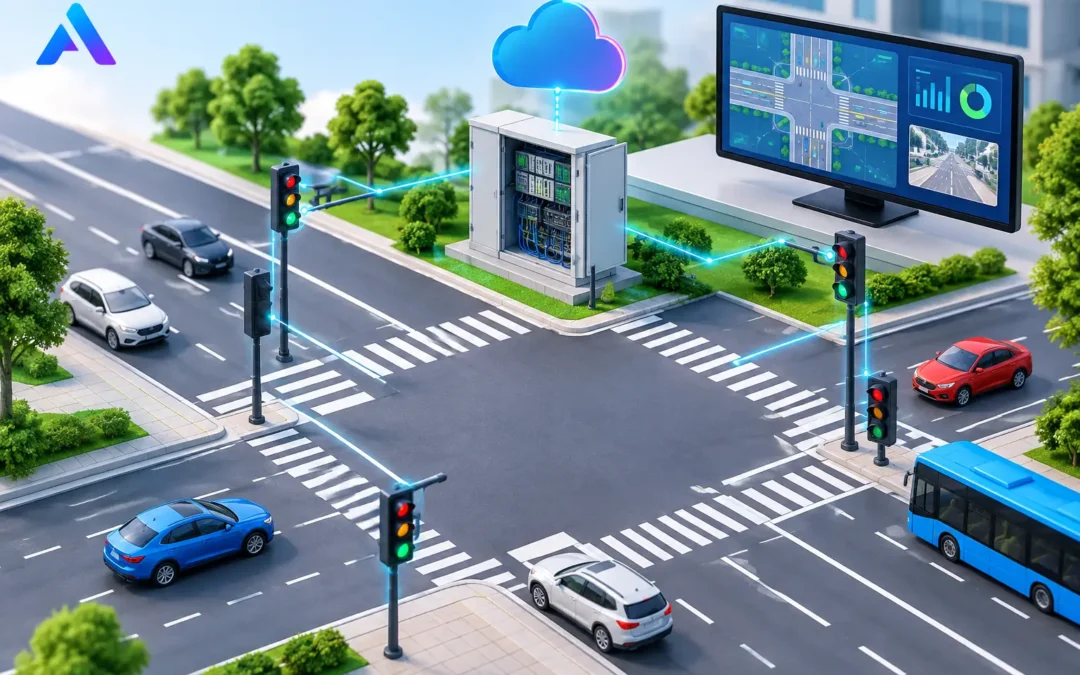
A missed call at a side-road approach can add delay through several signal cycles. A false call can waste green time that a main-road movement needs. This signal controller integration guide sets out how to connect above-ground radar and AI video detection to a traffic signal controller without creating avoidable risk, disruption or uncertainty at commissioning.
The principle is straightforward: the detector must provide the controller with dependable, correctly timed information for the operational decision required. The practical detail is less simple. Detection performance, interface type, controller configuration, mounting position and validation all affect whether a scheme delivers safer crossings, better cycle efficiency and credible traffic data.
Start with the control objective, not the detector
Integration should begin with the junction problem. A detector is not an end in itself; it is an input to a defined control strategy. Engineers should establish which movement or user group needs to be detected, what action the controller should take, and what must happen if the input is unavailable.
For example, a side-road vehicle demand may require a momentary call, while a right-turn movement may need presence detection maintained until the vehicle clears. A cycle route might need early detection to call a stage before a rider reaches the stop line. At a pedestrian crossing, an approach zone may support demand management or occupancy monitoring, but the controller logic must remain appropriate to the approved crossing operation.
This distinction determines the required detection behaviour. A short pulse, an extended pulse and continuous presence are not interchangeable. Specifying a device solely because it can detect a vehicle, cyclist or pedestrian leaves too much to interpretation later in the project.
A useful design brief defines:
- the road users and movements to be detected;
- the detection area, including lane coverage and approach distance;
- the controller action associated with each detection event;
- minimum detection persistence and acceptable latency;
- fallback behaviour for detector, communications or power faults; and
- the data outputs required beyond real-time signal operation.
Clear operating requirements also make acceptance testing more meaningful. Rather than asking whether the detector is working, the project team can test whether it produces the right controller response for the intended movement under representative traffic conditions.
Choose the integration architecture early
Above-ground detection offers a significant advantage over inductive loops: it can usually be installed and adjusted without cutting the carriageway. That reduces traffic management, reinstatement risk and future maintenance exposure. However, the interface still needs to be agreed before equipment arrives on site.
Many signal controller integrations use discrete detector inputs. The detector provides a relay, solid-state or opto-isolated output that is mapped to a configured controller input. This can be an effective and proven arrangement where the requirement is demand, extension, presence or a simple alarm condition. The important questions are whether the output is normally open or normally closed, whether it is pulse or maintained, and how the controller interprets a fault state.
Some schemes require networked integration or access to richer data. AI video and radar systems may provide classified counts, speed, occupancy, queue length or approach information in addition to simple calls. These data streams can inform monitoring platforms, adaptive strategies or scheme evaluation, but they should not be assumed to be controller-ready without checking the relevant interface, protocol and controller capability.
It depends on the operational requirement. A discrete output may be the most resilient option for a conventional junction demand. Where a local authority needs ongoing network insight, a separate data connection can complement the safety-critical control interface. Separating real-time control from analytics often simplifies fault finding and preserves a clear operational boundary.
Confirm electrical and controller compatibility
Before installation, document the controller make, model, available input cards, input voltage, common reference arrangements and configured detector channels. Confirm whether the selected detector output requires an interposing relay or interface module. Input supervision, cable lengths, earthing and electrical segregation should be considered as part of the design, not treated as site adjustments.
The controller configuration must then match the physical connection. That includes the detector input number, stage or phase association, demand type, timing parameters and any conditional logic. A correctly wired detector assigned to the wrong phase can be more disruptive than an obvious failed input because it may create plausible but incorrect calls.
For work on live highway assets, follow the relevant authority requirements, controller manufacturer guidance and approved installation practices. Integration drawings should show both the field device connection and the controller function it supports. This protects maintainers long after the commissioning team has left site.
Design detection zones around real traffic behaviour
The best controller interface cannot compensate for a poorly positioned detection zone. Radar and AI video systems should be designed around the trajectory, speed and stopping behaviour of the traffic being controlled.
At a side-road stop line, a presence zone may need to cover the lead vehicle while avoiding vehicles circulating on an adjacent carriageway. On a fast approach, an advance zone needs sufficient distance to provide useful notice without creating calls from traffic that may turn away or stop elsewhere. For cyclists, the zone must account for their position within the carriageway, lower profile, variable speed and the possibility of filtering movements.
Camera mounting height, angle, field of view, lighting conditions and potential occlusion need review for AI video detection. Radar placement requires equivalent care around its field of detection, lane separation, roadside furniture and reflections from large vehicles or street infrastructure. Neither technology is inherently right for every location. Radar can be particularly effective in poor light and adverse weather, while AI video can provide detailed classification and visual scene understanding where the view is suitable.
A site survey should identify the factors most likely to degrade detection: parked vehicles, queuing traffic, vegetation, bridge parapets, signal heads, street lighting columns and seasonal sun position. The survey should also establish a safe mounting location that supports maintenance access without further carriageway intervention.
Build fault behaviour into the scheme
Traffic control decisions must not depend on an assumed perfect detector. The integration design should define what the controller does when a detector loses power, ceases communications, produces a stuck call or reports an internal fault.
For a low-risk vehicle demand, the fallback may be a controller configuration that services the movement on a suitable cyclic basis. For a specialist movement or safety-related detection function, the acceptable fallback may be different and should be assessed by the scheme designer and highway authority. The goal is not simply to flag a failure, but to avoid an unsafe or operationally unacceptable junction state.
Fault monitoring is also valuable for maintenance. A detector that remains occupied for an implausibly long period, or one that records no activity during a busy period, may need investigation before complaints reach the control room. Where supported, device health data can provide early warning of power, communications, obstruction or configuration issues.
Commission against scenarios, not just input lamps
Seeing a controller input illuminate confirms a connection. It does not prove that the junction operates correctly. Commissioning should test the complete chain: road user enters the zone, detector classifies or registers the event, output reaches the controller, controller applies the configured logic, and the signal response occurs at the required time.
Test representative scenarios across each relevant lane and movement. This should include a single vehicle at the stop line, multiple queued vehicles, turning traffic, cyclists where specified, and periods of low traffic. At locations with mixed traffic, verify that buses, motorcycles, cars and lorries do not create unacceptable cross-lane calls. Repeat checks in darkness or poor weather where practical if these conditions are material to the selected technology.
Record the final zone configuration, detector settings, controller input mapping, cable schedule and test results. A short commissioning record is far more useful when it includes the operational intent behind each input. It enables future maintenance teams to distinguish a deliberate setting from an accidental change.
Use post-installation data to refine performance
Above-ground detection can be adjusted without excavating the road, which creates an opportunity that loop-based systems rarely offer: measured refinement after live operation begins. Review call rates, occupancy durations, stage demand and observed queue behaviour after the junction has experienced normal traffic patterns.
If a demand is being called too early, too frequently or not consistently enough, investigate the zone and controller parameters together. Reducing a detection area may remove false calls but could also exclude legitimate cyclists. Extending presence time may assist a slow-moving queue but could hold a stage unnecessarily. Changes should be controlled, documented and assessed against the original operational objective.
For authorities managing multiple sites, consistent configuration records and comparative data help identify recurring issues. They also support evidence-based decisions on where non-intrusive detection can replace failing loops, improve cycle efficiency or provide better visibility of road-user behaviour.
A well-integrated detector should become unremarkable in daily operation: calls arrive when they should, green time is used productively, and maintenance teams have clear evidence when intervention is needed. That is the standard worth designing for at every junction.