
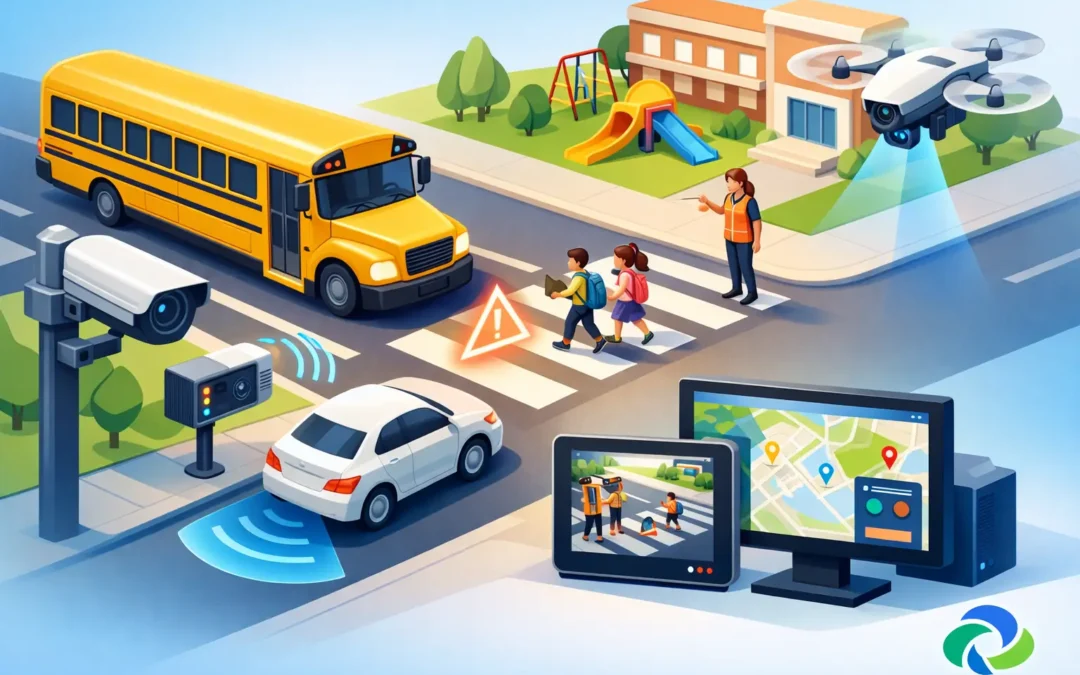
At 08:35, a school approach can change from a quiet residential road to a concentrated safety risk within minutes. Parents stopping and starting, children crossing between vehicles, cyclists filtering through traffic and buses arriving together create conditions that standard network data often misses. Road safety monitoring for schools gives highway authorities the site-specific evidence needed to act on those conditions, rather than relying on complaints or a single periodic survey.
For road safety teams, the challenge is not simply proving that traffic is present. It is understanding how vehicles, cyclists and pedestrians behave during the arrival and departure peaks, where conflict points develop, and whether an intervention changes that behaviour over time. The right monitoring approach turns a school frontage from an anecdotal concern into a measurable safety programme.
Why school sites need more than a traffic count
A seven-day count can establish traffic volume and speed, but it rarely tells the full story at a school. The critical risks may occur for 20 minutes in the morning, 15 minutes in the afternoon and only on particular days. A daily average can mask a queue that blocks a crossing, a pattern of vehicles mounting the footway, or a small number of high-speed approaches when children are waiting to cross.
School travel behaviour is also unusually variable. Term dates, weather, staggered starts, after-school clubs and changes to parking controls all affect demand. Monitoring therefore needs enough resolution to distinguish a persistent issue from a one-off event. It should also be repeatable, allowing authorities to compare conditions before and after a scheme has been introduced.
This matters when deciding between measures such as a speed information display, revised waiting restrictions, a raised table, improved crossing provision, a School Street or changed signal operation. Each measure addresses a different problem. Without reliable detection and data, there is a risk of treating visible congestion while leaving the more serious safety conflict unresolved.
What road safety monitoring for schools should measure
Effective monitoring begins with the decision it needs to support. A site concerned about speeding requires different evidence from one where the main issue is informal parking or pedestrian delay. In practice, a useful survey combines several measures rather than treating vehicle volume as the sole indicator.
Traffic speed should be assessed by direction and time period, with particular attention to the upper end of the speed distribution rather than the mean alone. Mean speed can look acceptable while a smaller group of drivers creates an unacceptable risk. Approach speed profiles also help engineers identify whether drivers are slowing at the correct point before a crossing, gateway feature or school entrance.
Classified traffic counts reveal the mix of cars, vans, buses, lorries, motorcycles and cycles using the route. This is valuable where servicing activity, bus movements or rat-running contributes to conflict. Directional data shows whether a particular approach is creating queues or whether an intervention is displacing traffic onto a nearby residential street.
At more complex sites, video analytics can add the behavioural context that radar counts cannot provide alone. It can identify turning movements, queue length, pedestrian crossing activity, cycle movements and potential interaction zones. Used appropriately, this helps teams understand why a measured speed or volume pattern is occurring.
The most useful datasets commonly include:
- vehicle speed distributions and compliance with the signed limit;
- classified, directional flows in short time intervals;
- pedestrian and cyclist movements at crossings and desire lines;
- queue lengths, turning movements and obstruction of key visibility areas; and
- before-and-after results following a scheme, enforcement period or operational change.
Not every site needs every measure. A lightly trafficked rural school may need a focused speed assessment on the main approach, while an urban school on a bus route may require a fuller picture of kerbside activity, crossing demand and peak-period queueing.
Selecting detection technology for the site
The installation method is part of the safety and operational decision. Traditional inductive loops can provide dependable presence detection, but cutting into the carriageway requires traffic management, civil works and subsequent reinstatement. That disruption is difficult to justify for short-term surveys and can be particularly unwelcome outside active school gates.
Above-ground radar provides a practical alternative for speed measurement, vehicle detection and classification applications. It can be installed at the roadside without disturbing the carriageway surface, reducing time on site and avoiding damage associated with roadworks, resurfacing or utility activity. Radar is particularly effective where the primary requirement is approaching vehicle speed, direction and volume.
AI-powered video detection is suited to locations where the movement of different road users needs to be understood. A correctly positioned camera can monitor defined zones, classify road users and provide movement data for complex approaches, crossings and school entrances. Its value depends on a clear field of view, appropriate mounting height and careful configuration of detection zones. Mature trees, poor lighting, parked vehicles and large vehicles can all affect performance, so a desk study alone is not enough.
Wireless traffic sensors can also support temporary or permanent studies where rapid deployment is needed. Their suitability depends on the required data, site geometry and communications arrangement. The key principle is to specify technology against the detection objective, not because one sensor type is familiar.
For any video-based deployment, privacy must be considered at the design stage. Authorities should apply data minimisation, define the purpose of the monitoring, set appropriate retention arrangements and ensure the system is configured for traffic analytics rather than unnecessary personal identification. Clear governance builds public confidence, especially around schools.
Turning monitoring data into safer interventions
Data only improves safety when it changes a decision. The strongest programmes establish a baseline, identify the specific risk, introduce a proportionate measure and monitor the outcome using the same methodology. This creates evidence that can support future funding, scheme design and stakeholder engagement.
Consider a site where parents report speeding near the entrance. Radar data may show that speeds are generally low during the busy arrival period because of congestion, but rise sharply immediately before and after it. The appropriate response may be a speed management measure on the approach, rather than changes at the gate itself. Conversely, video data may show that the principal risk is vehicles performing three-point turns across a pedestrian desire line. In that case, kerbside management or an altered access arrangement may be more effective than a speed display.
Monitoring can also improve the operation of active traffic management. Vehicle, cycle and pedestrian detection can inform signal timings near school crossings, helping to reduce unnecessary waiting while maintaining safe crossing opportunities. It must be designed carefully. Extending green time for a vehicle movement may improve capacity, but it can increase pedestrian delay and encourage unsafe crossing behaviour. Detection strategy should reflect the hierarchy of users at the location.
Before-and-after monitoring should look beyond whether traffic volumes fell. Useful evidence includes changes in speed distribution, crossing opportunities, queue extent, compliance with restrictions and the movement of vulnerable road users. A reduction in the number of vehicles outside the gate is positive, but it is not a complete success if traffic has simply moved to an adjacent road with poor footway provision.
Plan deployment around the school day
A technically capable sensor will still produce poor evidence if it is deployed without local context. Site surveys should account for school entrances, crossing patrol locations, bus stops, nearby junctions, parking restrictions, street furniture and known parent drop-off patterns. Detector placement must preserve the required detection range and view while avoiding avoidable obstruction or vandalism risk.
Engagement with the school is equally practical. It helps survey teams avoid examinations, events and unusual timetable days, and it can explain why equipment is being installed. For permanent systems, early engagement can also identify concerns around equipment location, visual impact and privacy.
Seasonality should be acknowledged. A survey in favourable weather may understate vehicle demand in winter, while a study during roadworks or a temporary diversion may not represent normal operation. Where decisions carry significant safety or capital implications, longer monitoring periods and repeat surveys provide a more defensible basis for action.
For authorities managing competing demands across a network, school monitoring should not be viewed as an isolated exercise. Consistent detection and analytics create comparable evidence across sites, helping teams prioritise where the greatest safety benefit can be achieved. The most valuable result is not simply a dataset or a device at the roadside, but a clearer decision about what children, families and local communities need from that street next.