
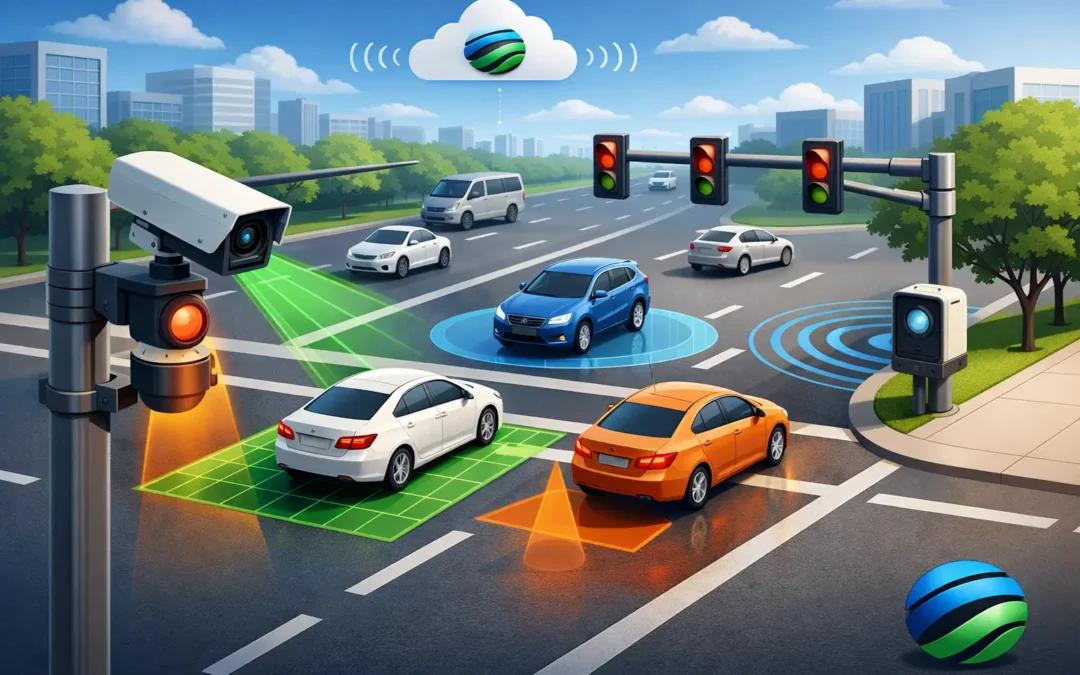
A missed cyclist at a junction can mean an unnecessary wait at a red signal. A false vehicle call can waste green time on an empty approach. In both cases, traffic detector reliability is not an abstract product characteristic: it directly affects safety, capacity, public confidence and the quality of operational decisions made across the network.
For highway authorities and traffic engineers, the question is rarely whether a detector can identify a vehicle under ideal conditions. The more useful question is whether it will continue to deliver usable, repeatable information through rain, darkness, congestion, seasonal changes and changing road layouts. Achieving that standard depends on much more than selecting a sensor from a specification sheet.
Reliability begins with the detection task
A reliable detection system starts with a clear definition of what it is required to detect, where, and for what control purpose. Vehicle presence at a stop line, queue length on an approach, speed on a rural route, cycle demand at a crossing and classified count data are all different tasks. They may require different sensor positions, detection zones and performance measures.
This distinction matters because a system can be reliable for one application and unsuitable for another. A radar detector may provide highly dependable presence and speed information in poor visibility, for example, while an AI video detector can add valuable lane-by-lane classification, queue monitoring and vulnerable road user detection where the scene and mounting arrangement support it. The appropriate technology is determined by the operational objective, not by a single headline feature.
The specification should also establish what constitutes acceptable performance. Is the priority high recall, so that nearly every approaching cyclist receives a call? Is it low false activation on a lightly trafficked side road? Is there a maximum acceptable detection delay for a signal-controlled junction? Defining these requirements early gives designers, installers and maintainers a practical benchmark against which the installation can be assessed.
What affects traffic detector reliability in service?
Above-ground detection avoids the recurring vulnerability of cutting into the carriageway to install or replace inductive loops. That removes disruption associated with lane closures, reinstatement and loop failure caused by road deterioration. However, non-intrusive equipment still needs careful engineering. Reliability is built through the complete detection chain: sensor selection, site survey, mounting, configuration, communications, controller integration and ongoing validation.
Site geometry and mounting position
The physical environment determines what a detector can see and how consistently it can interpret activity. A sensor mounted too low may have its view obstructed by larger vehicles. One mounted too far from the intended detection area may struggle to separate lanes or distinguish a cyclist from adjacent traffic. Curved approaches, steep gradients, central islands, parked vehicles, street furniture and overhanging vegetation can all influence coverage.
Video detection is particularly dependent on a stable, well-composed field of view. Camera angle, focal length, lighting conditions and the position of the horizon affect the accuracy of virtual detection zones and AI classification. A small movement of the mounting pole after impact or high winds can alter the scene enough to require a configuration review.
Radar is generally less affected by darkness and adverse weather, but it still requires correct alignment and sensible zone design. Reflections from roadside structures, the geometry of multi-lane approaches and the presence of opposing traffic should all be considered during commissioning. Neither technology benefits from a generic, one-size-fits-all mounting arrangement.
Weather, lighting and real traffic behaviour
UK roads present conditions that are rarely constant. Low winter sun, heavy rain, spray, fog and darkness can challenge optical systems. For video, well-designed analytics and appropriate camera selection help manage these conditions, but the real scene must be assessed rather than assumed. Headlight glare, shadows from trees and reflections from wet carriageways can affect detection if the scene has not been properly configured.
Traffic behaviour also creates complexity. Vehicles may queue across lane markings, turn from unexpected positions or stop short of the usual detection point. Cyclists may approach on the carriageway, in a mandatory cycle lane or via a shared-use facility. Reliable operation requires detection zones that reflect how people actually use the junction, not only how the layout appears on a drawing.
Power, communications and integration
A detector is only as useful as the information delivered to the controller or data platform. Intermittent power, unstable network connections, incorrect input mapping or unsuitable interface settings can look like a sensing issue when the detector itself is operating correctly.
Commissioning should therefore test the full path from road user movement to controller response or recorded dataset. For a signal application, that includes confirming the intended call is registered, held and released at the correct time. For a traffic survey or analytics deployment, it includes checking timestamps, classifications, direction of travel and data transmission. Fault diagnostics should make it straightforward to establish whether the issue lies with the sensor, cabling, communications or downstream system.
Installation quality is a performance control
It is tempting to treat installation as a separate contractor activity once a technology choice has been made. In practice, installation quality is one of the strongest controls on long-term performance.
A proper site survey should identify suitable mounting assets, available power, cable routes, likely obstructions and safe access requirements. It should also establish whether existing signal poles are suitable or whether a dedicated mounting point is needed. The survey is the point at which design assumptions meet the actual road environment.
During installation, correct sensor orientation, secure mounting and cable protection are fundamental. For video systems, clean optics and stable brackets are not minor details. For radar, accurate aiming and configuration of the monitored area are equally critical. Equipment should be installed so that routine inspection and adjustment can be undertaken safely, without unnecessary traffic management wherever possible.
Non-intrusive systems offer a significant practical advantage here. Above-ground devices can often be installed, adjusted or replaced without opening the carriageway. This reduces time on site, limits disruption to road users and removes the risk of repeated damage to embedded loops during resurfacing or utility works. The benefit is not simply faster deployment; it is a more maintainable detection strategy over the life of the junction or route.
Calibration is not a one-off event
Commissioning confirms that a detector works on the day it is installed. Calibration ensures it works for the intended application. The process should include live observation of representative traffic conditions, testing across each relevant lane or approach, and verification of outputs at the controller or management platform.
For AI video detectors, this may involve refining detection areas, exclusion zones and classification rules to reduce unwanted activations while retaining the desired road users. A busy urban junction may need specific treatment for pedestrian movement near the carriageway, bus stops or side-road activity. A rural crossing may require a different emphasis, such as dependable detection of cyclists and motorcycles at lower traffic volumes.
There is always a trade-off between sensitivity and false calls. Setting a detector to capture every possible movement may increase unnecessary demand. Tightening the rules too far may miss legitimate users. The correct balance depends on the consequences of each outcome. At a signal-controlled crossing, a missed call for a vulnerable road user can be more significant than an occasional additional stage. On a constrained network, repeated false calls may have a material impact on coordination and delay.
Maintaining confidence in the data
Reliable detectors need proportionate verification after commissioning. The frequency depends on the application, criticality and local conditions. A detector controlling demand at a high-risk junction warrants closer operational oversight than a temporary count site, although both should have a defined method for identifying faults or implausible data.
Practical monitoring can include reviewing detector health status, comparing output against site observations, checking for sudden changes in counts or occupancy, and investigating persistent controller calls. A sharp fall in detected cyclists may indicate a genuine change in travel patterns, but it could also point to an altered camera view, damaged equipment or an incorrectly amended configuration.
Maintenance should be planned around the technology and environment. Video equipment may require lens cleaning and periodic review for obscured views or vegetation growth. Radar equipment benefits from checks on alignment, physical condition and zone performance after nearby works or impact. Firmware and analytics updates should be controlled, tested and documented so that improvements do not introduce unintended changes to operational behaviour.
Selecting for whole-life performance
The most dependable solution is not always the sensor with the longest feature list. It is the one that can be specified, installed, supported and maintained effectively at the individual site. Consider the detection objective, site constraints, integration requirements, access arrangements and the skills available to configure and verify the system.
A mixed approach is often appropriate. Radar can provide dependable all-weather detection for vehicles and cycles, while AI video can deliver richer situational insight where classification, queue measurement or visual verification adds operational value. Wireless sensors may suit locations where rapid deployment and minimal civil works are priorities. The strongest design is the one that uses each technology where its characteristics genuinely improve the outcome.
For transport authorities, reliable detection is a foundation for safer roads, reduced congestion and more credible network data. Treat the detector as part of the traffic management system rather than a standalone device, and reliability becomes something that can be designed, tested and sustained – not merely hoped for after installation.